
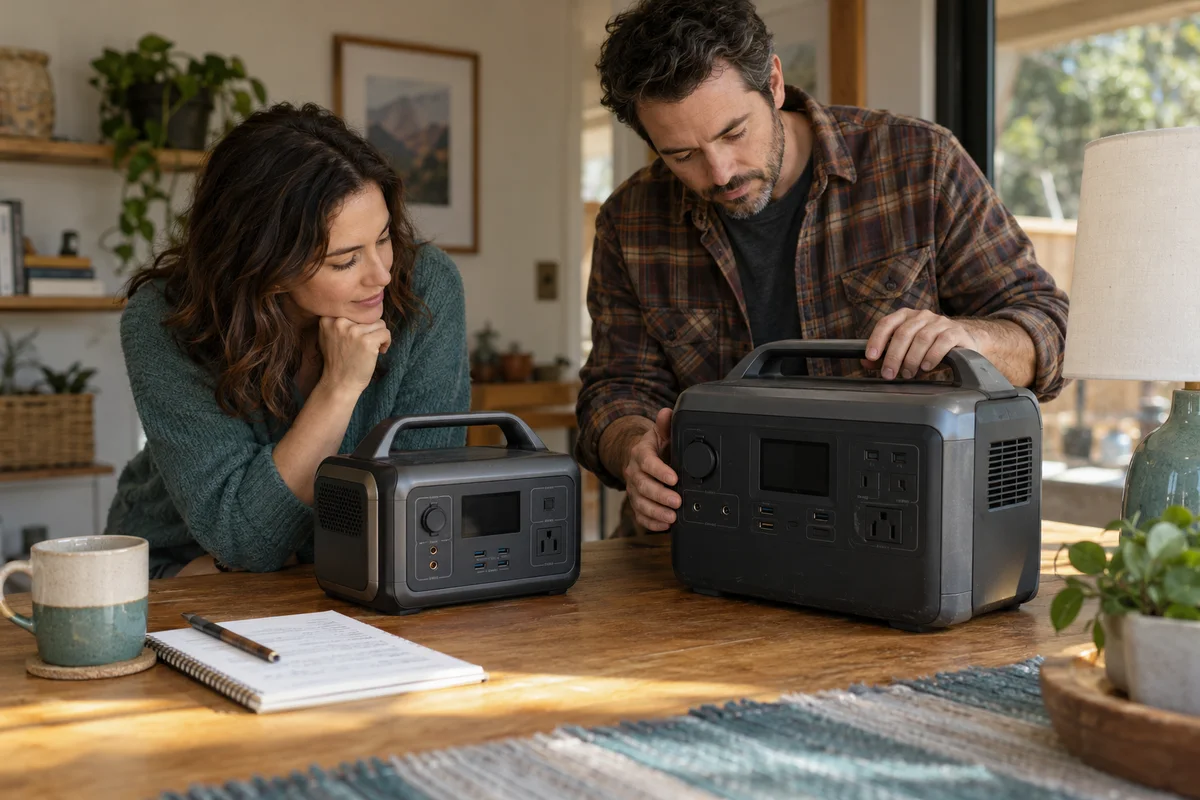
AI-generated scene illustration; not a photograph of the recommended product.
A household has narrowed a backup-power purchase to BLUETTI AC180 and Elite 100 V2. Both advertise 1,800W AC output, so the next question is not which has the larger headline. It is whether extra stored energy, a different recharge route or a specific connection will make the purchase useful during an ordinary interruption.
The short answer
AC180 lists 1,152Wh capacity; Elite 100 V2 lists 1,024Wh. Both list 1,800W rated AC output. AC180 therefore has more nameplate energy, not more continuous rated AC power. Elite lists a higher maximum solar input, which matters only with a compatible array and usable sunlight.
Shortlist AC180 when its extra energy addresses a defined compatible load and the recharge arrangement already works. Shortlist Elite when its supported connections and recharge options solve a requirement AC180 does not. Neither specification sheet proves actual runtime or uninterrupted operation with your equipment.
Contents
- The short answer
- The comparison
- The energy decision
- The output decision
- The recharge decision
- Continuity and placement
- The ownership worksheet
- Buying advice
- Frequently asked questions
- Sources and verification
The comparison
| Published US specification | AC180 | Elite 100 V2 |
|---|---|---|
| Battery nameplate | 1,152Wh | 1,024Wh |
| Rated AC output | 1,800W total | 1,800W total |
| Maximum solar input | 500W | 1,000W |
| Primary decision | More nameplate reserve | Different input and connection options |
The figures come from the current AC180 and Elite pages. These are manufacturer specifications, not side-by-side measurements.
Check exact US model identity before comparing a bundle. AC180P has a different capacity from AC180. Panels, expansion components and cables shown in a promotional image may belong to another selected package.
The energy decision
The nameplate difference is 128Wh. That is 12.5% of Elite’s listed 1,024Wh, but it is not a measured 12.5% runtime advantage. Conversion losses, usable reserve, station consumption, temperature and the load’s behavior remain separate.
Write down what the household needs to complete: finish a work session, retain a limited lighting reserve or support another approved noncritical appliance. Use a representative consumption record rather than an isolated maximum rating as the runtime input.
For example, a lamp and a cycling appliance do not create the same energy pattern. The appliance may start briefly at a higher demand and then cycle. A simple division can organize a budget without proving that its startup or switching behavior is supported.
Keep critical and medical equipment on a purpose-designed plan confirmed with its provider. Neither station wins that qualification merely because one stores more energy.
The output decision
The shared 1,800W figure is a total rated AC-output limit, not an allowance for every outlet separately. Several sockets do not mean several simultaneous 1,800W appliances.
List each intended device and its required connection. Check voltage, frequency, startup requirements and any manufacturer restriction. A station that supplies enough steady power can still be inappropriate for the exact equipment or operating arrangement.
Treat boosted or lifting modes separately from rated output. Do not use a promotional larger number as a universal compressor-starting guarantee, an allowance for sensitive electronics or a reason to ignore a load manufacturer’s instructions.
For a device using USB-C, qualify the exact port profile and cable rather than relying on total AC capacity. Our Elite USB-C guide handles that chain. A suitable direct connection can matter more than a modest difference in stored energy.
The recharge decision
Elite’s 1,000W maximum solar-input headline is higher than AC180’s 500W. It does not promise twice the actual harvest or half the real recharge time. Panel voltage, current, connector compatibility, shading, orientation and weather govern the complete arrangement.
Start with the available location and permitted equipment. A household without a suitable panel location gains little from an input ceiling it cannot use. Conversely, an already qualified larger array may make that ceiling a meaningful reason to investigate Elite.
Confirm each station’s current electrical input limits before buying panels. Do not design a series or parallel array from this comparison, mix unverified leads or assume an existing panel works because a plug looks familiar.
Wall recharging also belongs in the plan. Identify an appropriate source and the supported charging mode. A brief restoration of grid power is useful only when the station can be recharged safely under its actual conditions.
Continuity and placement
A backup battery and a high-performance UPS are different purchase categories. The current Elite US manual restricts applications such as servers or workstations requiring high-performance UPS protection. A fast transfer-time headline does not override that boundary.
Obtain exact-load guidance when continuity matters. Do not stack power devices to improvise approval or test a transition with valuable active data. Our sensitive-load guide explains the distinction.
Placement is another pass-or-fail requirement. Both candidates need their instructed operating environment, ventilation and safe stationary arrangement. More capacity does not justify a damp garage, covered vents or an obstructed walkway.
Our separate carrying comparison addresses grip, route and conflicting published AC180 weight statements. This page does not calculate a weight saving from those unresolved figures.
The ownership worksheet
Before checkout, complete these fields for both candidates:
- Exact model, region and selected bundle.
- Intended tasks and the consequence of interruption.
- Required connections, total load and startup qualification.
- Representative energy demand and a reserve policy.
- Supported wall, solar or other recharge route.
- Storage and operating positions.
- Needed accessories, replacement support and seller terms.
Record which field actually changes the choice. If both pass and the only difference is a modest reserve preference, compare the complete delivered offer. Do not add an unneeded panel package solely to make a higher input rating appear useful.
Buying advice
Consider AC180 for a defined household reserve when the extra nameplate energy matters, its connections pass and the recharge route is practical. Consider Elite when a verified connection or input advantage addresses a genuine recurring requirement.
Pass on either purchase if it depends on whole-home wiring, indefinite supply, an unresolved equipment restriction or a fabricated runtime estimate. Retaining an existing suitable station can be better value than replacing it for a headline that changes no actual task.
The partner CTA below is for AC180, not both products or every pictured bundle. The Elite overview provides its separate listing route. Verify current seller stock, included accessories and delivery without assuming manufacturer-page availability applies to the marketplace.
Frequently asked questions
More output?
Both list 1,800W rated AC output. AC180’s larger capacity is an energy difference, not a higher continuous AC rating.
More runtime?
The 128Wh nameplate difference is not a measured runtime result. Use the actual supported load and conditions.
Faster solar?
Elite has the higher listed maximum input. Real harvest and recharge time depend on the qualified array and conditions.
Whole-home backup?
Neither ordinary portable listing authorizes a home-wiring connection. Use a professionally designed appropriate system for that requirement.
Sources and verification
Checked November 2, 2026. Published-specification comparison only; no runtime, charging or continuity test.
- BLUETTI AC180 US product specifications
- BLUETTI Elite 100 V2 US product information
- Elite 100 V2 US manual
Keep reading
Related guides
 Power & Outdoors
AC180 E-Bike Charging
Assess AC180 for an e-bike recharge through the approved charger, battery condition, dry supervised charging and a realistic household energy budget.
Read guide → Power & Outdoors
Elite 100 V2 Garage-Door Backup
Compare Elite 100 V2 with a garage opener’s supported battery-backup path before treating portable AC power as a complete access solution.
Read guide → Power & Outdoors
AC180 Slow-Cooker Backup
Separate slow-cooker electrical compatibility, interruption history and food handling before choosing AC180 for a household dinner backup plan.
Read guide →