
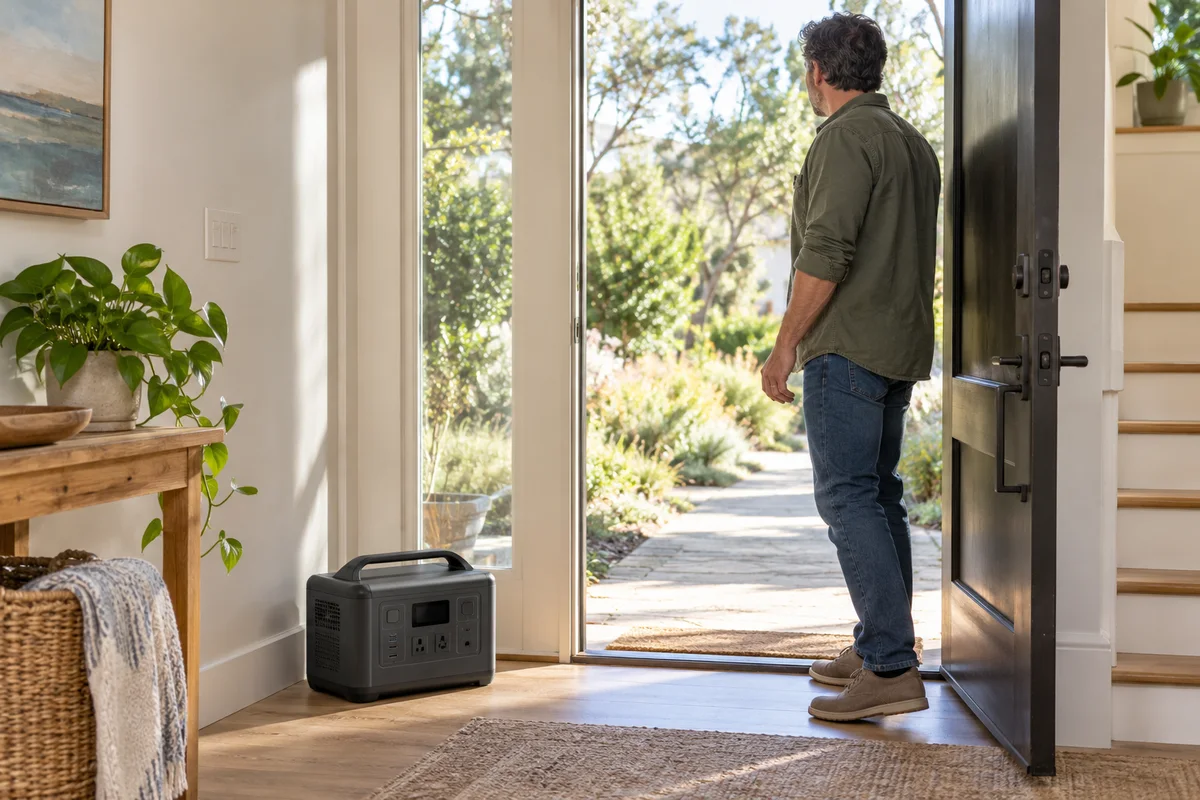
AI-generated scene illustration; not a photograph of the recommended product.
A household wants one portable power station to move between a storage cupboard, a living-room position and a car. Capacity is easy to compare online. The awkward part is the actual carry: a low shelf, a narrow doorway and a trunk lip do not appear in a watt-hour specification.
This comparison considers AC180 and Elite 100 V2 through that handling task. It does not assume that a product described as portable is comfortable for every person to move.
The short answer
Elite 100 V2’s referenced US manual lists approximately 11.5 kg. AC180’s current official product page contains inconsistent weight statements, so obtain confirmation for the exact unit rather than using this page to calculate a precise weight saving.
Compare the complete route, grip, dimensions and safe stationary placement before choosing. Greater capacity does not compensate for equipment the intended user cannot relocate safely under the manufacturer’s instructions.
Contents
- The short answer
- Start with the move that happens most often
- Treat the weight discrepancy as unresolved information
- Include geometry and grip
- Keep carrying separate from operating
- Compare energy only after the handling gate
- Use a carry-route card
- Buying advice
- Frequently asked questions
- Sources and verification
Start with the move that happens most often
List where the station starts and where it ends. Moving it once when delivered is different from moving it before every use. Include how frequently the normal household routine actually requires relocation.
Inspect the route while empty-handed. Look for tight turns, doors, floor transitions and objects that reduce space. Do not discover those constraints while carrying equipment or while an outage creates additional hazards.
The endpoint matters too. A low cupboard can require a different reach from a table. A trunk can introduce a lift over an edge rather than a simple level transfer. These are different tasks, even when the walking distance is short.
Treat the weight discrepancy as unresolved information
The AC180 page currently presents one weight in a comparison section and another in its portability description. WideLore has not weighed a unit to settle the discrepancy.
Ask the manufacturer or actual seller for the exact model’s current net weight and measurement context. Shipping weight, packaged weight and the station’s net weight should not be merged into one field.
Do not calculate a precise percentage reduction from inconsistent source values. The sensible purchasing conclusion is to resolve the uncertain input before relying on it, not choose whichever number makes a preferred model look better.
Elite 100 V2’s manual figure is also a published specification, not a personal lifting assessment. A lower documented weight can be relevant without establishing that the intended user should carry it alone.
Include geometry and grip
Two objects with similar mass can feel different to handle because of shape, grip and how far the load sits from the body. The available doorway and destination also constrain what can be moved comfortably.
Compare the current exact-model dimensions with the route. Allow for the handling space, not merely the rectangle occupied after the station has been set down.
If an assessment opportunity is legitimately available through the seller, use its conditions and the product instructions. Do not simulate a lift with an unstable homemade weight or stage a difficult stair carry to prove suitability.
When the user has uncertainty about lifting, seek appropriate help or choose a plan that avoids frequent carrying. This article does not prescribe a safe lifting limit for an individual.
Keep carrying separate from operating
The AC180 placement guide addresses stationary use and says not to move the unit while operating, following its referenced instructions. Do not turn a portable-power purchase into a plan to carry active equipment through the home.
For each model, follow the current supplied instructions for shutdown, disconnection, moving and restarting. This comparison does not provide a substitute sequence or authorize pulling a unit by its cables.
The Elite 100 V2 manual also warns against drops and violent impacts and discusses mechanical assistance where needed. That does not make an ordinary household cart suitable for stairs or an unsecured transport arrangement.
Compare energy only after the handling gate
The referenced product information lists AC180 at 1,152 Wh, while the Elite 100 V2 manual lists 1,024 Wh. The nameplate difference is 128 Wh. It is not a measured difference in usable household runtime.
Evaluate required ports, permitted loads and recharge opportunities separately. More nameplate energy is valuable only when it serves the actual task and the complete operating arrangement is appropriate.
A household might reasonably prefer a unit that stays in one suitable location. Another might value a more manageable supported move. Neither conclusion follows from capacity alone, and neither model is automatically best for every room.
Use a carry-route card
| Check | Record for each candidate |
|---|---|
| Identity | Exact model and region |
| Weight | Confirmed net figure and source |
| Shape | Current dimensions and grip arrangement |
| Start | Storage height and access |
| Route | Doors, turns, level changes and clear space |
| Destination | Stable dry location with permitted ventilation |
| Frequency | How often a move is genuinely needed |
| Assistance | Suitable help or supported equipment where necessary |
Keep a photograph of the empty route for personal planning, without publishing household location information. It can help a seller understand the access question more clearly than “is it lightweight?”
If one field fails, redesign the routine before upgrading capacity. Leaving the station in an appropriate location may remove the need for repeated moves, provided every operating requirement remains satisfied.
Buying advice
Consider Elite 100 V2 when its documented equipment and the verified handling arrangement suit a defined portable, noncritical task. The partner link on this page is for Elite 100 V2; AC180 is the comparison candidate.
Consider AC180 only after resolving the weight information and confirming that its capacity and connections address a real need. Do not buy it simply because the larger nameplate number seems like more value.
Pass on either model if the only plan involves difficult unsupported carrying, moving while operating or compromising a walkway. A different size or a professionally designed stationary solution may better match the requirement.
Check seller-specific stock and delivery separately. We have not confirmed marketplace inventory or performed a side-by-side carrying test, and no emergency-readiness deadline is promised.
Frequently asked questions
Is Elite 100 V2 guaranteed easy for one person to carry?
No. Its published weight is information for planning, not a universal lifting recommendation.
Why not give an exact weight difference?
The current AC180 page contains inconsistent figures. A precise comparison would conceal that unresolved source issue.
Does 128 Wh more nameplate energy mean a fixed number of extra hours?
No. Actual runtime depends on the load, usable energy, losses and conditions.
Can I move a station while it powers the room?
Follow the exact model’s instructions. The referenced AC180 instructions prohibit moving it while operating; this guide recommends planning stationary use.
Sources and verification
Checked October 23, 2026. This is a document-based route and purchase comparison, not a lifting, runtime or safety qualification test.
- AC180 official page: capacity and conflicting weight descriptions
- Elite 100 V2 US manual: weight, capacity and moving requirements
Keep reading
Related guides
 Power & Outdoors
Elite 100 V2 Dual Charging: Do Not Add the Maxima
Use Elite 100 V2's separate combined charging ceiling instead of adding AC and solar maxima when budgeting a short recharge window.
Read guide → Power & Outdoors
AC180 vs AC180P: The Suffix Changes Battery Capacity
Compare AC180 and AC180P nameplate energy without confusing watt-hours with output power, then verify the exact selected model and delivery.
Read guide → Power & Outdoors
Elite 100 V2 Noise: Read the 30dB Condition
Read Elite 100 V2's conditioned 30dB claim alongside its manual maximum, then assess charging, placement and realistic home-office noise needs.
Read guide →