
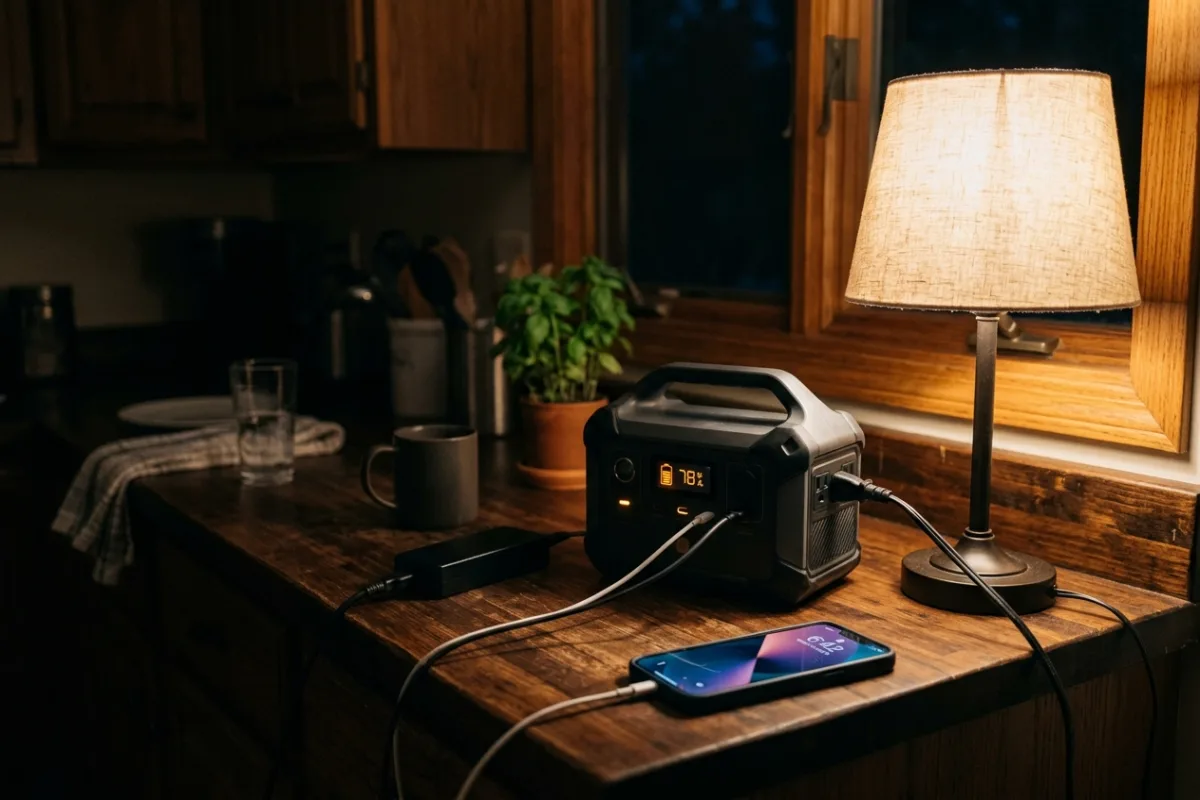
You live in a two-bedroom apartment with no generator hookup and no interest in running a gas engine on a balcony. When a storm knocks the power out for a few hours, you need something that keeps the router, a lamp, and the refrigerator running until the grid comes back, not a device that is still charging when the lights return. The same box has to fit in a hall closet the other 350 days of the year and ride along in the trunk for a weekend camping trip without needing its own suitcase. What you are shopping for is one lightweight power station that recharges fast enough to be ready before the next outage and quiet enough to sit next to a couch.
This review is built from published manufacturer specifications and the current product documentation for the power-outdoors category, not from a laboratory test bench. It compares the BLUETTI Elite 100 V2 against the rivals a shopper actually sees beside it, for one clearly defined household job.
The verdict
BLUETTI publishes 1,024Wh capacity and 1,800W rated AC output for the Elite 100 V2. It is a candidate for defined portable, noncritical backup tasks when the supported outputs, actual load, recharge routine and carrying requirements fit. Verify interruption tolerance with your equipment; a transfer-time figure does not guarantee uninterrupted operation or medical-device suitability.
Check the current BLUETTI Elite 100 V2 listing →BLUETTI Elite 100 V2 at a glance
These are the published specifications that matter most for the use case above. Manufacturers revise hardware between production runs, so confirm the current listing before ordering.
| Capacity | 1,024Wh LiFePO4 |
|---|---|
| Continuous AC Output | 1,800W (2,700W surge) |
| Weight | 25 lbs (11.5 kg) |
| Fast Charge Time | 0-80% in 45 min, full charge in about 70 min (AC or 1,000W solar) |
| Cycle Life | 4,000+ cycles to 80% capacity |
Why it wins this category
A better spec sheet is only useful when it removes work from a real routine. These are the four places where the BLUETTI Elite 100 V2 changes the outcome rather than the marketing copy.
Fastest Recharge in Its Class
The Elite 100 V2's published 45-minute charge to 80% and roughly 70-minute full charge on AC or 1,000W solar beats the closer-to-two-hour full recharge that a comparable 1,070Wh Jackery model lists on standard wall power. For a household that gets only a short warning before a storm, or a camper topping up between drives, that gap changes whether the unit is ready when you need it.
Light Enough to Carry Solo
At a manufacturer-listed 25 lbs, the Elite 100 V2 is easier for one person to move between a hall closet, a car trunk, and a campsite than the EcoFlow DELTA 3 Plus, whose published weight for the base unit runs closer to 27.6 lbs. A few pounds at this scale is the difference between a quick grab and a two-handed lift.
Verify Noise and Continuity
Noise depends on operating conditions and load. Confirm the current manual's permitted backup modes and test a supervised noncritical arrangement before relying on it. Medical or critical equipment needs a purpose-designed plan confirmed with its provider; ordinary marketing and a transfer-time figure do not establish suitability.
Strong Solar Input for Its Size
The published 1,000W maximum solar input is higher than the 600W ceiling listed for the Anker SOLIX C1000 Gen 2, a station in the same 1,024Wh capacity class. For anyone recharging fully from panels during a multi-day outage or an off-grid weekend, that higher ceiling on paper means less time waiting on the sun to refill a nearly empty battery.
How it compares to the alternatives
Each of these is a capable product with a real audience. The question is not whether they work, but which one fits the job described above with the least compromise.
Jackery Explorer 1000 v2
Lightweight 1,070Wh camping station from an established brand
Where it is strong: Jackery's own listed specs put the Explorer 1000 v2 at roughly 1,070Wh of capacity and about 23.8 lbs, both slightly ahead of the Elite 100 V2 on paper, backed by years of camping-focused accessories.
Where it falls short here: Its full recharge on standard wall power runs closer to 1.7 hours by the manufacturer's own figures, well behind the Elite 100 V2's published 70-minute full charge, which matters most when topping up between a storm's waves or breaking camp in a hurry.
Anker SOLIX C1000 Gen 2
Higher-wattage 1,024Wh station built for heavy household loads
Where it is strong: Anker lists a 2,000W continuous output and a 49-minute full AC recharge on the C1000 Gen 2, both ahead of the Elite 100 V2's published numbers, suiting heavy tool or appliance use.
Where it falls short here: Its solar input tops out at a published 600W, well under the Elite 100 V2's 1,000W maximum, so anyone recharging from panels during a multi-day outage or an off-grid stay will wait longer to refill the same size battery.
EcoFlow DELTA 3 Plus
Expandable 1,024Wh base unit with add-on battery packs
Where it is strong: EcoFlow's spec sheet lists the DELTA 3 Plus base unit alongside optional battery packs that can expand total capacity well beyond 1,024Wh, plus a manufacturer-backed 5-year warranty for anyone planning to grow the setup.
Where it falls short here: That same spec sheet lists the base unit at roughly 27.6 lbs, about two and a half pounds heavier than the Elite 100 V2's published 25 lbs, a gap that shows up every time it is carried to the car alone.
Weighed against those three, the BLUETTI Elite 100 V2 remains the one that covers this scenario end to end without asking you to accept a workaround somewhere else.
Who it fits
Apartment Renters Without Generator Hookups
If your building does not allow a gas generator and there is nowhere to vent one anyway, a quiet LiFePO4 station that lists 30dB operation and a fast indoor-safe recharge is a workable stand-in for keeping essentials running through a short outage.
Weekend Campers Who Pack Light
Car campers already juggling a cooler, tent, and chairs benefit from a manufacturer-listed 25-lb unit that fits in a single trunk load and can top off from a portable solar panel between stops, rather than a heavier station eating into limited cargo space.
Noncritical Portable Desk Power
Consider it for a defined noncritical desk-power task only after confirming load and output compatibility. The current US manual excludes devices such as data servers or workstations that require a high-performance UPS. A switching-time headline does not override that restriction or guarantee an uninterrupted call, save, or data operation.
What to be realistic about
No product is the right answer for every household. Skip this one, or plan around these points, if any of them describe your situation.
- Skip this if you need to run high-draw shop tools or a full-size air conditioner for hours, since 1,800W output and 1,024Wh of capacity drain fast under sustained heavy loads.
- If whole-home backup covering a furnace, well pump, or several large appliances at once is the goal, a fixed home battery or larger generator is the more realistic category.
- Avoid treating the listed 4,000-cycle LiFePO4 rating as a guarantee of lifespan, since real-world cycle life depends on depth of discharge, temperature, and how it is stored between uses.
Living with it after week one
Follow the current regional manual's storage, charging and ventilation requirements. Confirm exact load and output compatibility and perform a supervised noncritical ordinary-use check. Solar input needs a separately verified panel, cable and electrical arrangement. Do not treat a household power station as a universal medical backup or guaranteed seamless UPS.
Frequently asked questions
Is the BLUETTI Elite 100 V2 quiet enough to run indoors overnight?
Noise varies by load, operating mode and environment. A published light-load figure is not a guarantee for your overnight setup. Follow safe placement and equipment guidance and evaluate ordinary noncritical use.
Can the Elite 100 V2 fully recharge from solar panels alone?
Compatible solar panels can charge the station within its input and operating limits. Actual input and time depend on the supported arrangement and real conditions. The maximum solar-input number does not guarantee a full recharge within a fixed period.
Does this replace a whole-home backup generator?
No. With 1,024Wh of capacity and 1,800W of continuous output, it is built for select circuits and portable devices, not for running an entire house through an extended outage. For whole-home coverage, a permanently installed generator or a much larger fixed battery system is the more appropriate category.
Keep reading
Related guides
 Power & Outdoors
AC180 Grid Enhancement and UPS
Understand AC180 Grid Enhancement and its UPS transfer limitation before choosing backup power for a household continuity requirement.
Read guide → Power & Outdoors
AC180 Voltage and Frequency
Check AC180 regional output voltage separately from selectable frequency and plug shape before pairing imported appliances with a US power station.
Read guide → Power & Outdoors
Elite 100 V2 Grounded Charging
Check the Elite 100 V2 AC charging outlet and supplied grounded lead before buying backup power for an older home or a rented workspace.
Read guide →