

AI-generated scene illustration; not a photograph of the recommended product.
The EC200 looks adjustable enough for a shared home office, but one person’s weight is outside the range shown on the current manufacturer page. A sale banner and a sturdy-looking base can make that detail feel negotiable. It is better treated as a purchase boundary that needs clarification before anyone sits down to test a limit.
The short answer
Read the exact EC200 listing’s stated user range before deciding whether it belongs on your shortlist. ProtoArc’s current U.S. EC200 page, checked November 20, 2026, gives a recommended user-weight range of 90–220 lb and a recommended height range of 5 ft 4 in–6 ft. Its comparison table also labels weight capacity as 220 lb.
Do not replace those statements with a higher number from an unrelated chair, a component advertisement or an older screenshot. If the selected offer conflicts, obtain model-specific written clarification. Being within a stated range still does not guarantee a comfortable fit.
Contents
- The short answer
- Separate the numbers being compared
- Resolve a conflicting offer before ordering
- Treat dimensions as another independent gate
- Make a shared-office eligibility card
- Include ordinary use, not just a seated photograph
- Buying advice
- Frequently asked questions
- Sources and verification
Separate the numbers being compared
A product page can describe recommended user weight, rated capacity, chair shipping weight and the rating of an individual component. Those fields do not answer the same question.
The weight of the packaged chair is not a user limit. A gas-lift classification is not an independent rating for the assembled product. A broad claim that another chair in the brand’s range supports a particular load does not transfer to EC200.
Keep the exact wording beside each figure when comparing offers. Do not silently relabel a recommendation as a tested breaking point or treat a maximum as a comfort guarantee.
This guide does not perform or recommend a load test. The decision is whether the manufacturer supports the intended use, not whether a chair survives an improvised demonstration.
Resolve a conflicting offer before ordering
Save the selected model name, seller identity and relevant specifications privately. Include the regional page and the date when asking support about a discrepancy.
Ask which complete chair the offer actually supplies and which user limits apply to it. A photograph or the words ergonomic chair may not distinguish EC200 from EC200 Pro or another version.
A useful response names the exact product and resolves the conflicting values. A general statement that the chair is strong does not do that. Do not average two numbers or choose whichever supports the purchase you already wanted.
If support cannot settle the conflict, retain it as unresolved. A different chair with clearly documented suitability may be a better decision than paying for uncertainty and hoping the largest number was correct.
Treat dimensions as another independent gate
A person can fall within the stated weight range while the seat, arms or backrest still do not fit. Conversely, a seat that looks roomy does not establish support outside the manufacturer’s published user range.
Check usable seat width, seat depth, supported height adjustment and space between the arm supports. Use the exact model’s dimensional drawing, not overall width as a substitute for sitting space.
OSHA’s chair guidance addresses adequate seat size, support and adjustment within the whole workstation. It does not certify EC200 or turn a generic ergonomic description into individual approval.
The high-desk guide covers a separate geometry problem. Solving desk height does not change the chair’s supported user limits.
Make a shared-office eligibility card
| Gate | What to establish |
|---|---|
| Model | Exact EC200 version and region |
| Seller | Identity of the actual offer |
| User range | Current complete-chair statement |
| Conflicts | Written clarification if figures differ |
| Dimensions | Usable space and supported adjustments |
| Each person | Separate fit and eligibility check |
| Trial | Seller’s permitted evaluation and remedy |
Keep personal measurements private. The card is for household decision-making, not a public comparison of family members or a medical record.
For a chair shared by two people, evaluate both separately. Do not average their weights or assume the person who uses it less can be ignored. The supported use has to cover the actual arrangement.
If a user is outside a published range, ask for suitable alternatives before arranging a physical trial. Do not use cushions, a different cylinder or a modified base as a way to claim a new capacity.
Include ordinary use, not just a seated photograph
A purchase must support sitting down, standing up and working at the desk as described by the manufacturer. A carefully posed image cannot demonstrate all those transitions.
Follow assembly and inspection instructions. A chair with damage, loose structural parts or an unknown history needs appropriate support assessment, regardless of what its original product page promised.
Never bounce, add another person, stack objects or deliberately overload a chair to evaluate strength. That creates a hazard without producing a valid certification or reliable long-term answer.
An existing chair that appears to function does not prove that continued unsupported use is acceptable. Seek clarification rather than treating past survival as a new specification.
Buying advice
Consider EC200 when every intended user meets the applicable documented requirements and the actual dimensions and adjustments support the workstation. The EC200 overview provides broader feature context, but does not override the exact listing or supplied instructions.
Choose a different clearly supported chair when the range or usable dimensions do not suit the intended user. Look for explicit complete-product information instead of assembling a capacity claim from the strongest-looking parts.
Avoid buying a chair solely for its longest warranty or most impressive certification headline. Eligibility, ordinary fit and the exact seller’s terms are separate purchase checks.
The partner CTA below is for EC200 hardware. It is not a promise of suitability for every body size, a load-test certificate or permission to use the chair outside its documented limits. Confirm the actual selected offer before paying.
Frequently asked questions
Is the 220 lb figure a personal fit guarantee?
No. It is a current manufacturer-page statement. Dimensions, support and ordinary workstation fit need separate assessment.
Can a Class 4 gas lift increase the chair’s capacity?
Do not infer a complete-chair capacity from an individual component classification or replace parts to create an unsupported configuration.
Should two users’ weights be averaged?
No. Each intended user’s situation must be evaluated separately against the applicable product requirements.
What if a marketplace lists a different limit?
Ask the seller and manufacturer to reconcile the exact version and statement before relying on either value.
Sources and verification
Checked November 20, 2026. Current published specifications and an original eligibility checklist; no physical chair evaluation or load testing.
- ProtoArc EC200 U.S. product page — recommended user ranges and comparison table.
- OSHA workstation chairs — seat sizing, support and workstation context.
Keep reading
Related guides
 Home Office
EC200 Lumbar Pillow: Check the Space It Removes
Assess how an added lumbar pillow changes EC200 seat space, support and desk reach before buying a chair-and-cushion combination.
Read guide → Home Office
EC300 Warranty: A Chair Is Not a Spare-Part Order
Separate complete EC300 chair coverage, paid spare-part orders and independent protection plans before relying on a long warranty banner.
Read guide →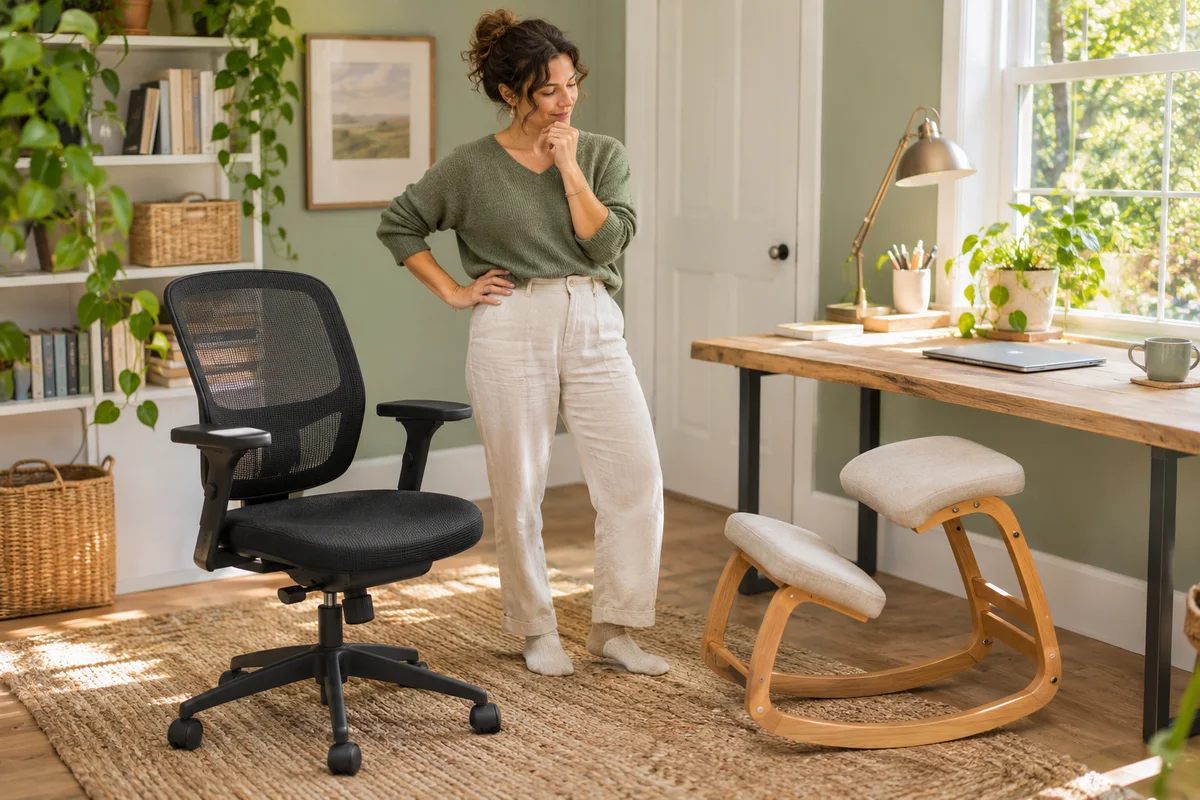 Home Office
EC200 or a Kneeling Chair: Compare the Working Task
Compare a ProtoArc EC200 with a rocking kneeling chair through desk reach, support, position changes and everyday tasks rather than posture promises.
Read guide →