
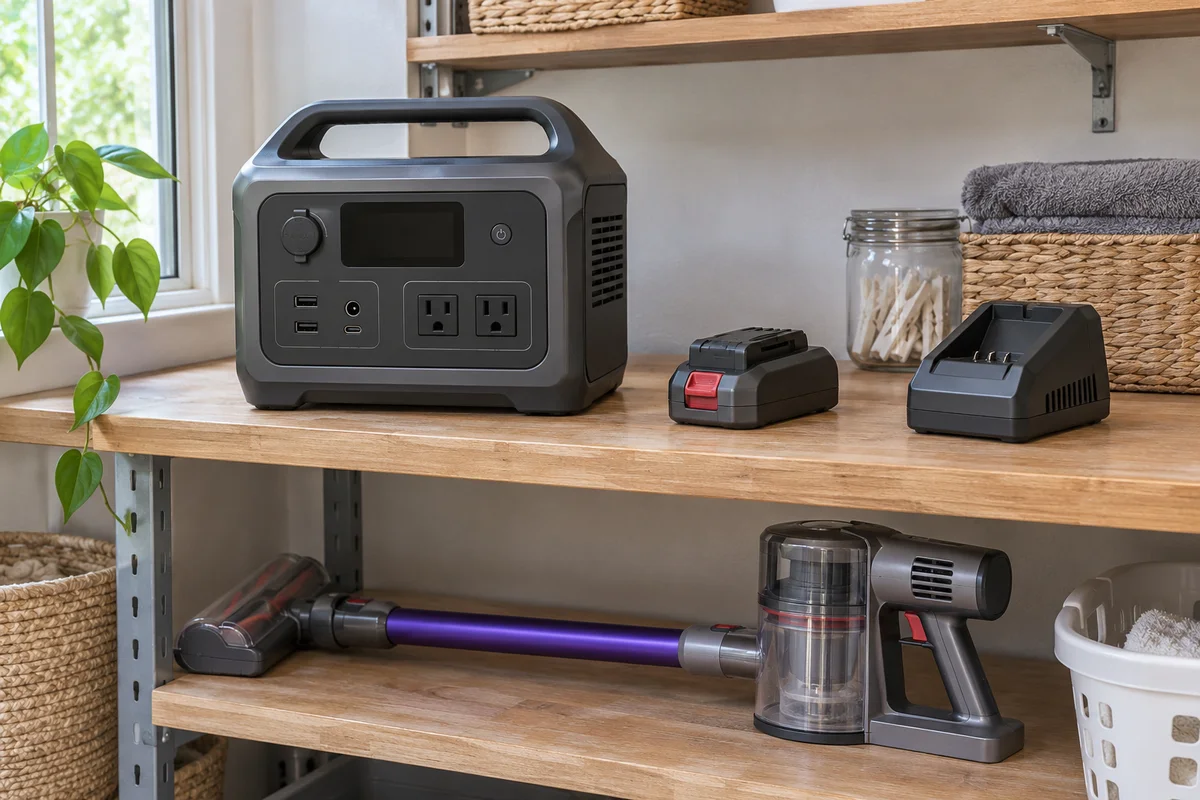
AI-generated scene illustration; not a photograph of the recommended product.
The power is out and a cordless vacuum has an empty battery. A portable station seems like an easy way to replenish it. The vacuum’s motor-power number then becomes the assumed charging load, even though the station would power the approved charger rather than the motor directly.
For an AC180 and a household vacuum such as Eureka NEC440, qualify that charging chain before budgeting energy. Neither brand’s general capability statement establishes that every charger, adapter or direct battery connection is suitable.
The short answer
Treat this as two linked systems: AC180 supplies a supported AC load, and the vacuum’s own approved charger charges its designated battery. Do not connect AC180’s DC outlet directly to the vacuum pack or substitute an adapter because a connector fits.
Check the actual charger’s input requirements and the complete supported arrangement, then budget charging energy and reserve priorities. The vacuum motor’s wattage is not a measurement of its charger demand. No joint compatibility test is claimed here.
Contents
- The short answer
- Draw the chain first
- Identify the relevant input
- A hypothetical energy worksheet
- Keep a qualification card
- Decide whether cleaning can wait
- Keep the location suitable
- Buying advice
- A handover for another household member
- Frequently asked questions
- Sources and verification
Draw the chain first
Write the components in order: source, approved charging connection, exact vacuum charger and designated pack. Keep each product’s instructions attached to its own role.
A cordless appliance’s battery label concerns the appliance’s electrical system. It does not automatically identify the input that a separate charger requires.
The NEC440 manual requires the specified charger and designated battery. A portable station does not relax that requirement.
Do not build a direct-cable shortcut around the charger. If the exact supply chain is not established, obtain manufacturer clarification before connecting anything.
Identify the relevant input
Read the actual approved charger’s input label and applicable instructions. Distinguish its AC input from its battery-side output. If either is unclear, ask the manufacturer rather than converting one into the other by assumption.
The vacuum’s advertised motor power describes a different operating task. Using that number as constant charger draw can produce a very misleading reserve estimate.
Likewise, the charger’s maximum label does not establish a constant draw throughout charging. Battery state and the charging process can change demand.
A useful record names the charger, its required input, the supported source and any unresolved condition. It should not simply say “small appliance, probably fine.”
A hypothetical energy worksheet
Suppose an appropriate observation established an average source-side charging demand of 30W for five hours. The arithmetic would be 150Wh before any additional source-side costs not included in that observation.
Those figures are illustrative inputs, not NEC440 measurements, its charger specification or a promised recharge time. Do not reuse them to claim this combination has been validated.
The purpose is to account for the actual charging task over time. A short burst of vacuuming afterward does not make the preceding recharge free.
Use suitable manufacturer information or appropriate ordinary measurements for the real equipment. Do not open a charger, probe exposed circuits or improvise a battery test to obtain a number.
Keep a qualification card
| Check | Record | Stop when |
|---|---|---|
| Source | Exact regional station and instructions | Required supply remains unclear |
| Charger | Approved model and AC input | Charger is unidentified or damaged |
| Pack | Designated compatible battery | Fit is the only evidence |
| Environment | Both products’ permitted conditions | Location fails either requirement |
| Energy | Applicable demand over charging time | Budget uses motor watts instead |
| Priority | Reserve needed for other tasks | Cleaning consumes an essential reserve |
Keep the card narrow. It establishes questions to resolve; it is not a certification of the pair.
If a household already owns both products, check their actual supplied labels. If shopping, ask before buying one product solely to support the other.
The AC180 overview and NEC440 charging-window guide cover their separate ownership requirements.
Decide whether cleaning can wait
During an outage, optional cleaning competes with other planned loads. A tidy room can matter, but that does not make every vacuum recharge the highest priority.
Write down the remaining reserve and the next credible replenishment opportunity. Compare postponing vacuuming, using an appropriate existing manual cleaning tool, or charging later when ordinary power returns.
This is not advice for hazardous, wet, flood or fire cleanup. The vacuum’s household dry-use limits remain in force. Do not use a battery source to justify collecting unsuitable material.
Medical and other critical-equipment requirements need an appropriate dedicated plan. An informal cleaning budget should not determine the reserve for those needs.
Keep the location suitable
Follow both sets of environmental and ventilation instructions. A station that fits in a cupboard is not automatically approved to operate there, and a vacuum charger should not be moved to a wet utility surface for convenience.
Keep charging equipment identifiable and clear of normal household traffic. Avoid cable routes through closing doors or around moving furniture.
Do not operate a fuel generator indoors to replenish the station. Adding a battery between a generator and a vacuum does not cancel generator hazards.
Our generator-recharging guide treats that separate source decision. This article supplies no wiring, grounding or installation procedure.
Buying advice
Consider AC180 when a wider supported household backup plan justifies it, not merely because a vacuum occasionally needs charging. A modest cleaning task may not justify a large extra energy system.
For an existing station, evaluate vacuum charging as one optional qualified load within the reserve plan. There is no need to buy another vacuum if the actual problem is an unsuitable or unconfirmed charger arrangement.
If the proposed combination cannot be supported clearly, delay the dependent purchase. Obtain an exact answer rather than assuming general AC output means universal charger approval.
Check the selected station offer’s current package, inventory, delivery and return terms. The partner link below is for AC180, not a vacuum charger or a jointly approved equipment bundle.
A manufacturer label or specification is useful evidence, but it is not our hands-on test. No charging time, number of recharges or energy-efficiency advantage is promised.
A handover for another household member
Keep the approved equipment together without mixing similar adapters. Record which charger belongs to which pack and who resolves an abnormal condition.
Explain the priority decision as well as the connection decision. “This charging job can wait” may prevent an optional task from consuming a reserve intended for something else.
If equipment becomes damaged, overheats abnormally or otherwise behaves unexpectedly, stop and follow the relevant support instructions. Do not continue to obtain a complete energy reading.
Frequently asked questions
Should I budget the vacuum motor’s wattage as charging demand?
No. Qualify the separate charger’s input and the actual charging process.
Can I connect the pack straight to AC180’s DC outlet?
No direct connection is authorized here. Use only the designated battery and manufacturer-approved charging arrangement.
Are the 30W and five-hour figures NEC440 specifications?
No. They are explicitly hypothetical arithmetic inputs.
Is a portable station necessary for occasional vacuum charging?
Not necessarily. Consider postponing the task or an appropriate existing alternative before buying another system.
Sources and verification
Checked November 22, 2026. No joint compatibility, charging or energy-consumption test.
Keep reading
Related guides
 Power & Outdoors
AC180 Capacity: Compare Watt-Hours, Not Bare mAh
Normalize AC180 and power-bank capacity labels using watt-hours, documented nominal voltage and a clear separation from delivered runtime.
Read guide → Power & Outdoors
AC180 or a Fuel Generator: Start With the Property
Compare AC180 with a fuel generator through property constraints, duration, replenishment and the complete ownership plan.
Read guide → Power & Outdoors
AC180 Pass-Through Charging: Watch the Energy Balance
Plan AC180 pass-through charging with accepted input, connected demand and a time-based energy worksheet before choosing a solar bundle.
Read guide →