
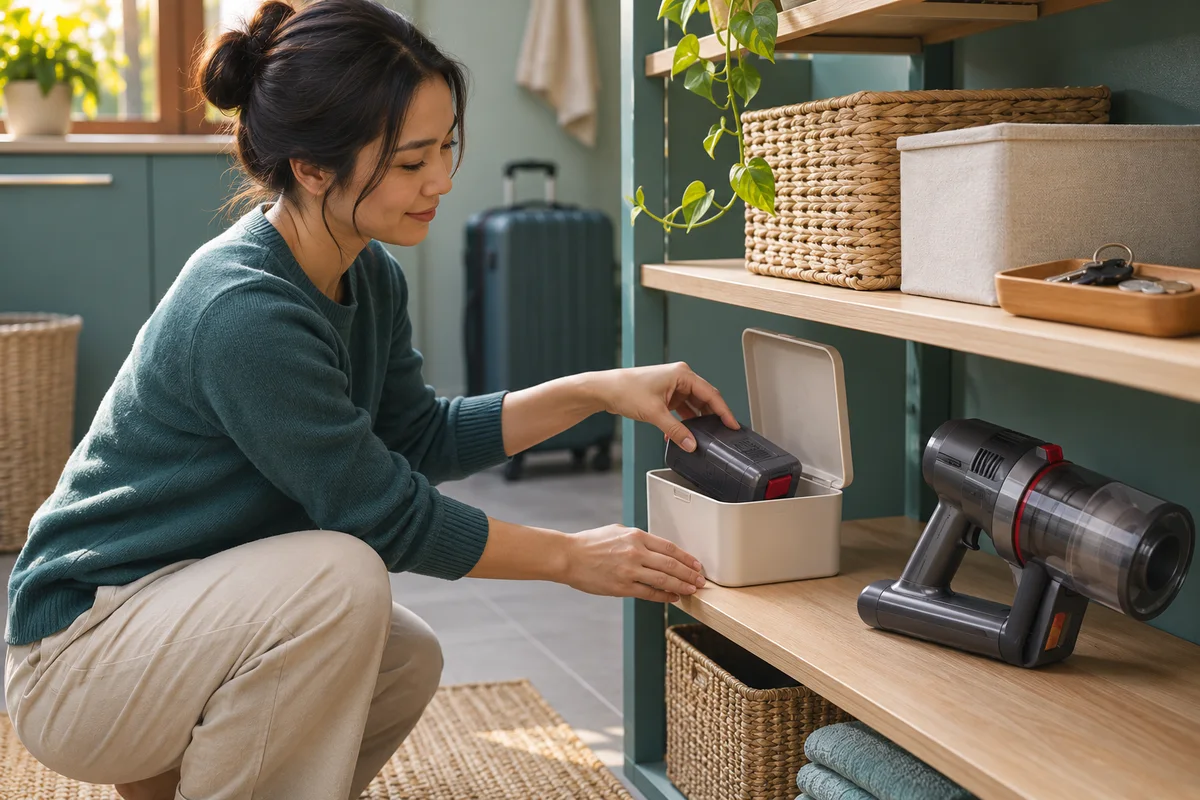
AI-generated scene illustration; not a photograph of the recommended product.
The household is leaving for a long trip, or the vacuum will stay unused while a room is renovated. It is easy to empty the bin, put Eureka NEC440 in a closet and assume the next recharge can wait until it is needed again.
Long-term storage is a different job from parking the vacuum between weekly cleans. The manual includes a battery-maintenance interval and environmental conditions. Those instructions should influence a purchase intended for occasional use, not be discovered after months of neglect.
The short answer
For non-use longer than two months, the NEC440-series manual says to unplug the power plug and fully charge the battery every two months. It also specifies a 5–40°C ambient range for charging, use and storage and requires battery disconnection before storage.
Follow the exact supplied instructions together rather than replacing them with generic advice for another battery. Keep the disconnected pack away from loose metal and arrange a responsible check if the absence will extend beyond the interval.
Contents
- The short answer
- Separate daily parking from absence
- A before-leaving record
- Protect the disconnected pack
- Cleaning is another preparation task
- Returning to service
- Buying advice
- A practical handover note
- Frequently asked questions
- Sources and verification
Separate daily parking from absence
A vacuum kept ready for ordinary cleaning has a different schedule from one left in an unused property. Daily convenience does not establish a long-term storage method.
Write the expected non-use period and who can carry out the manufacturer-directed checks. If nobody will be present for an extended absence, ask Eureka how to handle the particular situation before leaving. Do not invent a longer interval.
Similarly, “closet” is not an environmental specification. A dry indoor utility area and an unheated detached storage space can behave differently across the season. Use the documented range and the actual location’s conditions.
This article does not predict battery lifespan or guarantee that a stored pack remains healthy. The purpose is to avoid buying an occasional-use appliance without an achievable care routine.
A before-leaving record
| Item | Record before storage |
|---|---|
| Model | Exact vacuum and supplied battery identity |
| Instructions | Applicable manual and long-non-use paragraph |
| Location | Dry supported environment within the stated range |
| Pack | Disconnected and protected from loose metal |
| Check | Date and responsible adult |
| Return | Normal inspection and supported recharge plan |
Keep the record where the responsible person can find it. A reminder on the traveler’s phone is less useful if someone else must attend to the appliance.
Do not leave private travel details on a public notice or shared online photograph. The appliance reminder needs the care date, not a complete itinerary.
Use the actual calendar interval specified by the manufacturer. Do not silently convert it into an assumed number of discharge cycles or a percentage threshold from another model’s guide.
Protect the disconnected pack
Battery removal does not turn a pack into an ordinary object for a drawer full of keys, screws or coins. The manual warns against loose metal bridging terminals.
Choose a location where the pack stays identifiable, protected from accidental contact and away from inappropriate heat or moisture. Follow the manufacturer’s instructions; no homemade electrical insulation or improvised storage enclosure is prescribed here.
Do not charge, reuse or attempt to repair a visibly damaged pack. Do not open the casing or try to revive a deeply unresponsive battery with another charger.
Our battery-retirement guide addresses end-of-life handling, which is different from routine storage. A calendar reminder is not permission to continue using damaged equipment.
Cleaning is another preparation task
Empty and care for the vacuum only through the permitted method. If a component has been washed, follow its drying instructions completely before appropriate storage or reassembly.
Do not rinse the whole floorhead or assume every visible part is washable. The component-cleaning guide distinguishes the allowed care tasks. Long absence does not expand those permissions.
Choose supported physical storage that does not leave the vacuum precariously balanced. The wall-mount plan handles that layout decision separately.
Do not squeeze the appliance into a location where a closing door presses controls, crushes a cable or dislodges components. An unused appliance still occupies real household space.
Returning to service
Before ordinary use, inspect visible condition and review the applicable instructions. Confirm that the correct charger and designated battery remain with the vacuum rather than assuming a similar adapter belongs to it.
A pack that needs attention after absence should not trigger an immediate complete-vacuum replacement. Describe the storage period, care history and current symptom to official support.
Equally, a remembered charge date is not proof that everything is ready. Follow the documented charging and operating checks and stop if equipment is damaged or abnormal. Do not perform repeated forced starts as a diagnostic experiment.
If a support-directed replacement is appropriate, obtain the exact currently approved part. Our spare-battery guide explains why apparent physical fit is not sufficient compatibility evidence.
Buying advice
Consider NEC440 when its dry-cleaning role, normal handling and long-term care requirements fit the actual home. Someone using it regularly may find the storage schedule easy to incorporate; someone absent for long periods may face a meaningful ownership obligation.
Before buying for a vacation home, identify who can follow the check schedule. If no suitable arrangement exists, compare other supported cleaning solutions rather than treating battery care as optional.
For occasional short cleaning jobs, assess whether an appropriate existing tool already meets the need. A cordless appliance adds a battery and charger to maintain even when its floor-cleaning work is limited.
Include supported storage, approved replacement-part access and seller service in the comparison. Do not treat an available-looking spare battery advertisement as proof of current genuine inventory.
The partner offer below is for the NEC440BK vacuum. Confirm the exact supplied pack, accessories, stock, delivery and return terms before ordering. No replacement-battery stock or cost is asserted.
A practical handover note
Keep the note concise: the model, exact source instructions, storage position, next care date and legitimate support contact. Distinguish actions already completed from actions still due.
If another person will perform a check, make sure they can do so normally and safely. Do not expect them to infer a procedure from a photograph of a packed closet.
Update the record after the check rather than marking the entire absence covered in advance. An unattended reminder is not a completed action.
This is planning guidance, not a guarantee against failure. Manufacturer requirements, the condition of the actual equipment and appropriate support still govern what happens next.
Frequently asked questions
What interval does the manual give for long non-use?
For non-use beyond two months, it says to fully charge every two months and unplug the power plug. Read the full applicable instructions.
Can I leave the battery loose with tools?
No. Keep it away from loose metal that can bridge terminals, following the manufacturer’s precautions.
Does this prove the battery will work after any absence?
No. We have not assessed a pack or measured storage loss. Follow the documented checks and obtain support for abnormalities.
Should another vacuum’s storage percentage be copied?
No. Use the instructions for this exact equipment rather than combining different manufacturers’ battery advice.
Sources and verification
Checked November 21, 2026. The PDF cover identifies NEC440 Series despite different embedded document metadata. No battery or storage test.
Keep reading
Related guides
 Cleaning
NEC440 Suction Numbers: Pa, Air Watts and Motor Watts
Compare NEC440 pressure, air-watt and motor-power claims with their original labels instead of inventing one universal performance score.
Read guide → Cleaning
NEC440 Noise: A Specification Is Not a Quiet-Room Test
Assess NEC440 noise for a shared home without turning a published specification or operating mode into a quietness guarantee.
Read guide → Cleaning
NEC440 or a Carpet Cleaner: Dry Pickup Is Different
Compare NEC440 dry pickup with a carpet extractor's different task, textile permissions and aftercare before buying for an old stain.
Read guide →