

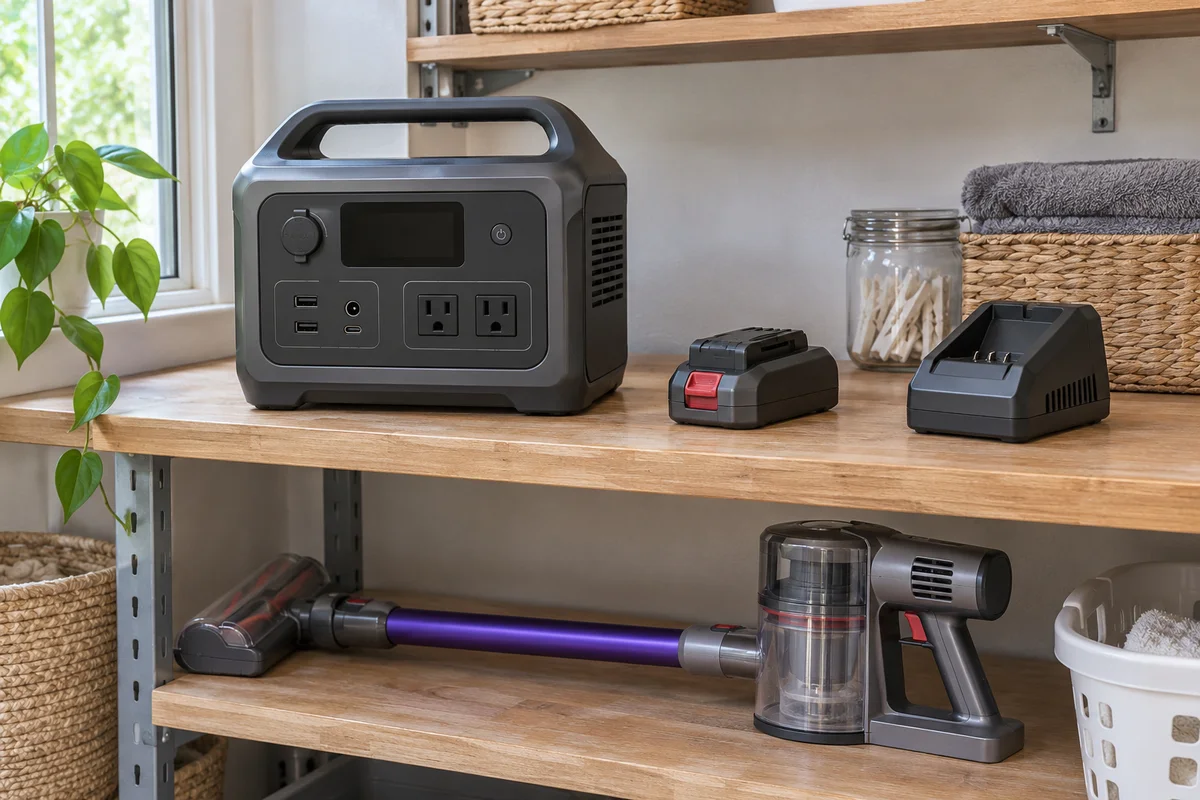
AI-generated scene illustration; not a photograph of the recommended product.
A portable power station advertises 1,152Wh while a smaller battery advertises tens of thousands of mAh. The second number looks larger, but the comparison is missing a unit relationship. Buying the bigger-looking number can mean buying much less stored energy than expected.
For BLUETTI AC180, normalize the energy labels before deciding whether its size earns a place at home. This is a capacity-comparison task, not a recommendation to buy the largest battery or an estimate of delivered laptop charges.
The short answer
BLUETTI lists AC180 at 1,152 watt-hours. A milliamp-hour figure alone cannot be compared directly with that energy rating: it also needs the applicable nominal battery voltage. Convert mAh to amp-hours, then multiply by that voltage to obtain watt-hours.
Use the battery’s documented rating or manufacturer clarification, not an arbitrary USB output voltage. After normalizing the labels, separately check output compatibility, usable delivered energy and the actual task. Comparable nameplate energy does not guarantee comparable runtime.
Contents
- The short answer
- Keep the units attached
- A worked example
- Build a common-unit table
- Nameplate energy is not delivered energy
- Compatibility comes next
- Buying advice
- Common shortcuts to avoid
- Frequently asked questions
- Sources and verification
Keep the units attached
Watt-hours describe energy. Amp-hours describe charge, and milliamp-hours are thousandths of an amp-hour. A watt rating describes power rather than the total energy reserve.
These distinctions explain why a battery with a higher mAh number does not necessarily contain more energy than one with a lower number. Voltage is part of the relationship, not a detail to discard.
The FAA’s battery-rating explanation gives the conversion. We use its arithmetic here, not its travel rules as a shopping endorsement. Aircraft acceptance is a separate matter addressed in our existing flight guide.
Write the complete label on the comparison sheet. A number copied without its unit is no longer a useful specification.
A worked example
Take a hypothetical battery marked 20,000mAh at a nominal 3.7V. First divide by 1,000: 20,000mAh becomes 20Ah. Then multiply 20Ah by 3.7V to obtain 74Wh.
If a different hypothetical battery genuinely had the same 20Ah rating at 12V, its corresponding energy would be 240Wh. The charge number stayed the same; the voltage changed.
Neither example describes a named alternative we tested or a verified seller offer. They show why the missing voltage prevents a valid comparison.
Do not insert a convenient 5V USB output into a rating stated at internal cell voltage. Ask which voltage belongs to the quoted capacity. If the source does not establish it, keep the energy field unresolved rather than manufacturing an attractive total.
Build a common-unit table
| Field | Record | Purpose |
|---|---|---|
| Product identity | Exact model and variant | Prevent mixing specifications |
| Stated capacity | Number and original unit | Preserve the original evidence |
| Nominal voltage | Applicable documented voltage | Support any required conversion |
| Energy | Manufacturer Wh or justified calculation | Compare like quantities |
| Output | Required port and supported profile | Establish device compatibility |
| Unknowns | Unclear label or test conditions | Avoid false precision |
For AC180, use the published Wh rating directly. Do not reverse-engineer an unofficial mAh figure merely to place a much larger number beside a smaller battery’s packaging.
For a power bank, prefer an unambiguous manufacturer Wh rating when available. A retailer’s shortened title is weaker evidence than the actual applicable label.
Keep the source and check date beside the table. Similar-looking variants can have different capacities or output arrangements.
Nameplate energy is not delivered energy
A normalized table solves one problem: comparing stated stored energy. It does not establish how much reaches a particular device through a particular port.
Conversion losses, the load’s behavior, operating conditions and the station’s own consumption affect the result. Do not divide a nameplate rating by a phone’s advertised battery capacity and present the quotient as tested full recharges.
For an ordinary planning example, distinguish energy requested by equipment from energy supplied at its input. A laptop charging its own battery while working is not necessarily drawing the same amount throughout the session.
The router-and-laptop budget develops the load side. Use actual applicable observations rather than borrowing another publication’s runtime.
Compatibility comes next
Two batteries can have comparable energy labels but very different supported outputs. A laptop still needs a compatible charging profile and cable; an AC appliance needs a suitable documented AC source.
Do not choose AC180 solely because its Wh figure is greater. A lighter compatible source can be more appropriate when the work is genuinely mobile and modest.
Our AC180 versus laptop power-bank guide handles that category decision. This article adds the common-unit calculation before the choice, not another port comparison.
Likewise, a source that cannot support the device is not rescued by a large reserve. Energy and power are complementary checks, not interchangeable reasons to declare compatibility.
Buying advice
Consider AC180 when its supported outputs and reserve suit the actual stationary job and the household can accommodate its handling, placement and recharging requirements. Buy for a defined task rather than the largest normalized number.
Prefer a suitable smaller source when that task does not require the larger arrangement. A capacity comparison can legitimately conclude that no upgrade is necessary.
Before checkout, retain the exact model, published Wh rating, required output, planned load and realistic recharge opportunity. Mark any unsupported conversion as unresolved.
Check the selected partner seller’s current package, inventory, delivery and return terms independently. Manufacturer-store notices do not establish another seller’s stock. No current price or comparative value ranking is claimed here.
The partner offer below is for AC180 hardware. It is not an independently verified battery-capacity test or a guarantee of a particular number of phone or laptop charges.
Common shortcuts to avoid
Do not compare bare numbers across different units. Do not use output voltage to fill an unknown nominal rating. Do not mix an AC180P capacity with an AC180 title.
Avoid treating decimal places as evidence of measurement. A calculator can produce a precise result from the wrong inputs.
Finally, do not treat a successful conversion as completion of the purchase assessment. It makes one row comparable; the rest of the household requirement remains to be checked.
Frequently asked questions
Is 20,000mAh automatically more energy than 1,152Wh?
No. Those quantities cannot be compared as bare numbers. The mAh rating needs its applicable voltage before conversion.
Can I always use the USB port’s 5V?
No. Establish the voltage associated with the battery’s stated capacity rather than substituting an output setting.
Does Wh predict exact recharge counts?
No. Delivered energy, losses, the device and operating conditions require separate assessment.
Has WideLore measured AC180 capacity?
No. This is published-specification analysis and explicitly hypothetical arithmetic, not a discharge test.
Sources and verification
Checked November 22, 2026. No capacity, runtime or charge-count measurements.
Keep reading
Related guides
 Power & Outdoors
AC180 and Vacuum Charging: Budget the Charger, Not the Motor
Qualify a cordless vacuum's approved charger before budgeting AC180 reserve; motor watts and recharge demand are different quantities.
Read guide → Power & Outdoors
AC180 or a Fuel Generator: Start With the Property
Compare AC180 with a fuel generator through property constraints, duration, replenishment and the complete ownership plan.
Read guide → Power & Outdoors
AC180 Pass-Through Charging: Watch the Energy Balance
Plan AC180 pass-through charging with accepted input, connected demand and a time-based energy worksheet before choosing a solar bundle.
Read guide →