
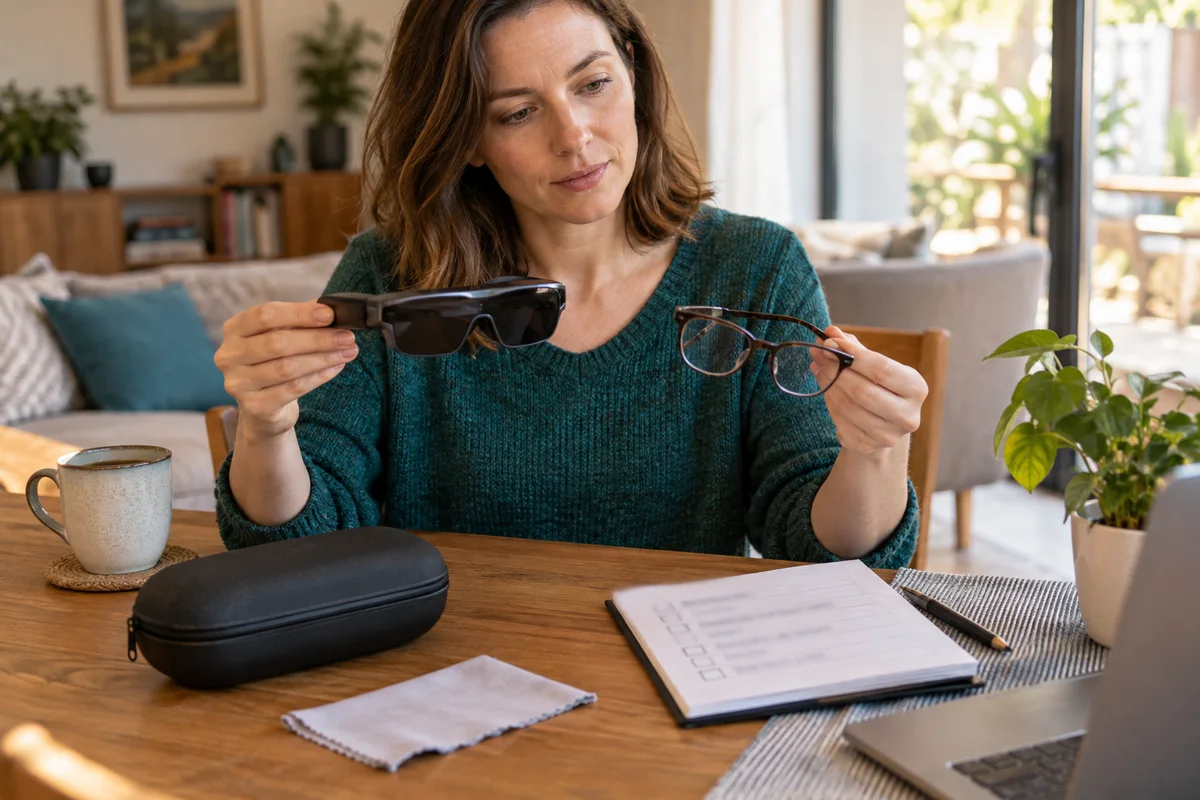
AI-generated scene illustration; not a photograph of the recommended product.
You normally wear prescription glasses, so the built-in adjustment on a pair of display glasses looks like one less accessory to buy. Then the order asks about a lens frame, an insert or a prescription service, and a simple entertainment purchase becomes a collection of unanswered optical and seller questions.
Before ordering Rokid Max 2, separate the device, your lens needs and the return conditions. A focus dial can be useful without replacing every part of a prescription, and a return window can exist without offering an unrestricted home trial.
The short answer
Rokid’s Max 2 FAQ states a built-in adjustment range from 0.00D to -6.00D for nearsightedness and describes additional prescription-lens solutions for needs outside that range or for farsightedness or astigmatism. Do not interpret the dial as complete correction for every wearer.
Ask the manufacturer and an appropriate eye-care professional or lens provider to confirm the correct arrangement for your current prescription. Confirm accessory compatibility, ordering fields, delivery and the actual seller’s conditions before paying. This guide is a procurement checklist, not prescribing advice.
Contents
- Keep the three decisions separate
- Ask what information the lens provider needs
- Confirm the complete accessory package
- Read conditions before planning an evaluation
- Prepare a supported fit check
- Make the buying decision
- Frequently asked questions
- Sources and verification
Keep the three decisions separate
The first decision is whether a private wearable display serves your intended use. The second is how the device will work with your lens needs and physical fit. The third is whether the seller’s purchase conditions make the remaining uncertainty acceptable.
Do not answer the second question with an entertainment feature. A large virtual screen or a high refresh-rate claim does not tell you which lens arrangement is appropriate. Equally, a lens solution does not confirm that your phone or laptop supports the display connection.
Write the unresolved questions before building a cart. This prevents an accessory bundle from appearing complete merely because it contains several useful-looking items. You may need fewer accessories, different accessories or a different product category entirely.
Ask what information the lens provider needs
Use a current prescription and ask the provider which information is required for this exact display-glasses model. Do not copy numbers from an old order, estimate missing measurements or select optical values based on internet comments.
Clarify whether the proposed service supplies a frame, lenses, a complete insert or another item. Similar descriptions can refer to different deliverables. Ask who is responsible for verifying the information and what happens if an order is incomplete.
Keep health and purchasing questions in their appropriate places. The manufacturer can explain device compatibility; the qualified provider can address prescribed-lens requirements. A general shopping article cannot decide whether an optical arrangement is medically suitable for you.
Avoid modifying lenses or stacking unsupported parts to make an unsuitable combination fit. If a provider cannot confirm compatibility clearly, pause the purchase. The cost of an incorrect accessory can be harder to recover than an ordinary unopened cable.
Confirm the complete accessory package
Write the exact product name and the accessory’s exact compatibility statement. “For Rokid glasses” may not identify the particular model family. Check the current manufacturer information rather than assuming every product carrying the brand uses the same frame.
Rokid’s FAQ discusses compatible prescription solutions, but you still need to verify the actual item offered by the seller. Availability, regional service and accessory packages can differ. A claim about support does not mean custom lenses are automatically included.
Ask how the accessory is fitted and maintained using the approved instructions. Confirm whether the glasses’ ordinary case accommodates the permitted assembled arrangement or whether storage requires another step. These are practical ownership questions, not reasons to invent a fitting technique.
Keep the source-device requirement separate. A correct lens arrangement cannot fix a missing video-output capability. Our USB-C source checklist covers that prerequisite without treating every USB-C port as a display port.
Read conditions before planning an evaluation
Read the actual seller’s terms, not only a headline saying returns are available. Determine the period, required condition, packaging, included parts, non-defective return shipping and whether customized optical accessories have separate restrictions.
The official Rokid product page checked October 13 describes returns with condition requirements, including unused and resalable items, and customer responsibility for non-defective return shipping. Those are the official site’s stated conditions, not a promise that every partner seller applies the same policy.
Do not plan an extended home trial based solely on the number of days in a banner. Ask how the seller permits fit or display evaluation before accepting an item. An authorized store demonstration or another explicitly permitted arrangement may reduce uncertainty without assuming used goods can be returned.
Keep written answers dated and linked to the order. If a salesperson’s explanation conflicts with the published policy, seek clarification before paying rather than hoping the more generous interpretation will apply later.
Prepare a supported fit check
Once an appropriate evaluation is permitted, use representative content from your intended task. Check the supported frame adjustment, the placement of the approved lens arrangement and whether ordinary text can be viewed as needed.
Do not turn the check into a diagnosis or push through discomfort to justify the purchase. Stop if the experience is uncomfortable and seek appropriate guidance. This article cannot promise a particular session length, fatigue reduction or eye-health result.
For work use, our desktop-text acceptance checklist separates readability from an impressive perceived screen size. For entertainment, assess the actual application and private-viewing workflow rather than a generic promotional clip.
Record the unresolved issue precisely. “The product is bad” is less useful to support than a description of the source, approved setup and what did not meet your needs. Do not change several optical and software variables at once without guidance.
Make the buying decision
Create an order card with six fields: exact display model, confirmed lens needs, compatible accessory or service, supported source device, permitted evaluation arrangement and complete delivered cost. Include customization and return conditions where relevant.
The Max 2 can be a candidate when the manufacturer’s supported arrangement meets your needs and you accept the ownership routine. Its focus adjustment may reduce accessory requirements for some users, but that does not establish that it eliminates your own lens requirement.
Pass if an essential field remains uncertain or if the purchase relies on a generic promise that the dial replaces prescription glasses. A conventional screen, a different supported wearable display or a later purchase after professional confirmation may be the better choice.
Do not buy additional accessories merely to make the order feel comprehensive. Each item should answer a confirmed requirement. An unnecessary insert, adapter or case increases cost without resolving the uncertainty that matters.
After the order card is complete, check the current partner listing for the exact package and seller. A practical purchase is one whose lens and policy questions were settled before checkout, not one assembled from assumptions after delivery.
Frequently asked questions
Does the built-in adjustment cover every prescription?
No. Rokid describes a nearsightedness adjustment and additional lens solutions. Obtain confirmation for your own current prescription rather than extrapolating.
Are prescription lenses automatically included?
Do not assume so. Confirm whether the package includes a frame, lenses, a service or none of those, and verify exact compatibility.
Does a 30-day return headline mean I can use the product freely at home?
Not necessarily. Read the complete condition, shipping and customization terms and ask about any permitted evaluation before ordering.
Sources and verification
Checked October 13, 2026. This article does not prescribe optical correction or establish wearer comfort. Seller terms may change and must be reconfirmed.
Keep reading
Related guides
 Home Tech & Audio
AR Glasses for Desktop Work: Test Text, Not Screen Size
Compare Rokid Max 2 with a conventional monitor using source resolution, readable text, window layout, and your actual work task.
Read guide → Home Tech & Audio
AR Glasses Travel Checklist: Check USB-C Before Buying
Verify the phone, cable, power, and actual viewing app before packing Rokid Max 2 as your travel screen.
Read guide → Home Tech & Audio
Can AR Glasses Solve a Shared-Living-Room Screen Clash?
Decide whether a private display really solves your shared-room problem before buying Rokid Max 2 glasses, adapters, and extra audio gear.
Read guide →