

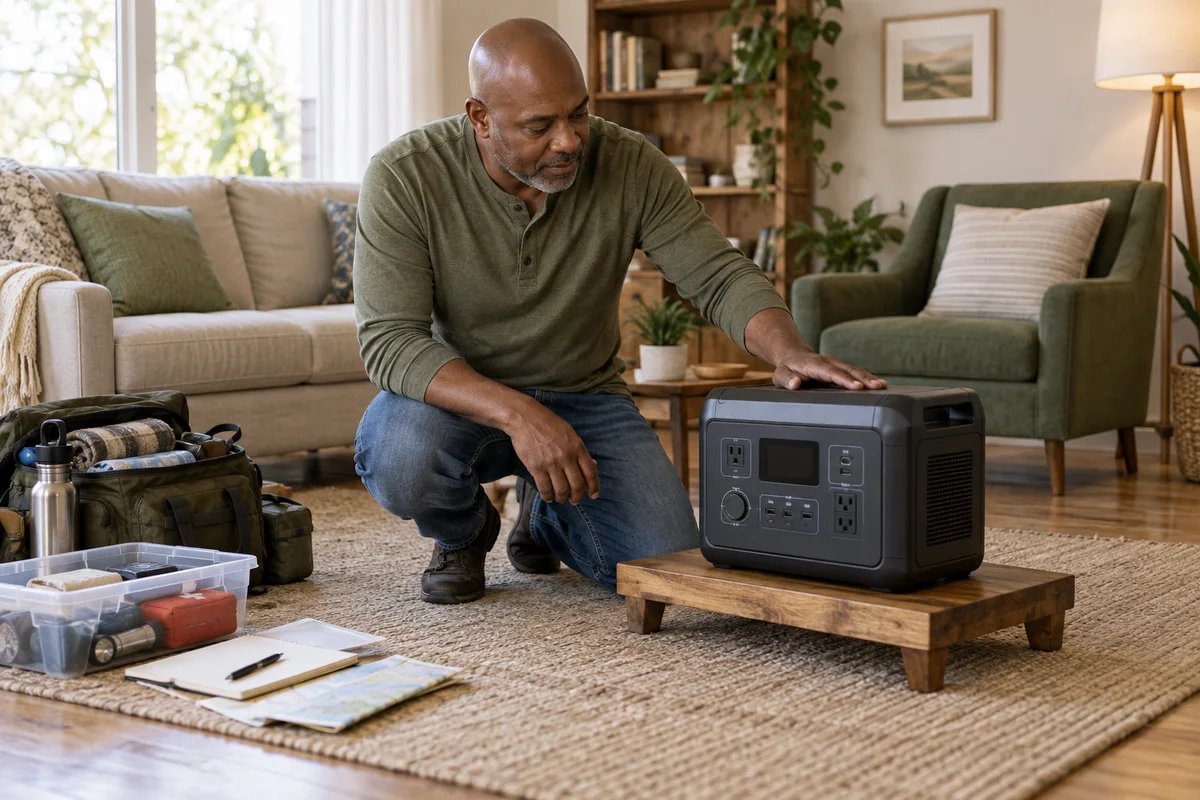
AI-generated scene illustration; not a photograph of the recommended product.
The power station was useful on a camping trip, but now it is November’s problem: a bulky battery on a spare shelf, still connected to cables nobody has touched for weeks. When the next trip arrives, the household expects it to work simply because it was working when it went away.
Long-term storage is a different job from keeping backup power ready for immediate use. For the BLUETTI Elite 100 V2, the distinction affects charge level, cable handling, and the date of the next check—not just the place where the unit sits.
The short answer
For extended storage, the Elite 100 V2 manual specifies approximately 40–60% state of charge, power off, cables disconnected, and a cool, dry location away from flammable materials. It calls for a full charge-and-discharge cycle every three months.
Treat that as a model-specific maintenance instruction, not a promise of immediate outage readiness. Someone storing a unit between trips and someone preparing for a forecast interruption may need different plans. Do not borrow a different BLUETTI model’s storage interval.
Decide which job the station has this month
Start with one sentence: “This unit is being stored until our next planned use,” or “This unit needs to be ready for a likely interruption.” If both seem true, decide which matters first and check the supplied manual’s instructions for the intended arrangement.
A family that camps in summer may reasonably put the station into extended storage. A home expecting scheduled electrical work next week may instead need to prepare its actual loads. Half a battery stored appropriately is not the same resource as a unit deliberately prepared for a known task.
Avoid leaving the decision implicit. A plug left connected can make one person assume the station is maintained automatically, while another assumes it was switched off months earlier.
Turn the three-month instruction into an appointment
A maintenance interval is only useful if it survives the next busy weekend. Record the storage date, the observed charge level, and a check date approximately three months later. Use a calendar the responsible person actually opens.
For example, a household putting the unit away on October 15 can schedule a January check. That example is a reminder structure, not evidence that every storage environment produces the same battery behavior. An earlier inspection may be appropriate if the location changes or the equipment looks abnormal.
Assign an owner and a backup person. “Someone should check it” is weaker than a named household responsibility. Keep that information in private household notes rather than on a public product registration page.
Give the maintenance cycle enough time
Do not schedule the task five minutes before leaving for a trip. A charge-and-discharge cycle requires an appropriate setting, suitable noncritical loads, and time to follow the manual. It is not a reason to improvise a high-power load merely to finish faster.
Use the model’s documented procedure. Do not interpret “cycle” as permission to force the battery into an abnormal deeply discharged state, override warnings, or repeatedly restart it after protective shutdown. Ask BLUETTI for clarification if the supplied manual leaves a step unclear.
After maintenance, return the unit to the specified storage condition if it is going back into extended storage. Otherwise, the calendar event can be completed while the actual storage setup remains wrong.
Inspect the storage location, not just the percentage
A spare room can change while the battery stays in the same place. A winter heater may appear nearby. Boxes may block access. A water pipe may begin leaking. Household storage tends to expand into whatever space looks unused.
At each check, look at the surrounding area before turning the unit on. The goal is not to diagnose battery internals. It is to notice visible damage, moisture, blocked space, or a location that no longer matches the manual.
Keep ports protected from household clutter without wrapping or enclosing the station in a way that conflicts with its instructions. Do not treat an ordinary fabric cover, a sealed storage box, or a closed cabinet as an approved operating environment.
Use a small, useful record
A practical private note can fit on one page:
| Item | What to record |
|---|---|
| Model | Elite 100 V2 and the regional manual used |
| Storage start | Actual date and observed state of charge |
| Setup | Off, cables disconnected, chosen location |
| Scheduled care | Next three-month cycle appointment |
| Inspection | Visible condition and any change in the room |
| Return to use | Planned loads and checks still outstanding |
Avoid filling this record with estimated runtime numbers that were never measured. If a trip requires a refrigerator or other demanding appliance, create a separate load plan. The storage note only establishes what maintenance was done.
Bring it back into service deliberately
Before the next use, read the note, inspect the equipment, and prepare it according to the current instructions. Confirm the outlets and settings needed for the actual devices rather than assuming they match the last trip.
A low or intermittent load also deserves its own check. The Elite 100 V2 ECO-mode guide explains why a charged station can still fail to maintain a small intended load if the configuration is unsuitable. Storage condition, charge level, and output behavior answer different questions.
If the next plan involves solar charging, use the separate solar-panel compatibility checklist. A successful storage cycle does not verify a panel’s electrical compatibility or the suitability of an adapter.
Compare ownership effort before buying
The Elite 100 V2 may suit someone who wants portable energy for defined tasks and will maintain it between uses. The full Elite 100 V2 review covers broader buying considerations; this guide adds the calendar burden that a capacity comparison can overlook.
It is less appealing as an “install it and forget it” purchase for a household that will not inspect or maintain stored equipment. A rarely used product still takes space and attention. Include those costs alongside the purchase, accessories, and eventual replacement decisions.
For a small household need, compare a simpler solution that actually fits the job. Do not buy a larger station merely because the storage shelf happens to be empty. Conversely, do not choose a smaller device if the real load requirements remain unmet.
Frequently asked questions
Should I store the Elite 100 V2 fully charged?
The referenced manual specifies 40–60% for extended storage. That differs from deliberately preparing for an upcoming use. Follow the current regional manual for your situation.
Does three months mean I can ignore it until then?
No. The interval is a maintenance reminder, not an assurance against changing room conditions, damage, or abnormal behavior. Inspect sooner if something changes.
Can I use an AC180 storage instruction instead?
No. Even products from the same manufacturer can have different instructions. Keep the Elite 100 V2 manual with this unit’s maintenance record.
Does a completed cycle prove emergency readiness?
No. You still need suitable charge, settings, connections, and verified compatibility with the intended loads. This consumer station should not be assumed suitable for critical equipment.
Sources and verification
Checked October 15, 2026. The calendar and household examples are editorial planning tools, not battery-life measurements.
- BLUETTI Elite 100 V2 manual — storage state of charge, disconnection, environment, and three-month maintenance cycle.
- BLUETTI user-guide directory — official model-specific manual entry; verify the guide supplied for the unit sold in your region.
Keep reading
Related guides
 Power & Outdoors
AC180 Earthquake Backup: Make a Safe Placement Plan
Use the October ShakeOut reminder to assess stable placement, ventilation, access, and household hazards before choosing an AC180.
Read guide → Power & Outdoors
Can You Fly With an AC180? Check Watt-Hours First
Compare the AC180's 1,152Wh battery with current U.S. passenger-baggage limits before buying portable power for a trip involving flights.
Read guide → Power & Outdoors
Can an AC180 Run a Space Heater? Do the Energy Math
Separate AC180 output power from stored energy and build a cold-weather outage plan that does not rely on battery room heating.
Read guide →