
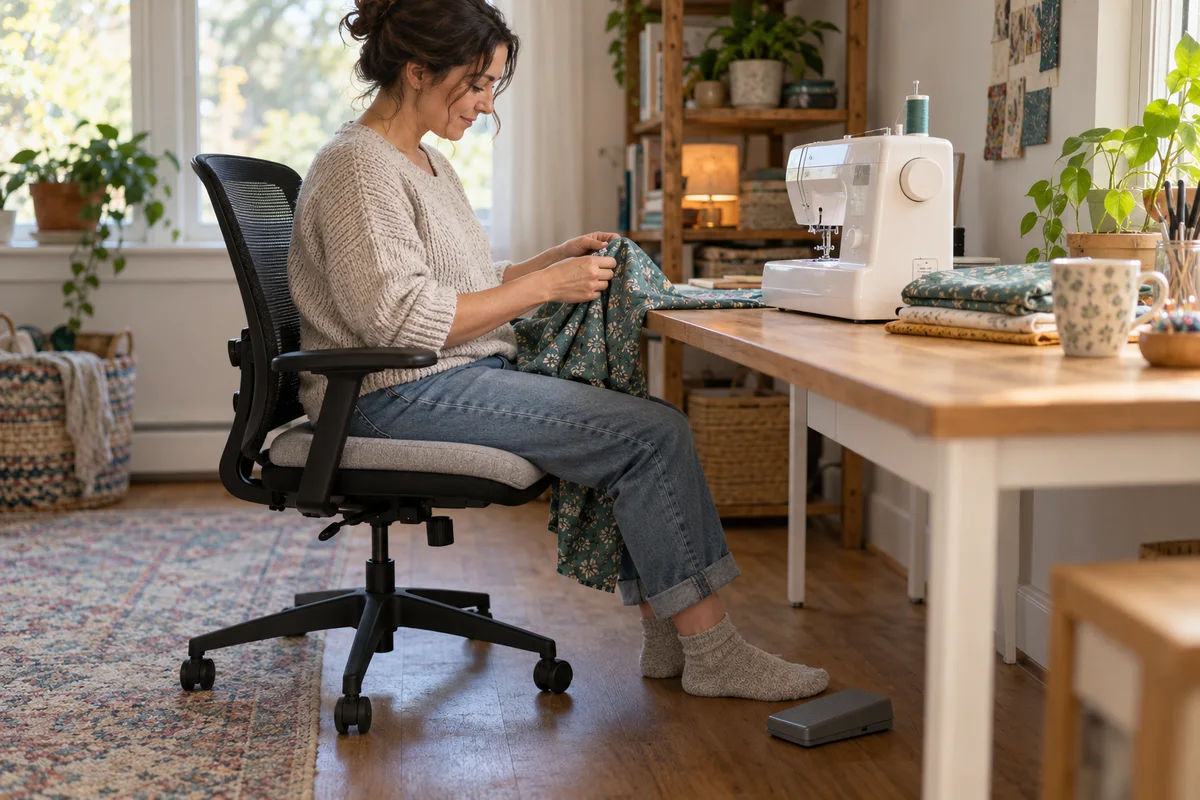
AI-generated scene illustration; not a photograph of the recommended product.
The dining table becomes a sewing station on Saturday, then a work desk on Monday. A chair that feels useful at the laptop may put the sewing pedal out of reach or leave the needle area too far away. Choosing ProtoArc EC300 for this room means checking the whole sewing task, not simply choosing the chair with more adjustments.
The short answer
EC300 is an office chair with adjustable components, not a manufacturer-certified sewing workstation. Assess the machine’s working height, view of the needle area, hand space, pedal position and chair stability together.
CCOHS’s seated-work guidance distinguishes visual, hand and foot tasks, and recommends keeping foot controls in front rather than requiring a twisted position. That combination makes a sewing assessment different from a laptop-chair fit check.
Contents
- The short answer
- Three simultaneous tasks
- The table and pedal
- The EC300 fit
- Fabric and arm space
- A station worksheet
- The room reset
- Buying advice
- Frequently asked questions
- Sources and verification
Three simultaneous tasks
Write down what the seat must allow while you sew: seeing the working area, guiding fabric and using the pedal. A setting that improves one may interfere with another. Raising the seat to meet a tall table can make the pedal harder to use.
Begin with the actual sewing machine on its normal table and follow its own setup instructions. Tabletop thickness, machine position and the space below matter more than whether the furniture is described as a craft desk.
Keep the cutting, pressing and sewing jobs separate. They may require different surfaces and positions. Do not expect one office-chair setting to accommodate every stage or use a wheeled chair as a platform to reach supplies.
If another person shares the station, assess each person rather than averaging their needs. Our shared-chair guide can help record different starting settings, but the sewing pedal adds a requirement that a keyboard-only setup does not have.
The table and pedal
With the machine switched off according to its instructions, examine the route to the pedal. It should not require reaching sideways around a table leg or pushing the chair away from the machine. Keep the cable clear of wheels and normal entry and exit.
Check whether you can support yourself comfortably while placing the working foot as required. Do not prescribe a universal knee angle or pedal distance from a photograph. Use appropriate workstation advice and the needs of the actual user.
A pedal that slides and a chair that rolls create different problems. Moving the pedal closer does not resolve an unsuitable seat height; lowering the seat does not fix a loose floor arrangement. Address the specific cause with supported equipment.
Do not wedge casters, remove the base or improvise a gas-lift modification. If the task needs a stable non-rolling chair, compare that category rather than trying to make EC300 something it is not.
The EC300 fit
The EC300 product page lists a five-position sliding seat, an adjustable backrest and height-adjustable armrests. These are useful fit questions, but their presence does not prove that the chair will move sufficiently low or clear your particular table.
Ask for the actual minimum and maximum usable seat height when the seller’s measurements are unclear. Total chair height is not seat height. Likewise, a seat-slide travel figure is not the complete sitting depth.
The backrest and integrated lumbar support move together on this model. Check whether a supported position works when you are close enough to the machine. Do not add a headrest adjustment to compensate for a table that is too high.
Our seat-depth guide covers the control itself. Here the question is whether the available supported setting allows the combined sewing task without losing useful foot access.
Fabric and arm space
Use the actual table opening to assess where arm pads and the chair back will sit. Height adjustment does not imply flip-up arms, removable arms or a completely open-sided seat. Get written clarification before making a purchase that depends on any unconfirmed feature.
Consider the fabric you normally handle. A small repair and a bulky project can occupy different space around the operator. Do not let a large piece drape into wheels or a moving mechanism.
Start an assessment with the machine off and the table clear. Check entry, exit and comfortable reach before introducing fabric or ordinary sewing. Avoid reaching under an occupied chair to force a control while holding a project.
If an authorized normal-use assessment is possible, follow the machine and chair instructions and stop when the arrangement feels unstable or interferes with safe operation. This article is not a sewing-machine operating lesson or an ergonomic treatment plan.
A station worksheet
Keep a single-page record that identifies the limiting relationship instead of collecting every marketing feature.
| Relationship | What to establish |
|---|---|
| Seat and table | A usable working height for this user |
| Foot and pedal | Supported access without a sideways reach |
| Arms and table | Clearance in the actual sewing position |
| Fabric and base | No interference with wheels or mechanisms |
| Body and backrest | Useful support within the chair’s designed range |
| Room and route | Safe entry, exit and space for other craft tasks |
Leave missing measurements blank and request them from the seller. A photograph can help explain the table layout, but there is no need to disclose personal measurements or a private home image publicly.
Compare EC300 with a simpler suitable chair using the same worksheet. A dedicated task seat may give up an office headrest while improving the space needed at the machine. The better purchase is the one that fits the task, not the one that wins on adjustment count.
The room reset
Plan how the station changes back to ordinary household use. A pedal left under a shared desk can confuse the next user, while fabric and cables left around a rolling base make the room harder to navigate.
Store the machine, pedal and tools as their instructions require. Keep a repeatable chair starting position without expecting that one position must be maintained throughout every activity.
Allow changes of task and appropriate breaks. CCOHS emphasizes that chair choice, workstation design and work organization belong together. A new chair is not a reason to promise pain prevention or prolonged uninterrupted sitting.
For an existing EC300 owner, rearranging a suitable table may be the relevant improvement. Do not replace a functional chair before identifying which part of the combined setup is actually failing.
Buying advice
Consider EC300 when it suits your normal office work and the sewing worksheet also passes within the intended configuration. Verify user limits, dimensions, arm clearance and the actual seller’s assessment and return conditions.
Pass if a successful setup depends on removing unapproved components, blocking the wheels or reaching awkwardly for the pedal. Also reconsider if a simpler appropriate fixed chair serves the craft task and your existing office chair already works.
The EC300 overview supplies broader model context. The partner link below is for the complete office chair, not a sewing chair certification, machine or pedal accessory. Check current availability and delivery before ordering.
Frequently asked questions
Is EC300 a sewing chair?
It is marketed as an office chair. Suitability for your sewing setup requires a task-specific assessment.
Do the arms fold away?
Do not infer that from height adjustment. Confirm the delivered configuration and do not rely on an unverified modification.
Is a taller seat better?
Only if the whole workstation still works. Improving table reach while losing supported pedal access is not a complete solution.
Can wheels be wedged?
Do not improvise that alteration. If a non-rolling chair is necessary, compare an appropriate supported product.
Sources and verification
Checked October 31, 2026. No sewing-session or medical outcome testing; workstation reasoning is not a claim of joint product approval.
- ProtoArc EC300 exact-model features
- ProtoArc EC300 adjustment FAQ
- CCOHS visual, manual and foot tasks in seated work
Keep reading
Related guides
 Home Office
EC200 Guitar Practice Space
Check EC200 arm clearance, guitar movement and foot support before choosing a single chair for office work and household music practice.
Read guide → Home Office
EC200 Cleaning and Care
Check EC200 mesh and cushion care against the intended home-office routine without assuming that washable, removable or disinfectable are equivalent.
Read guide → Home Office
EC200 Recline Resistance
Separate EC200 reclining resistance from the angle lock, then check control reach and workstation fit before choosing a chair for recline breaks.
Read guide →