
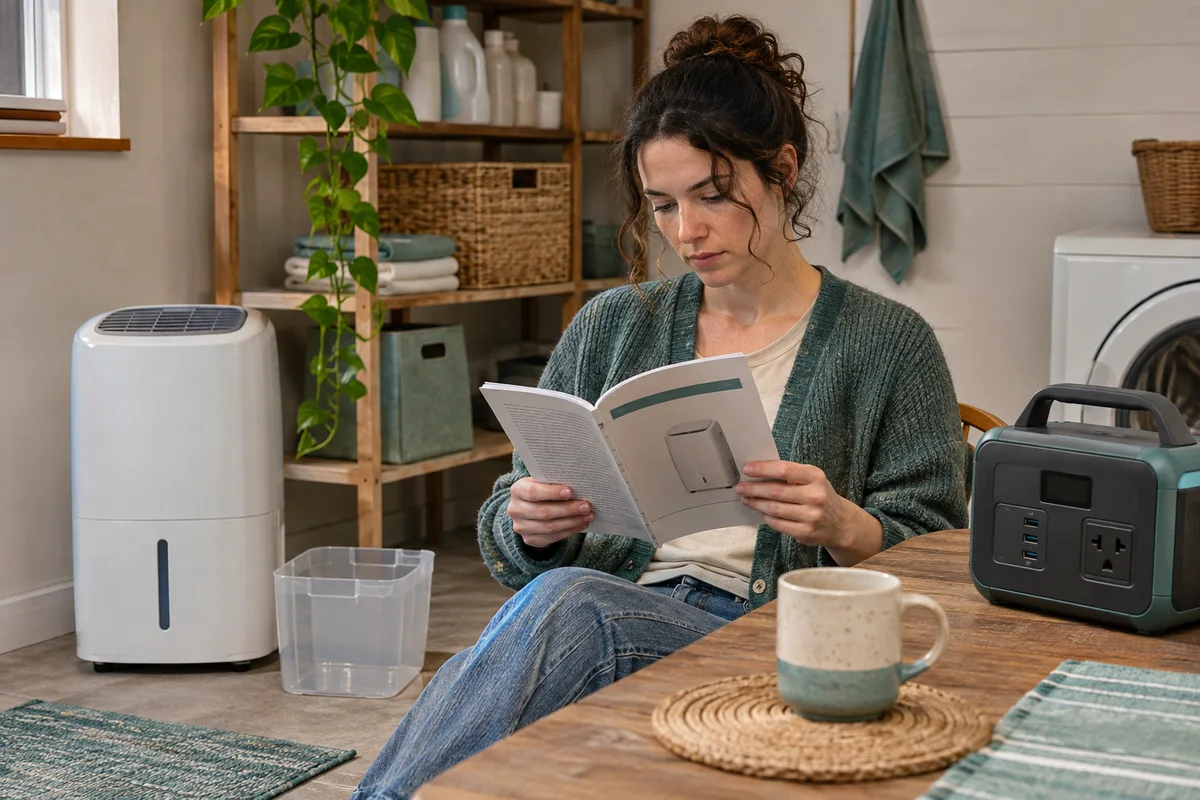
AI-generated scene illustration; not a photograph of the recommended product.
The utility room feels damp after several wet days, and the household wonders whether BLUETTI AC180 could keep a dehumidifier running through a short outage. The appliance may look modest beside a refrigerator, but it still has an electrical load, a moisture-removal task and somewhere the collected water must go.
Choosing a station means checking all three. A running fan, a lit humidity display or a partly filled bucket does not alone establish that the room’s actual moisture problem is being controlled.
The short answer
Consider AC180 only for a supported, defined dehumidifier task in an appropriate dry electrical arrangement. Check the exact unit’s compressor starting requirements, operating demand, permitted temperature, water collection and restart behavior.
AC180’s published 1,800W total AC output and 1,152Wh capacity do not establish a universal dehumidifier pairing or overnight drying result. Correcting the moisture source, choosing an appropriate dehumidifier or retaining normal mains operation may matter more than adding reserve power.
Contents
- The short answer
- Define the moisture task
- Two different capacities
- The compressor demand
- Room temperature
- Collection and drainage
- A representative session
- The task worksheet
- Buying advice
- Frequently asked questions
- Sources and verification
Define the moisture task
Write down what the appliance is expected to accomplish. Maintaining an ordinary room condition is different from responding to active flooding, a leak or water-damaged electrical equipment. This article does not provide flood recovery, mold remediation or electrical re-entry instructions.
If there is standing water, damaged equipment or another immediate hazard, obtain appropriate qualified assistance. Do not carry a station into an unsafe space because it avoids using a nearby wall outlet.
For an ordinary permitted room task, record conditions and the reason for concern using an appropriate method. Keep observations separate from a diagnosis. A smell or a single display number cannot identify every source of dampness.
Two different capacities
A dehumidifier’s removal capacity describes water collected under specified conditions. AC180’s watt-hour capacity describes stored electrical energy. They are not comparable capacities simply because both appear prominently on product pages.
Do not infer a fixed bucket yield from battery size. Room temperature, humidity, air movement, controls and the particular appliance affect moisture removal. An electrical runtime estimate still would not prove the desired room result.
The ENERGY STAR dehumidifier guide discusses sizing and operating conditions. Use the exact appliance’s current instructions and relevant room assessment instead of copying a pints-per-day figure from a different model.
The compressor demand
Identify whether the exact appliance uses a compressor and obtain its supported supply and starting requirements. The US AC180 specifications list total rated AC output, not a manufacturer approval for every compressor below a headline running wattage.
Keep running consumption, maximum input and startup behavior as separate fields. A brief average observation may miss an important demand or operating transition. An adapter rating also does not describe a measured representative session.
Do not use a lifting or boost headline as a universal compressor-start guarantee. If the dehumidifier and station makers cannot establish a suitable arrangement, choose another supported route rather than experimenting during the outage.
Room temperature
An appliance can consume power while removing moisture less effectively than expected. ENERGY STAR notes that colder conditions can affect refrigerated-coil operation and that buyers should choose equipment specified for the temperature of its intended room.
That makes the actual utility-room conditions part of the power purchase. Do not spend scarce reserve to support an appliance outside its operating range and assume that more battery capacity corrects the mismatch.
Check the station’s environment separately. A room suitable for the dehumidifier is not automatically suitable for AC180, its ventilation or electrical connections. Do not warm, cover or modify either product to compensate for an unsuitable location.
Collection and drainage
Decide how the supported appliance handles water. A bucket can fill and trigger the unit’s designed stop behavior; a continuous drain has its own permitted route and any model-specific pumping requirement.
A full-bucket stop is different from an exhausted battery or a station output shutdown. Record which condition would end the intended session. Buying additional watt-hours may accomplish little if no one can manage the appliance’s collection task.
Keep water routes away from electrical equipment. ENERGY STAR specifically separates drainage from electrical cords and connections. Do not improvise a hose across a walkway, place the station beside a drain discharge or assume a pump continues without its own power requirement.
A representative session
After the arrangement is supported, use appropriate representative energy information for the actual room task. Record session length, room conditions, settings and whether the bucket, controls or temperature caused pauses.
A cycling compressor does not operate like a constant lamp load. Conversely, a nameplate maximum should not be multiplied by a whole night and called a measured consumption result. The evidence needs to describe the intended operating pattern.
Our refrigerator reserve guide explains another cycling appliance. The dehumidifier adds an explicit moisture-removal outcome and water-handling constraint; refrigerator food-storage assumptions do not transfer here.
Keep a margin appropriate to the supported plan without inventing a universal percentage. The station also has operating overhead and conversion losses, and its starting charge might already have been used for other household priorities.
The task worksheet
| Field | What to establish |
|---|---|
| Problem | Ordinary moisture task or a specialist response |
| Appliance | Exact model and supported room conditions |
| Power | Supply, startup and complete operating demand |
| Water | Bucket management or approved drainage |
| Controls | Pauses, restart and full-bucket response |
| Reserve | Actual charge and competing priorities |
| Outcome | What observation would show the task is complete |
The worksheet should expose the limiting factor. If the room has an unresolved water source, more power may extend operation without resolving why the room remains damp.
If an existing suitable dehumidifier only needs routine drainage attention, address that supported upkeep before ordering a larger station or replacing the appliance. Do not assume every inconvenience is a capacity problem.
Buying advice
Shortlist AC180 when the exact supported appliance and room task fit a limited reserve, dry placement works and the water-handling routine remains manageable. Confirm that the intended period is useful rather than merely technically possible.
Pass when the proposal depends on an unverified compressor startup, unsupported temperature, unsafe wet location or an implied promise to dry a flooded room. A portable station is not a substitute for qualified building or electrical work.
Compare this use with the reserve’s other jobs. If communications or another defined priority matters more during an interruption, a dehumidifier session may be better postponed under appropriate guidance rather than given the whole battery.
BLUETTI’s direct-store AC180 page currently carries an expected-restock notice. It does not tell you the linked marketplace seller’s inventory. Verify the actual offer’s timing and contents instead of treating an order confirmation as a completed backup plan.
The AC180 overview explains broader ownership tradeoffs. The partner CTA sells station hardware, not a dehumidifier, drying service or jointly approved equipment bundle.
Frequently asked questions
Does removal capacity predict runtime?
No. Water-removal capacity and stored electrical energy describe different quantities and require different evidence.
Is fan operation enough?
No. It does not alone establish effective moisture removal or the intended room outcome.
Can the station sit near drainage?
Do not create that arrangement by assumption. Follow both products’ dry-placement and electrical-safety requirements.
Should the battery be larger?
Only after the actual constraint is identified. Temperature, drainage or an unresolved moisture source may be the more important issue.
Sources and verification
Checked November 4, 2026. Manufacturer specifications and ENERGY STAR operating guidance reviewed; no compressor-start, moisture-removal, room or runtime test.
Keep reading
Related guides
 Power & Outdoors
AC180 Electric Kettle Planning
Plan an AC180 kettle session around exact electrical requirements, permitted fill levels, keep-warm behavior and the household's remaining reserve.
Read guide → Power & Outdoors
AC180 E-Bike Charging
Assess AC180 for an e-bike recharge through the approved charger, battery condition, dry supervised charging and a realistic household energy budget.
Read guide → Power & Outdoors
AC180 vs Elite 100 V2
Compare AC180 and Elite 100 V2 through stored energy, solar-input limits, USB-C needs and household ownership before choosing a backup station.
Read guide →