
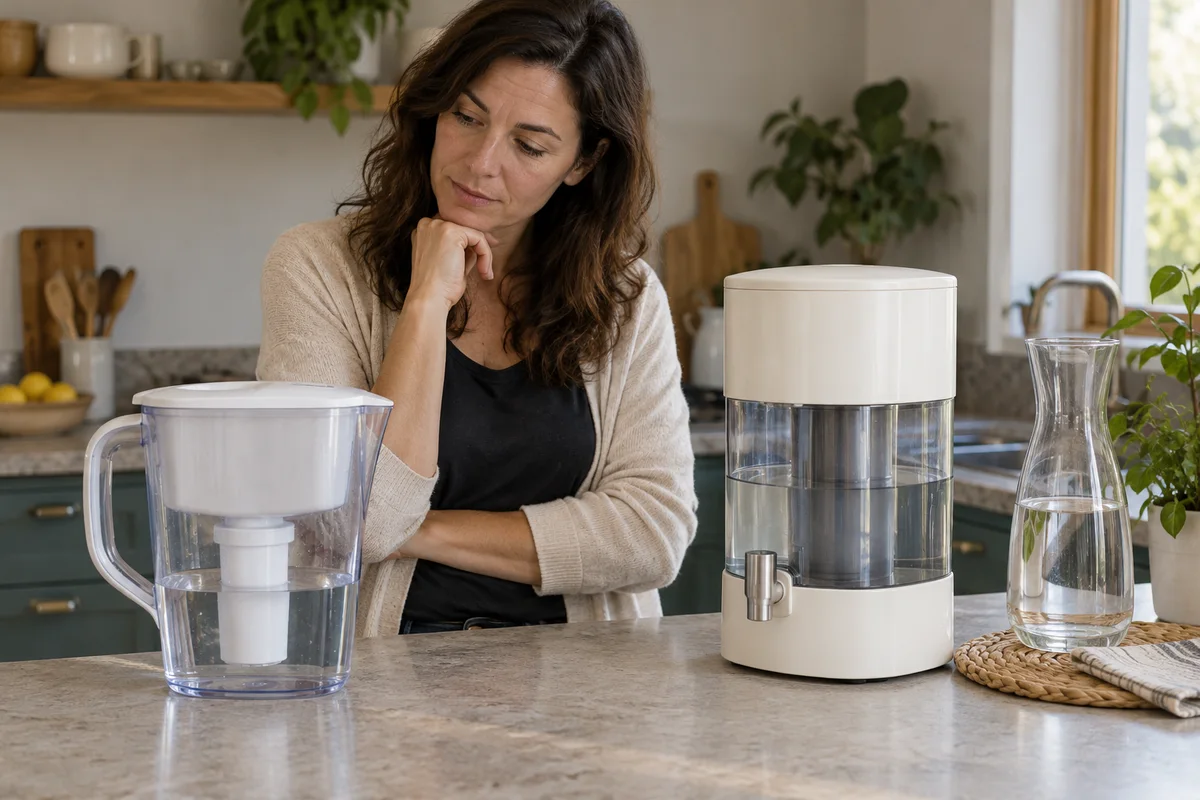
AI-generated scene illustration; not a photograph of the recommended product.
A small kitchen already has a filter pitcher in the refrigerator. An M6SL countertop system looks like an upgrade, but it would occupy counter space and add an electrical appliance to the routine. More filtration stages are not enough to settle whether that change is worthwhile.
Compare the treatment requirement and the ownership process separately. A household can prefer a simpler pitcher for a verified ordinary need, while another can justify a supported countertop RO system without claiming that every household requires one.
The short answer
Choose the category around a defined water question and an exact supported reduction claim, then compare the daily work. M6SL is an electrically powered countertop RO system with a detachable vessel and mineralization. A gravity filter pitcher is a different system, not simply a smaller version of M6SL.
M6SL may suit a household that has verified the treatment match and accepts its counter, refill, concentrate-water and replacement routine. A suitable pitcher may be more proportionate when it addresses the confirmed need with less equipment. Neither category is a universal response to unsafe or unknown water.
Contents
- The short answer
- The treatment gate
- The practical comparison
- Electricity and space
- Water handling
- Minerals and taste
- Replacement and upkeep
- A one-week routine map
- Buying advice
- Frequently asked questions
- Sources and verification
The treatment gate
Name the concern before comparing products. Taste preference, a documented substance and an active public advisory are different starting points. Do not infer the answer from the clearness of a glass or a low reading on a display.
Use the exact system and cartridge documentation. Brita’s performance-data entry illustrates why a brand name is not one universal reduction claim: the applicable product and filter must be identified.
Our water evidence card covers reports, testing and specific claims. This article assumes that gate is addressed and examines the different household routine the purchase creates.
Where a water authority has issued instructions, follow them. Do not use either a pitcher or an RO marketing description as permission to disregard an advisory or necessary qualified testing.
The practical comparison
| Household requirement | Gravity filter pitcher | M6SL countertop RO |
|---|---|---|
| Power | Gravity operation for the selected pitcher | Electricity required |
| Location | Suitable fill and storage space | Suitable powered counter location |
| Water handling | Fill the supported reservoir | Follow source and concentrate-water routine |
| Replacement | Exact compatible pitcher cartridge | Exact supported system filter |
| Serving | Selected vessel and household refill pattern | Supported detachable-vessel workflow |
The pitcher column describes the category represented by Brita’s current pitcher range, not every filter sold under its brand. Powered pitchers, faucet products and bottle filters should not be silently included.
The M6SL column follows Waterdrop’s exact model page. No comparative contaminant test or taste trial was performed for this article.
Electricity and space
A gravity pitcher can be useful when avoiding another powered countertop device is a genuine priority. Check the actual vessel size, storage position and ability to fill and lift it comfortably.
M6SL needs a suitable operating location and electrical supply. Its installation-free format does not remove clearance, care and water-handling requirements. Confirm the exact instructions rather than placing it wherever a photograph looks attractive.
Include the complete working area, not merely the machine’s rectangle. A fill route, serving vessel, source-water container and access for maintenance can matter in a crowded kitchen.
Do not put the powered system in the refrigerator or assume that its detachable pitcher gives it a chiller. The cold-water routine covers that separate arrangement. A fridge shelf and an appliance function are different purchase decisions.
Water handling
A pitcher owner may be accustomed to topping up a reservoir and waiting. Countertop RO adds another process: handling feed water and the water rejected during treatment according to the exact instructions.
That work can be acceptable, but it should be visible in the comparison. Ask who fills the system, where the relevant containers go and how the household avoids confusing unfinished and ready-to-serve steps.
Do not interpret the advertised pure-to-drain ratio as no waste or unlimited yield from a particular fill. Our ratio guide explains its accounting. This page does not assign a new measured water-saving result.
Compare a normal evening rather than a staged party. The useful question is whether someone will reliably perform the routine when the sink is busy and another person needs water for the next morning.
Minerals and taste
M6SL adds a mineralization stage. It should not be described as producing distilled water or as guaranteeing the same taste for every source and user.
A gravity pitcher also needs its exact cartridge considered. Do not assume all pitchers preserve or reduce the same substances in the same way, or that a generic cartridge recreates a branded system’s documented performance.
Treat taste as a preference that may need an appropriate permitted evaluation. A long stage count is not a taste score. Neither a preference statement nor a remineralization claim establishes a medical benefit.
For another appliance such as an espresso machine, check that appliance’s own water requirements. Buying drinking-water treatment does not automatically qualify the output for every other household device.
Replacement and upkeep
Compare the exact replacement parts, availability and instructions for both selected products. A calendar subscription is a delivery arrangement, not a water-quality test or proof that every cartridge lasts to a particular date.
Keep replacement timing linked to the actual manufacturer’s conditions and use. Do not convert the largest advertised life into a guaranteed household interval or a price-per-gallon calculation without verified inputs.
Use the M6SL ownership worksheet to list recurring obligations. For the pitcher, use the corresponding exact cartridge instructions rather than copying a schedule from another Brita model.
Include cleaning and storage as ordinary work. A cheaper starting price can still be unsuitable if the household will not maintain the product; a more expensive system can also add effort without addressing a new requirement.
A one-week routine map
Before buying, record when the household fills, serves, chills and cleans drinking-water equipment during an ordinary week. Use the existing routine as an observation, not a test of a product you do not own.
Mark the moments that fail: an empty vessel at breakfast, unavailable fridge space or too many separate refills. Then ask which candidate actually changes that failure and what extra task it introduces.
For M6SL, include operating-location and concentrate-water handling. For the pitcher, include capacity, waiting and cartridge access. Do not assume a new appliance increases the household’s willingness to do upkeep.
The map may show that the existing suitable pitcher needs a clearer refill responsibility rather than replacement. It may also reveal a genuine reason to investigate countertop RO. Both are legitimate purchasing outcomes.
Buying advice
Shortlist M6SL when the verified treatment requirement and its complete routine fit the household. Shortlist an appropriate gravity pitcher when its exact supported claims meet the need and fewer powered components are preferable.
Pass on a comparison justified only by stage counts, a generalized purity claim or an unverified cost saving. This article does not establish today’s prices, stock, taste preference or a household-specific treatment outcome.
The partner CTA is for M6SL, not a Brita pitcher or every RO model. Confirm the actual seller, included vessel and filter, availability, delivery and returns before ordering. More equipment should earn its place through a real requirement.
Frequently asked questions
Automatic upgrade?
No. A more complex treatment category is useful only when its supported capabilities and routine match the actual need.
All Brita filters alike?
No. Identify the exact system and cartridge and read the corresponding performance information.
Distilled output?
M6SL is a mineralized RO drinking-water system, not a distilled-water source.
Advisory replacement?
No. Follow the relevant authority’s instructions rather than treating either shopping category as universal emergency treatment.
Sources and verification
Checked November 2, 2026. Category and ownership comparison only. The older Brita PDF URL redirected to support, so no unverified cartridge interval or old PDF claim is reproduced here.
- Waterdrop M6SL exact-model information
- Brita current pitcher range
- Brita current performance-data entry
Keep reading
Related guides
 Kitchen
M6SL Aquarium Water Limits
Separate M6SL mineralized drinking water from an aquarium’s verified source-water plan before buying countertop RO for fishkeeping tasks.
Read guide → Kitchen
M6SL Espresso Water
Qualify M6SL finished water against your espresso machine's instructions before treating mineralized RO as a universal coffee-water solution.
Read guide → Kitchen
M6SL Houseplant Water
Separate houseplant species, drainage and water-source concerns before choosing M6SL mineralized RO for a household watering routine.
Read guide →