
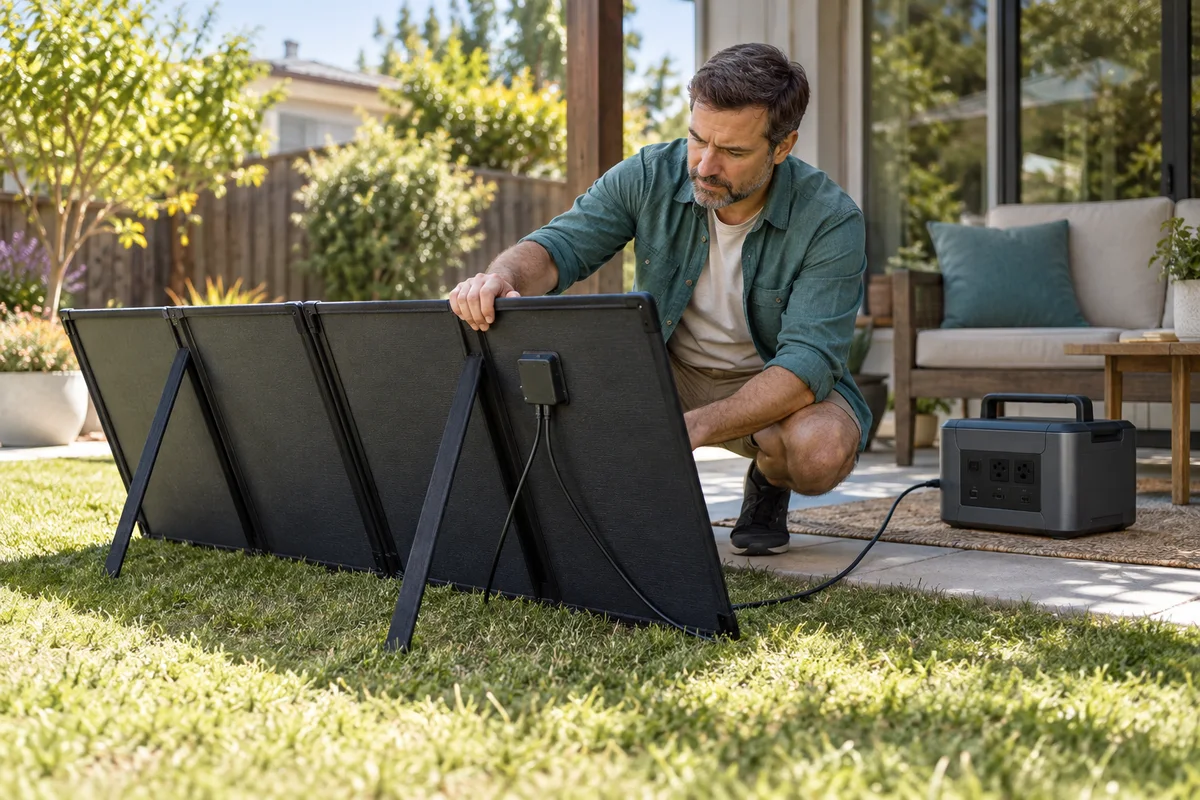
AI-generated scene illustration; not a photograph of the recommended product.
A portable power station arrives before a forecasted bad-weather weekend, but the panel you already own does not necessarily match its input. The listing’s large solar-watt figure is easy to compare. Voltage, current, cable details and the place where the panel will actually stand require more work.
For an Elite 100 V2 purchase, perform that work before choosing the biggest panel package. October 13’s home-preparedness focus is a useful reminder that equipment becomes a system only when its connections, energy source and operating conditions are understood.
The short answer
BLUETTI’s current US manual specifies a 12–60V DC input range, 20A maximum and 1,000W maximum for the Elite 100 V2. Its third-party panel FAQ refers to open-circuit voltage and MC4 connectors. Check every required electrical parameter and the exact cable arrangement, not wattage alone.
Confirm cold-condition voltage with the panel manufacturer or a qualified supplier, and never exceed the station’s permitted input. Also check charging temperature and delivery timing. A theoretically suitable panel that is shaded, unavailable or missing its cable does not meet an immediate recharge need.
Contents
- Start with your recharge task
- Collect the panel and station specifications
- Do not improvise an array
- Assess the real placement
- Check temperature and delivery
- Use a procurement card
- Frequently asked questions
- Sources and verification
Start with your recharge task
Decide what must be replenished, how often, and during which hours. A weekend camping routine with time to reposition a panel is different from an apartment outage where the only available light reaches a balcony briefly.
List the noncritical equipment you intend to support and its observed energy use. Do not begin by assuming that solar input will replace a full battery every day. A large input ceiling is a station capability, not a forecast of your available sunlight.
If your main need is short-duration backup between reliable wall-charging opportunities, buying panels immediately may add more cost and storage than value. If off-grid replenishment is genuinely important, the panel arrangement needs its own feasibility check rather than being treated as an automatic accessory.
Collect the panel and station specifications
Record exact model names for both devices and the regional station version. Obtain the current documents directly from the manufacturers. Keep open-circuit voltage, operating voltage, current information, power rating, connector type and cable details as separate fields.
The Elite 100 V2 manual is the source for the input limits given above. A panel’s headline watt rating does not answer whether its voltage is permitted. Neither does a familiar connector establish that the complete connection, polarity and cable are suitable.
Ask the supplier for compatibility confirmation that identifies the actual panel and arrangement. “Works with power stations” is too broad. A response referring only to a different BLUETTI model is not enough.
For cold-season use, ask how the panel’s voltage is evaluated at the intended conditions and whether the resulting maximum remains inside the station limit. Do not guess from the panel’s room-condition number or treat the input ceiling as a target that must be reached.
Do not improvise an array
Multiple panels introduce additional electrical questions. Do not assume that combining individually acceptable panels creates an acceptable arrangement. Ask for a manufacturer-supported configuration that remains within every limit.
The manual cautions against mixing panel types. More broadly, avoid using adapters as proof of compatibility. An adapter can physically join components without establishing that their electrical characteristics are appropriate.
This article is a purchasing checklist, not a series-or-parallel wiring tutorial. If a proposed array needs calculations or installation decisions you cannot verify confidently, obtain qualified help. The consequence of an incorrect input is more serious than a disappointing charging estimate.
Keep the supplier’s confirmed arrangement with the equipment records. If you later add another panel, repeat the assessment instead of treating the original answer as permission for unlimited expansion.
Assess the real placement
Observe the available site at several ordinary daylight times. Note shadows from buildings, railings, trees and furniture. Do not assume a panel receives an unobstructed day merely because a sales photograph shows it on open grass.
Confirm permission to use the site and keep walkways clear. A portable arrangement that blocks access, creates a trip hazard or requires an unsecured placement is not a workable household solution. Consider how it will be moved when conditions change.
Keep the station in its approved dry, ventilated environment. A panel’s outdoor suitability does not transfer automatically to the power station. Cable length, routing and protection must be appropriate to the supported setup, not improvised around an attractive photo location.
Use observed input from safe ordinary operation, once correctly configured, as planning information. Do not convert one bright afternoon into a year-round daily charging promise. Weather, placement and the station’s charging behavior can change.
Check temperature and delivery
The linked US manual lists a charging range of 0–40°C. That is separate from its discharge range. Being able to use a battery in a cold condition does not automatically mean it may be charged there.
Read all applicable conditions for your version. Do not deliberately expose the station to an unsuitable environment to obtain a better panel angle. If the arrangement requires frequent temperature-related relocation, include that work in your buying decision.
Check when every component will arrive. On the official page checked October 13, some bundle descriptions indicated later delivery for panels or solar cables than for the station. These notes apply to that seller’s described packages, not a promise about the partner listing.
Ask the actual seller whether the exact bundle includes the required cable and whether items ship separately. A product sold as a solar package can still leave you waiting for the component needed to use solar charging.
Use a procurement card
Create one card with these fields: station model and region, panel model, confirmed electrical limits, approved cable and polarity, supported arrangement, planned location, charging conditions, included items, delivery dates and support contact.
Put “not confirmed” beside unanswered fields. That is more useful than filling them with assumptions from another buyer’s setup. Do not place the order until every safety-critical field has a trustworthy answer.
The Elite 100 V2 can fit a buyer seeking a portable reserve with a compatible recharge arrangement and a realistic location. Pass if you need guaranteed daily replenishment from an unverified shaded site, or if the only appeal is the largest stated solar input.
Compare a smaller supported panel, wall charging where available, or a different professionally specified system with the same task. The preferred option is the one whose complete routine works, not necessarily the one with the highest possible watt number.
Our router-and-laptop energy worksheet addresses the load side of the plan. Use it alongside this input checklist, then check the current partner listing for the exact station package.
Frequently asked questions
Does a 1,000W input rating mean any 1,000W panel arrangement is safe?
No. Voltage, current, connectors, cable and the complete configuration must also meet the current specifications.
Can I infer compatibility because a connector fits?
No. Physical fit does not establish electrical suitability or polarity. Obtain exact-model confirmation.
Does a solar bundle guarantee every item ships together?
No. Check the seller’s current itemized contents and shipping notes before relying on a delivery deadline.
Sources and verification
Checked October 13, 2026. No solar input, cold-condition or charging-speed test was performed by WideLore.
- BLUETTI Elite 100 V2 official product and bundle notes
- Elite 100 V2 US manual, specifications and third-party panel FAQ
Keep reading
Related guides
 Power & Outdoors
Can You Fly With an AC180? Check Watt-Hours First
Compare the AC180's 1,152Wh battery with current U.S. passenger-baggage limits before buying portable power for a trip involving flights.
Read guide → Power & Outdoors
Can an AC180 Run a Space Heater? Do the Energy Math
Separate AC180 output power from stored energy and build a cold-weather outage plan that does not rely on battery room heating.
Read guide → Power & Outdoors
Elite 100 V2 ECO Mode: Check Small-Load Shutdown
Check Elite 100 V2 ECO behavior under low or intermittent demand before relying on small lights, chargers, or networking devices.
Read guide →