
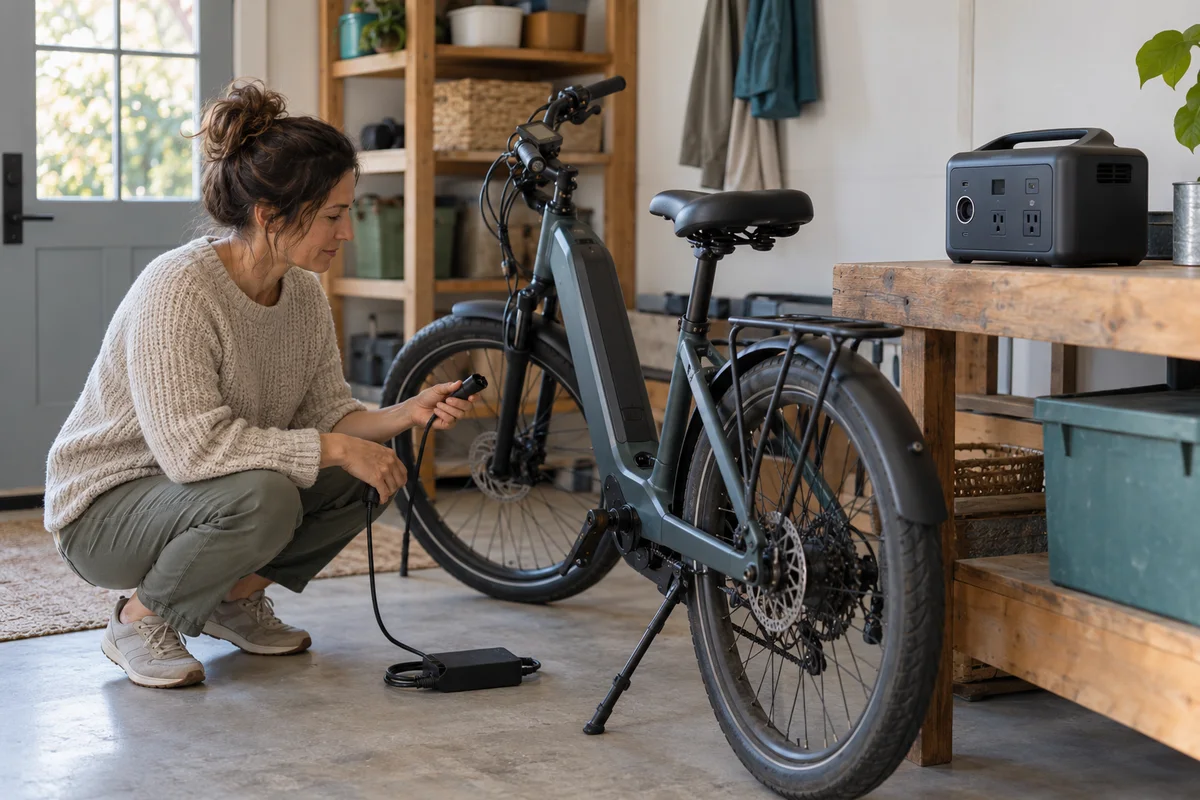
AI-generated scene illustration; not a photograph of the recommended product.
An e-bike commuter wants a reserve for recharging after a short household outage. The AC180 has enough impressive-looking output on the product page, but the bicycle battery has a completely different voltage printed on its label.
The missing link is the approved charger. A portable station can be considered as an AC supply for a qualified charging arrangement; it should not become an excuse to improvise a direct connection to an expensive lithium battery.
The short answer
Keep the original or manufacturer-approved e-bike charger in the chain. Qualify its AC-input requirements against AC180’s supported regional output and obtain exact-equipment guidance where needed. Do not connect the station’s 12V socket or USB-C port directly to a bike battery using an improvised adapter.
Plan charging only with an undamaged supported battery, an appropriate dry location and supervision. An electrical rating does not certify this station-and-bike combination, a full recharge count or an unattended overnight routine.
Contents
- The short answer
- The approved chain
- Input versus battery voltage
- The energy budget
- Location and supervision
- Condition and handling
- The commute plan
- The purchase worksheet
- Buying advice
- Frequently asked questions
- Sources and verification
The approved chain
Write the proposed arrangement as AC180, approved charger and exact bicycle battery. Each item has a separate role. The station supplies power; the charger manages the intended battery-charging process.
Bosch’s battery-safety guidance directs users to compatible chargers, checks for battery damage and supervised charging in an appropriate environment. Its instructions apply to the relevant Bosch equipment, not every bicycle under another brand.
For another e-bike, obtain that manufacturer’s current charger and battery instructions. A charger advertised as universal is not automatically an acceptable substitute because the connector fits.
Keep uncertainty visible. This guide has not connected AC180 to a bicycle, measured charging behavior or established approval from either manufacturer for a particular pair.
Input versus battery voltage
The battery’s voltage is not the charger’s AC-input voltage. Read the actual charger input label and instructions rather than trying to match the battery number to a station socket.
The current US AC180 specifications list 120V AC output and 1,800W total rated AC output. Confirm the exact regional station, charger frequency and operating requirements; do not transfer those US figures to a differently rated product.
Also distinguish charger input demand from its DC output to the battery. A battery-side watt figure is not a complete measurement of energy drawn from the station.
Do not use a lifting or boost mode to compensate for an incompatible charger. An unresolved input requirement is a reason to stop and obtain clarification, not a reason to try different power settings until something lights up.
The energy budget
A bicycle battery’s watt-hour label describes battery energy, not the exact wall energy required for the next top-up. Starting charge, charger behavior, losses and stopping conditions affect the charging session.
AC180’s 1,152Wh nameplate is also not a promise that all that energy reaches the bicycle. The station consumes energy and converts it before the approved charger performs another conversion.
For an existing supported arrangement, use an appropriate representative energy record or manufacturer guidance to estimate the session. Record whether the task is a small top-up or a near-empty recharge instead of treating every charging event as identical.
Do not divide 1,152Wh by a bike-battery label and publish the result as a guaranteed number of full charges. That calculation omits too much of the actual chain. Reserve energy for the household’s other agreed tasks.
Location and supervision
Bosch’s current page describes charging under supervision in a dry, ventilated environment, away from heat and flammable materials. Follow the exact battery and charger instructions, including their temperature requirements.
The station has its own environment and ventilation requirements. A location must suit all three components simultaneously. A damp porch, crowded cupboard or blocked household route is not made suitable by the station’s portability.
A winter garage can be a poor choice even when it is convenient. Check the charging conditions of the bike battery, charger and station separately; being able to discharge a station in colder conditions does not establish that another battery may be charged there.
Do not plan to leave the arrangement running while everyone sleeps or leaves home. If appropriate supervision and space are unavailable, a different charging time or a legitimate alternative arrangement may be preferable to buying a larger station.
Condition and handling
Inspect the battery and charger according to their maker’s guidance before a normal session. Damage, unusual behavior or a relevant manufacturer safety instruction needs appropriate support, not an alternative power source.
Do not open battery housings, bypass management electronics, modify leads or repair damaged charging components from a shopping guide. A portable station cannot make a damaged battery fit for use.
Follow the e-bike’s instructions for whether its battery remains installed or may be removed for charging. This page does not provide a universal removal procedure or prescribe a floor, shelf or carrier for every battery.
Keep the stationary arrangement clear of movement. Do not roll the bicycle across connected leads or move the station while operating. Consider the way the charger reaches the battery without stretching, pinching or creating a trip hazard.
The commute plan
Define what the top-up must accomplish without converting it into an invented distance estimate. Riding conditions, assistance level, battery state and the actual bicycle affect range.
A useful plan records the next trip, the amount of charging opportunity available and an acceptable alternative if charging cannot be completed. The battery reserve should not be the only way the household can avoid a rushed departure.
Separate recharging the bicycle from recharging AC180. A station that has already supplied household appliances may not retain the assumed reserve. Check readiness before a real need, not only when the bike is nearly empty.
Our AC180 charging-mode guide covers replenishing the station itself. That procedure is different from supplying the bicycle’s approved charger.
The purchase worksheet
Record exact bike battery and charger models, approved charger source, regional AC requirements, supported station output, intended session, representative energy evidence, safe location and supervision.
Add competing household loads and the station’s own recharge route. The list should reveal whether AC180 is solving a limited reserve requirement or being asked to replace an indefinitely available electrical supply.
If the approved charger arrangement remains unconfirmed, postpone the purchase for this use. Do not order adapters in the hope that physical compatibility will answer an electrical and battery-management question.
The AC180 overview covers broader backup tradeoffs. This article adds the e-bike charging chain and household routine, not a charger recommendation or a battery-repair procedure.
Buying advice
Consider AC180 only after the exact approved charger, supported supply arrangement and practical supervised session are established. A defined top-up task can be a sensible reason to investigate portable reserve.
Pass when the plan depends on a universal charger, direct improvised DC connection, unattended charging or a guaranteed number of recharges inferred from labels. A suitable ordinary mains-charging routine may already be the simpler choice.
The partner CTA is for AC180 hardware, not an e-bike, charger or certified charging package. Confirm current seller stock, contents, returns and manufacturer answers before checkout. No commute range or actual recharge performance is promised.
Frequently asked questions
Direct 12V connection?
Do not improvise one. Preserve the exact manufacturer-approved charging chain.
Full-charge count?
Nameplate division is not a verified recharge count. Both conversions, starting charge and actual conditions matter.
Overnight charging?
Do not use this article to justify unattended charging. Follow the battery and charger makers’ supervision requirements.
Any charger?
No. Connector fit and a similar voltage label do not establish approval for the battery.
Sources and verification
Checked November 2, 2026. Manufacturer safety and published-output analysis only; no bike, charging session or equipment combination tested.
Keep reading
Related guides
 Power & Outdoors
AC180 vs Elite 100 V2
Compare AC180 and Elite 100 V2 through stored energy, solar-input limits, USB-C needs and household ownership before choosing a backup station.
Read guide → Power & Outdoors
Elite 100 V2 Garage-Door Backup
Compare Elite 100 V2 with a garage opener’s supported battery-backup path before treating portable AC power as a complete access solution.
Read guide → Power & Outdoors
AC180 Slow-Cooker Backup
Separate slow-cooker electrical compatibility, interruption history and food handling before choosing AC180 for a household dinner backup plan.
Read guide →