
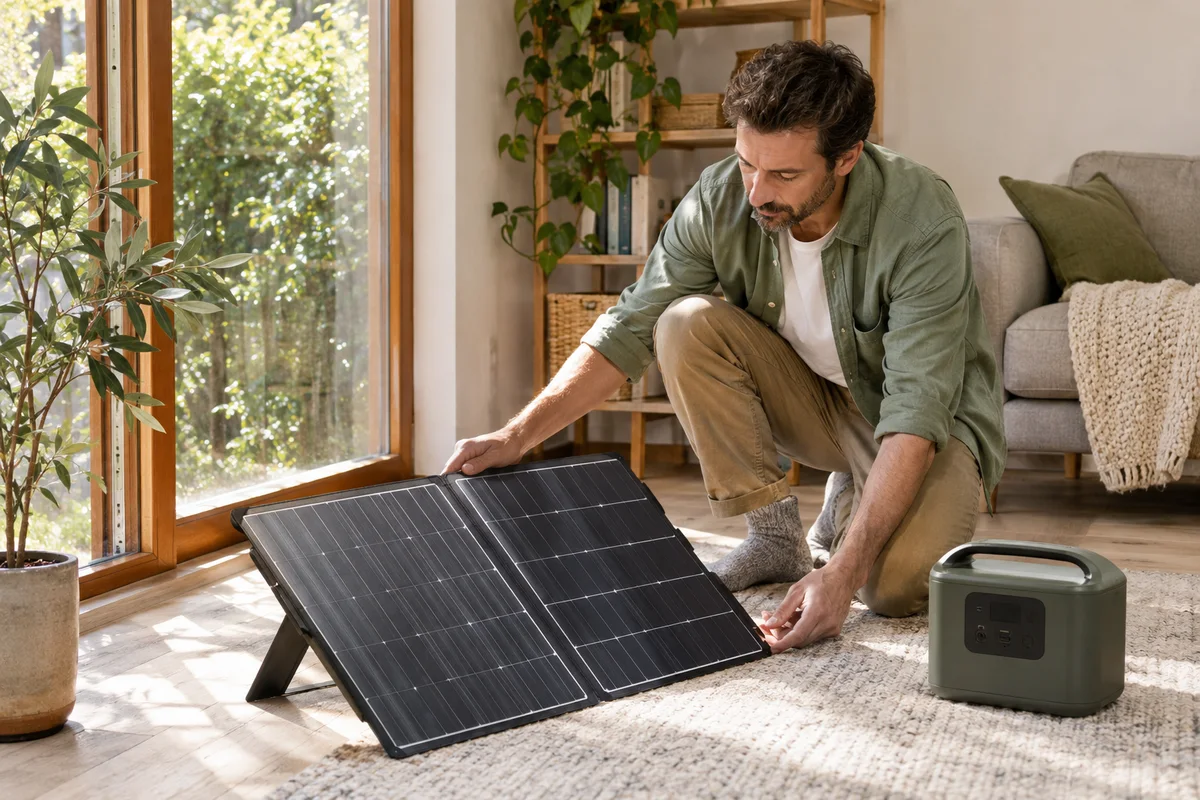
AI-generated scene illustration; not a photograph of the recommended product.
An apartment has a bright south-facing window but no suitable outdoor panel space. A folding solar bundle looks like an easy route to recharging an AC180 during an outage. The important question is not simply whether the room looks sunny. It is whether a permitted, compatible arrangement can deliver useful energy during the time it is available.
The short answer
A photovoltaic panel can generate through glass when light reaches it, but BLUETTI’s solar explanation says window coatings, multiple panes, tint, angle and other conditions can reduce output. Do not budget the panel’s rated watts as though it were in unobstructed outdoor sun.
Check the exact AC180 input limits and the selected panel’s specifications separately from the window question. A small input reading does not prove a reliable recharge plan. Compare actual supported conditions with your task before paying for a panel bundle.
Contents
- The short answer
- Separate brightness from electricity
- Confirm compatibility before measuring anything
- Choose a permitted location
- Make an input record rather than a promise
- Compare the panel bundle with the actual job
- Buying advice
- Frequently asked questions
- Sources and verification
Separate brightness from electricity
A bright room tells you something about visible light in that room. It does not directly measure electrical output at the station. The panel’s orientation, the portion receiving useful sunlight and the glass between it and the sun can all matter.
The manufacturer’s solar explanation addresses generation through windows. Its statement that generation is possible is not a household-specific yield guarantee or permission to ignore the panel’s deployment instructions.
For example, a window may admit direct light for only part of an afternoon. A panel placed to avoid furniture may receive a different pattern than the floor beside it. Describe the actual location and time rather than transferring a photograph of a panel in open sunlight to your room.
Confirm compatibility before measuring anything
The AC180 manual gives model-specific solar-input requirements. Read the applicable regional instructions and compare the intended panel and supported cable with them. A wattage headline alone is not a compatibility specification.
Do not connect an uncertain array to see whether the station accepts it. Obtain appropriate manufacturer confirmation for voltage, current, connectors and the exact arrangement. Avoid improvised adapters, unapproved wiring changes or assumptions drawn from a different power station.
The window reduces neither the need for electrical compatibility nor the importance of environmental limits. Lower observed output is not a protective substitute for checking the source specifications. A panel can be a poor energy match even when a connector physically fits.
Choose a permitted location
Keep the AC180 dry, stable, ventilated and accessible under its instructions. Do not put it in an enclosed sun-heated space to keep it close to a panel. A panel and a battery need not have identical environmental allowances.
Check the panel’s own instructions before choosing indoor placement. Leave walkways, doors and normal household access clear. Do not hang an unsecured panel outside a window, block an exit or pinch a cable through a closing frame to obtain more sunlight.
If the only workable route creates a handling or installation concern, stop the plan and seek a suitable alternative. A rental permission question and an electrical compatibility question are separate. The station’s portability does not supply approval for modifications to the building.
Make an input record rather than a promise
For an explicitly compatible, permitted setup, observe ordinary input using the supported equipment and controls. Record the time, weather, placement and whether the connected load is also drawing energy. Do not turn one momentary number into an all-day forecast.
| Record | Why it changes the decision |
|---|---|
| Window | Tint, coating, panes and usable sunlight |
| Panel | Exact model and permitted deployment |
| Electrical match | Confirmed station input and supported connection |
| Observation | Actual time and ordinary displayed input |
| Demand | What must be replenished for the real task |
| Fallback | A supported recharge route when sunlight is insufficient |
If output varies, that observation is more useful than inventing a fixed loss percentage. We have not measured your glazing or panel. Do not apply a universal indoor-solar efficiency number to a location we have not assessed.
Where an energy estimate is needed, label its assumptions and distinguish watts at a moment from watt-hours accumulated over time. A brief peak does not establish how much energy will be stored after conversion and charging conditions over a longer period.
Compare the panel bundle with the actual job
A household needing occasional small local tasks may value modest supplemental input. A household depending on a narrow daily recharge window needs a much stronger evidence basis. The same panel can be attractive in one situation and inadequate in another.
Our AC180 and Elite 100 V2 comparison compares rated features, not a guaranteed window harvest. A higher station input ceiling does not make the sunlight passing through the glass stronger. Buying a bigger accepting port is not the same as supplying it with more usable energy.
Consider whether ordinary supported wall charging before an event, reducing noncritical loads or charging at an appropriate alternative location better serves the task. Do not use this article to plan unsupported critical equipment or treat an uncertain solar arrangement as a life-safety reserve.
Buying advice
Consider an AC180 solar bundle when the exact panel, cable and placement are supported and the expected recharge role is proportionate to evidence from the real location. Confirm which items the selected seller actually includes. A panel pictured beside the station is not proof of every bundle’s contents.
Read our AC180 buying guide for the broader station decision. Skip the panel addition when the purchase depends on full rated output through glass, a guaranteed daily refill or an unsafe cable route. Keeping a suitable station-only setup can be more practical than storing a panel that cannot do its intended job.
We have not connected a panel, measured indoor production or compared products under controlled conditions. This guide helps identify the evidence a buyer needs, rather than supplying a fictional recharge result.
Frequently asked questions
Can a panel generate behind glass?
It can if suitable light reaches it, but the manufacturer’s explanation warns that output can be reduced. Useful recharge is a separate assessment.
Does 500 watts of accepted input mean 500 watts through my window?
No. An input limit is not a promise of available solar generation.
Can I test an unknown panel because the displayed watts might be low?
No. Establish electrical compatibility and permitted deployment before connection.
Have you calculated a guaranteed recharge time?
No. That requires appropriate evidence about the actual compatible equipment, location, conditions and energy demand.
Sources and verification
Checked November 19, 2026. Manufacturer solar explanation and AC180 requirements reviewed; no production or recharge test was performed.
- BLUETTI solar explanation, including generation through glass
- BLUETTI AC180 manual, solar-input and safety requirements
Keep reading
Related guides
 Power & Outdoors
AC180 Delivery Damage: Document Before Powering On
Prepare a safe support and return plan for an AC180 delivery with suspected damage; a return label alone does not settle lithium-battery transport.
Read guide → Power & Outdoors
Used AC180: Charge Percentage Is Not Battery Health
Assess a used BLUETTI AC180 through condition, documented ownership and support rather than treating a full battery icon as proof of remaining capacity.
Read guide → Power & Outdoors
AC180 App Control: Nearby Is Not Away From Home
Understand the AC180's documented Bluetooth app connection before buying a portable power station for away-from-home monitoring or control.
Read guide →