
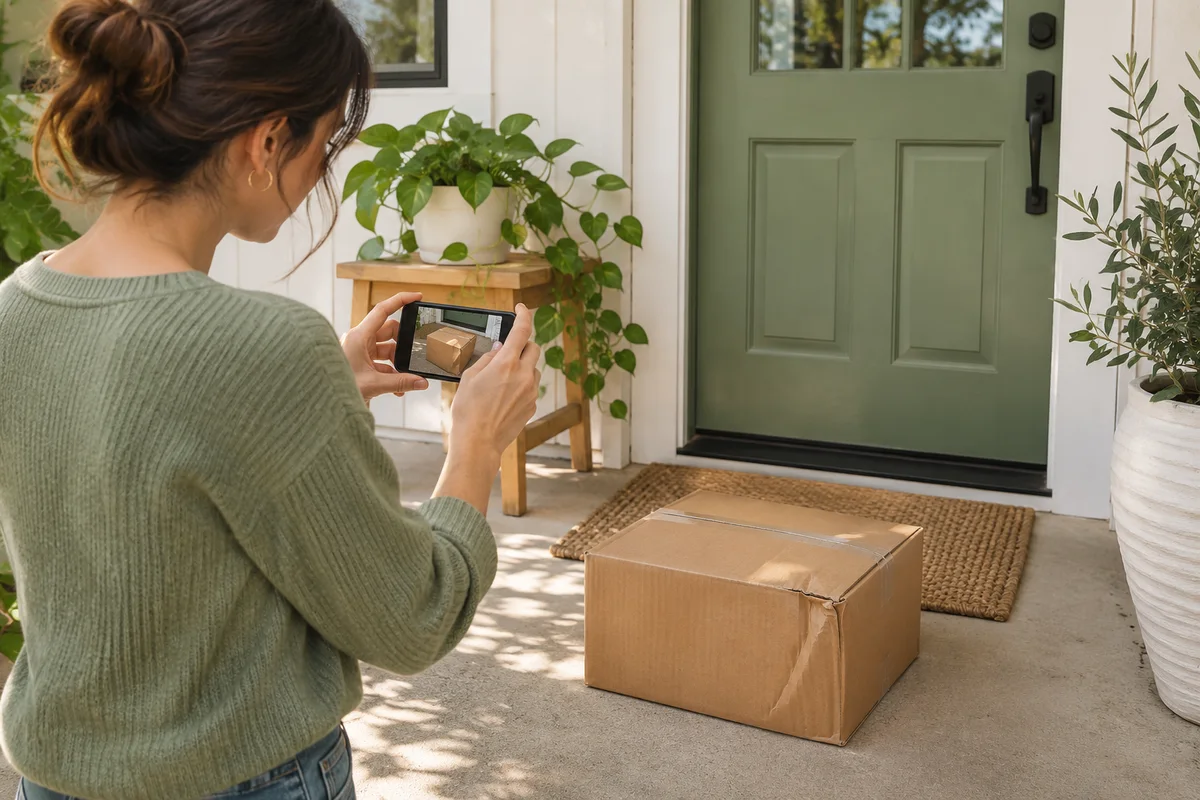
AI-generated scene illustration; not a photograph of the recommended product.
A portable power station arrives before a planned family visit, but one corner of the carton is badly crushed. The household wants to plug it in immediately to see whether it works. The better first decision is to separate delivery documentation, product condition and a supported next step before introducing charging or a connected appliance.
The short answer
If an AC180 delivery raises a concern about product or battery damage, do not power or charge it merely to prove it works. Follow the manufacturer’s safety guidance, document accessible information without unsafe handling and contact the actual seller or BLUETTI through the appropriate channel.
A damaged outer carton does not by itself diagnose a damaged battery, but an uneventful power-on does not certify safety either. If return or transport is needed, obtain instructions appropriate to the actual condition. Do not assume an ordinary return label resolves every lithium-battery shipping requirement.
Contents
- The short answer
- Distinguish the observations
- Keep safety ahead of the delivery deadline
- Document only what is safe and relevant
- Confirm the actual provider and terms
- Do not improvise lithium-battery transport
- Buying advice
- Frequently asked questions
- Sources and verification
Distinguish the observations
Record what is actually visible: the carton condition, any accessible product condition and the relevant delivery information. Do not describe a damaged box as a confirmed internal battery failure unless qualified assessment establishes that.
Conversely, do not use an intact-looking exterior as a guarantee that the whole delivery is sound. The purpose of the record is to give the appropriate provider a factual starting point, not to create a consumer-issued condition certificate.
Avoid opening the housing or performing electrical tests. The AC180 manual is the model-specific operating and safety starting point. This article does not provide an incident-response or battery-handling procedure.
Keep safety ahead of the delivery deadline
Do not let a planned outage, trip or gathering turn suspected damage into a rushed acceptance test. An order arriving on time is not the same as having suitable equipment ready for use. An alternative ordinary plan may be needed while support assesses the situation.
If there is an immediate hazard, such as smoke or another concerning active condition, keep people away and use appropriate emergency assistance. Do not approach for photographs, carry the unit through the home or put it into a vehicle to continue a shopping claim.
For a non-emergency concern, follow manufacturer direction about what information can be collected and what handling is appropriate. Do not charge, discharge or connect a load simply to produce a video for a seller. Resolve any unsafe request with the appropriate support provider instead.
Document only what is safe and relevant
Where safely accessible, keep the order record, delivery date, photographs of the packaging and a concise description of the concern. Use the actual seller’s private support channel for purchase and identifying details rather than posting them publicly.
| Record | Keep the description factual |
|---|---|
| Order | Exact model, seller and selected package |
| Arrival | Delivery date and visible carton condition |
| Product | Only safely observed condition |
| Operation | Whether it has remained unused |
| Support | Case number and instructions received |
| Resolution | Applicable assessment, replacement or return route |
Do not erase packaging evidence before the provider explains what is needed, but do not treat retaining a carton as permission to store a potentially hazardous item in it. Safety instructions take priority over a generic request to keep original packaging.
Keep a copy of the response. If different departments give conflicting instructions, ask for a clarified condition-specific route rather than choosing whichever instruction gets the return started fastest.
Confirm the actual provider and terms
The BLUETTI warranty and return policy describes its own conditions. A partner seller’s order can have separate return and service procedures. Identify who is responsible for the transaction rather than assuming every listing uses the manufacturer’s direct-store process.
Ask whether the concern requires an inspection, a replacement assessment or another supported resolution, and who will arrange it. Do not assume a fixed deadline or free shipping from a general brand statement. Confirm the terms that actually govern the selected purchase.
Our AC180 order-check guide addresses the earlier shopping stage: exact package, seller and timing. This guide starts after arrival, when the condition and handling route matter more than a sale headline.
Do not improvise lithium-battery transport
PHMSA publishes a consumer lithium-battery safety advisory that distinguishes used, damaged, defective and recalled batteries. Its relevance is that condition matters to handling and disposal; it is not a ready-made shipping authorization for this station.
Tell the responsible provider about the suspected condition before accepting a return route. Ask for instructions that account for a lithium-battery-containing product in that condition and the applicable carrier requirements. Do not privately decide that a generic label makes the package acceptable.
Do not mail, dismantle, put in household waste or take a suspect unit on a personal journey as an improvised solution. This article is not dangerous-goods shipping training and does not replace manufacturer, carrier or qualified professional guidance.
Buying advice
Before ordering an AC180, compare not only the selected package but the clarity of the seller’s damage-reporting and resolution process. A low price has less value if the household cannot identify who will handle an arrival problem. Keep the AC180 buying guide alongside the actual order terms.
After a suspect delivery, do not buy another station solely because a brief unsafe test seemed inconclusive. First pursue the appropriate assessment for the original transaction. If a suitable replacement is authorized, confirm its identity and condition rather than assuming any similar model is equivalent.
We have not inspected a damaged station or determined whether a particular carton caused product damage. The useful outcome is a documented, supported decision that does not make a shopping deadline more important than safe handling.
Frequently asked questions
Does a crushed carton prove the battery is damaged?
No. Document the observation without inventing an internal diagnosis, and obtain appropriate guidance.
Can I plug it in just to check?
Not as a way to clear suspected damage. Follow the manufacturer’s condition-specific safety instructions before operation or charging.
Is a normal return label enough?
Do not assume so. The provider and carrier need the relevant condition information and an appropriate transport arrangement.
Does this article tell me how to package a damaged battery?
No. Obtain the required condition-specific instructions from the responsible qualified parties.
Sources and verification
Checked November 19, 2026. Manufacturer and transport-authority material reviewed; no damaged product was handled or assessed.
- BLUETTI AC180 manual
- BLUETTI warranty and return policy
- PHMSA consumer lithium-battery safety advisory
Keep reading
Related guides
 Power & Outdoors
Used AC180: Charge Percentage Is Not Battery Health
Assess a used BLUETTI AC180 through condition, documented ownership and support rather than treating a full battery icon as proof of remaining capacity.
Read guide → Power & Outdoors
AC180 Solar Through a Window: Budget Actual Input
Check the real sunlight, safe placement and compatible input before buying an AC180 solar bundle for a panel that will sit behind a window.
Read guide → Power & Outdoors
AC180 App Control: Nearby Is Not Away From Home
Understand the AC180's documented Bluetooth app connection before buying a portable power station for away-from-home monitoring or control.
Read guide →