
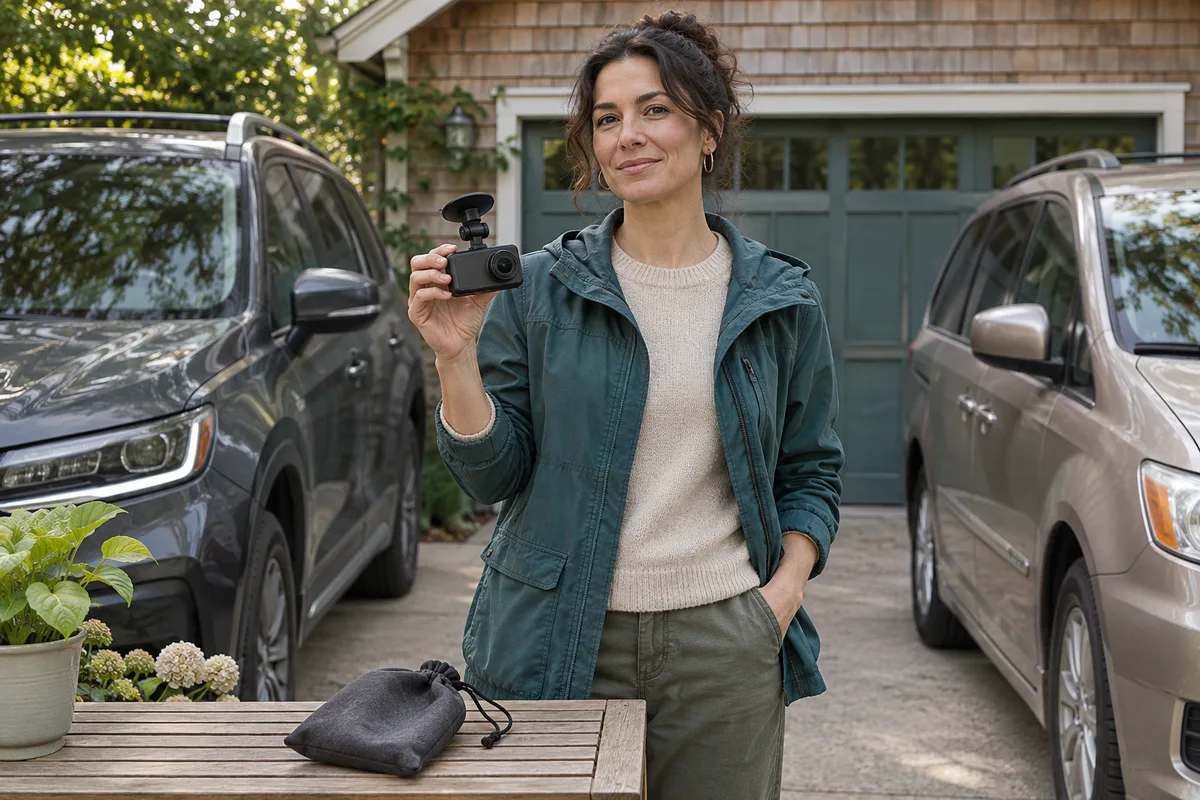
AI-generated scene illustration; not a photograph of the recommended product.
One household has a commuter car and a second vehicle for weekend trips. They rarely drive both at once, so one dash cam for both sounds like an economical choice. The part that moves, however, is only one piece of the installation. The car left at home may still need coverage, and the second car does not inherit the first one’s rear camera just because the front body moves.
The short answer
Treat sharing an A329S as two independent installations that may share a compatible front unit, not as moving an entire front-and-rear system. Verify the manufacturer-approved way to remove and reinstall the unit and confirm the correct mount, power and rear-camera parts in each vehicle. If both cars need coverage at once or nobody will reliably transfer it, separate systems may be the better buy.
VIOFO’s mount compatibility and accessory listings are starting points. They do not approve a given vehicle, improvised mounting hardware or a specific bundle’s contents.
Contents
- The short answer
- List what stays and what moves
- Identify when either car is uncovered
- Keep recording and storage separate
- Use a two car worksheet
- Price the missed handoff
- Buying advice
- Frequently asked questions
- Sources and verification
List what stays and what moves
Make two inventories. In each vehicle, identify the supported front mount and power connection. If the vehicle needs a rear view, add the actual rear module, compatible cable and approved route. Do not count a loose cable or a mount with an unknown model as a ready installation.
VIOFO’s A329 and A329S FAQ describes compatibility for the identified GPS module, and its accessory listing identifies the marketed part. A confirmed mount match does not prove that all other models or rear accessories interchange. Confirm the precise part for both cars. The cover is an illustrative scene, not a depiction of the supplied mount.
Our hatchback cable guide explains what to check on an individual moving rear opening. This guide asks a separate question: which pieces need to remain in place so that the household does not have to repeat the installation every time.
Identify when either car is uncovered
Write out an ordinary week. If the camera stays in the commuter car on Friday evening while the other vehicle leaves on Saturday morning, the second trip will be uncovered unless someone moves it first. If the first car remains parked, it no longer has camera coverage from that unit. A powered mount left behind is not a recorder.
Consider what happens when another driver changes plans. Assign who transfers and who checks the camera before each trip. If the routine relies on the same person remembering every time, the hidden cost is not just time; it is the chance that the setup is absent when somebody expects it.
A household that truly uses one car at a time might accept that limitation. A household needing independent parking or driving coverage cannot solve it by buying a second mount alone. No camera setup guarantees all footage will be saved.
Keep recording and storage separate
Use the manufacturer-approved removal method with the vehicle safely parked. Do not disconnect in the middle of recording or operate equipment while driving. Check how supported storage is handled in the intended configuration. If one medium moves with the unit, both cars’ files may be present on it. If storage is switched, follow the device instructions for supported media and verification.
Do not assume the camera’s settings change automatically between cars. A parked car can have a different power behavior or accessory configuration. After a supported transfer, verify the intended recording mode and actual saved views while safely parked. Front-only operation on one vehicle is not proof that the rear channel is working on the other.
Think about privacy as well. Drivers should know whether their trip files remain on a shared medium and who is responsible for saving important material before routine retention changes it. See our save-before-formatting guide for file preservation.
Use a two car worksheet
| Item | Record for each car |
|---|---|
| Mount | Exact supported part and location |
| Power | Approved cable and source |
| Rear | Required view, module and safe route |
| Storage | Supported medium and file owner |
| Check | Parked verification after transfer |
| Absence | What is not recorded without the unit |
| Cost | Hardware, installation and repeated effort |
If both cars have very different requirements, compare a permanently installed two-view setup in one with an independently suitable simpler unit in the other. That may be more practical than recreating every accessory on both sides. Compare actual seller and installation costs rather than assuming a shared front unit is automatically less expensive.
Price the missed handoff
A useful trial before buying accessories is to simulate the handoff with a small pouch or note, not with an unapproved installation. Put it where the camera would normally be stored. Over a typical sequence of departures, notice when the person taking the second car would actually have time to stop, confirm it is present and check it before leaving. The exercise does not test a camera. It tests whether the household’s schedule can support the shared routine.
If the bag or device would often leave the house with the wrong driver, a second simple recorder can have more practical value than a technically compatible shared system. Conversely, a predictable switch once a month may be manageable if the stationary installation work is already confirmed. Write down which car remains uncovered in each case.
Check whether the second vehicle already has a useful built-in recording system, and verify the conditions for retrieval before duplicating it. Compare complete setups rather than counting two mounts as two working cameras. If the second car needs only a forward view, do not automatically buy or install another rear system just to mirror the first.
Buying advice
Consider the A329S front-and-rear kit when the main vehicle benefits from that coverage and the selected package and parts are confirmed. Buy extra accessories only once the second arrangement is documented. Pass on the sharing idea if either car needs simultaneous coverage or if moving and checking the camera becomes a recurring burden. We did not install or transfer an A329S or confirm fit for a specific car.
Frequently asked questions
Will a second GPS mount record by itself?
No. A mount without the camera cannot provide that camera’s recording.
Does mount compatibility confirm the rear cable?
No. Verify the separate module, cable and supported configuration.
Can I rely on parking coverage in both cars?
Not from one front unit. Check what each car actually has installed and powered.
Should I choose two complete kits?
Only if both need the same coverage. A suitable simpler second system may be enough.
Sources and verification
Checked November 6, 2026. VIOFO documentation establishes selected mount and series distinctions. No two-vehicle installation or recording test was performed.
Keep reading
Related guides
 Garage & Workshop
A229 Plus vs a Front-Only Dash Cam
Decide whether a dedicated rear view earns the installation, storage and upkeep of A229 Plus over a simpler front-only dash cam.
Read guide → Garage & Workshop
RLink J2534 and BMW ISTA Offline Limits
Check BMW access, network requirements and conflicting TOPDON guidance before buying RLink J2534 for an offline workshop workflow.
Read guide → Garage & Workshop
A229 Plus vs Phone Recording for Daily Drives
Compare dedicated A229 Plus front-and-rear loop recording with phone video, storage and navigation before buying another in-car device.
Read guide →