
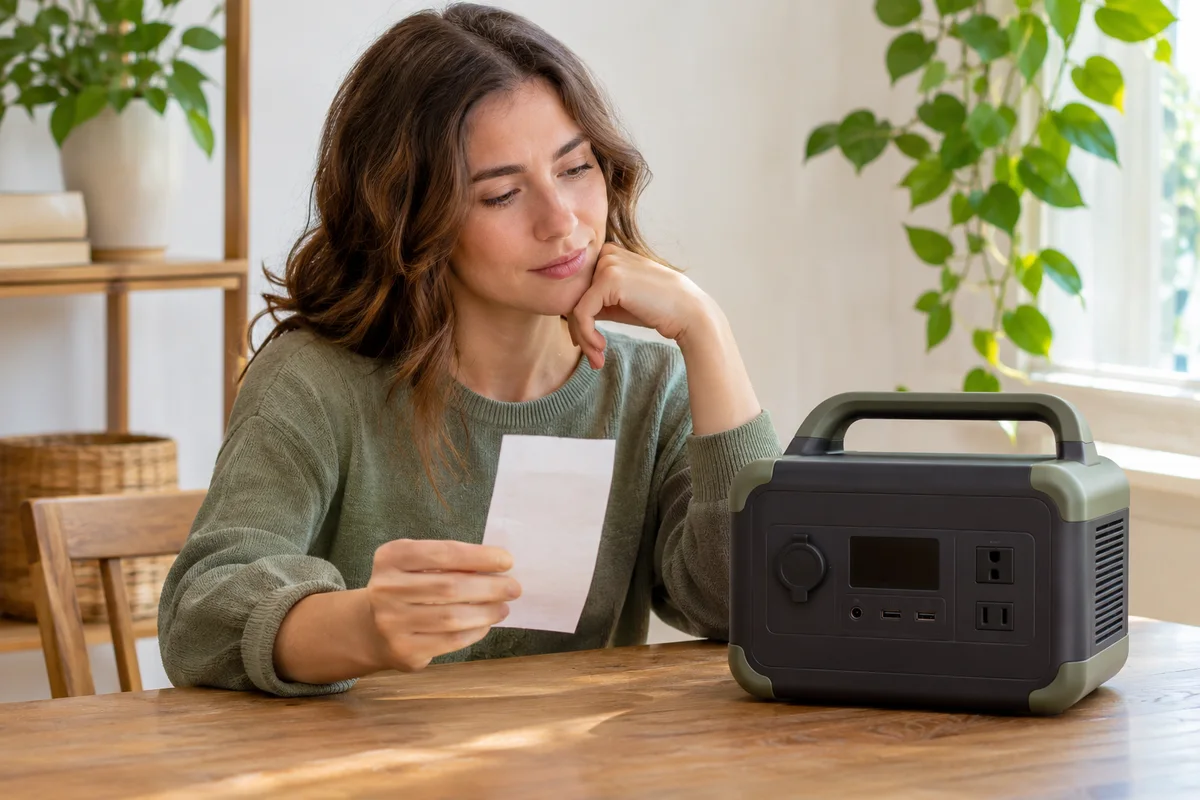
AI-generated scene illustration; not a photograph of the recommended product.
A secondhand AC180 listing shows a full battery icon and describes the unit as barely used. The price looks attractive compared with a new station. That photograph answers a narrow question about a displayed charge state, not the more expensive question of what condition the buyer is taking on.
The short answer
Do not treat a displayed charge percentage as proof of a used AC180’s remaining usable capacity, history or safety. Establish the exact model, condition, ownership evidence, included supported equipment and applicable assistance before considering a purchase.
BLUETTI’s warranty policy refers to the original consumer purchaser and valid purchase evidence. Do not assume a private resale restarts the clock or transfers every protection. Compare the actual used offer with a new or manufacturer-supported alternative, without turning an informal seller demonstration into a certified battery test.
Contents
- The short answer
- Define the offer before assessing the battery
- Separate charge state from condition
- Keep safety ahead of the bargain
- Verify assistance and ownership evidence
- Compare complete ownership choices
- Buying advice
- Frequently asked questions
- Sources and verification
Define the offer before assessing the battery
Ask whether the item is privately used, open-box, manufacturer-refurbished or another seller’s refurbishment. These labels do not establish the same inspection process or terms. Require the seller to explain what its description actually means.
Record the exact AC180 identity and regional version from the unit. A related model name can conceal different capacity or electrical specifications. Our AC180 and AC180P comparison addresses that separate suffix issue.
Check the included cables and other equipment against the applicable manual. A visually tidy station with missing supported charging equipment can create additional cost and sourcing work. Do not substitute an improvised adapter simply to make a low purchase price look complete.
Separate charge state from condition
Charge percentage describes the station’s reported state of charge. It is not the same measurement as original rated energy remaining after an unknown history. A full indicator can coexist with uncertainties the photograph does not resolve.
Ask about storage, unusual events, repairs and the reason for sale, while recognizing that a seller’s account is not independent verification. Do not assume that a low claimed cycle count answers every condition question. Calendar age, treatment and the actual equipment still matter to an informed assessment.
The AC180 manual includes storage and use requirements. Use the applicable regional instructions when discussing history; do not invent a formula that converts the seller’s description into a precise remaining-life percentage.
Keep safety ahead of the bargain
Do not charge or operate a unit whose condition raises safety concerns merely to demonstrate that it powers on. Follow manufacturer safety instructions and obtain appropriate support for suspected damage. A lower price does not justify bypassing those conditions.
Do not open the housing or attempt an internal battery inspection. This article provides no battery repair or diagnostic procedure. A consumer shopping check cannot establish that hidden components are safe, and a seller’s willingness to dismantle the unit is not a substitute for authorized assessment.
Visible condition can identify a reason to stop; lack of a visible mark is not proof of perfect internal condition. Keep that asymmetry clear. Avoid reassuring yourself with an uneventful brief demonstration when the purchase depends on an assurance nobody is qualified to provide.
Verify assistance and ownership evidence
Read the current BLUETTI warranty policy. It refers to the original consumer purchaser, valid purchase evidence, purchase country and exclusions. Ask BLUETTI what applies to the exact resale situation rather than declaring the warranty transferable or void from a general shopping article.
| Check | What to obtain |
|---|---|
| Model identity | Exact unit and regional version |
| Original purchase | Appropriate proof, where legitimately available |
| Seller status | Private, authorized or specifically refurbished |
| Condition claim | What was inspected and by whom |
| Assistance | Written answer for the exact ownership situation |
| Return route | Applicable terms and who bears the practical work |
Keep personal details on receipts private. Ask for information relevant to ownership and support, not unrelated identity documents. A clear product and transaction record is more useful than unnecessary disclosure.
If support cannot confirm a protection, price the offer without assuming it. Do not subtract the value of a promised warranty from the risk calculation until the applicable provider has established that the promise means something for this purchase.
Compare complete ownership choices
A used station can be less expensive at checkout while carrying uncertainty about history and recourse. A new purchase can cost more without guaranteeing that it fits the intended load. These are separate questions.
Define the noncritical task and verify model suitability using the AC180 buying guide. Do not accept unknown condition because the specification label appears sufficient. Likewise, do not buy a new unit whose actual task would be better served by a smaller appropriate device or a different supported system.
Avoid a homemade full-discharge challenge as a purchase shortcut. We have not designed a safe battery-health protocol or measured used-unit capacity. If condition is central to the value, seek an appropriate assessment and a seller arrangement that supplies meaningful recourse.
Buying advice
Consider a used offer only when its identity, condition evidence, assistance and return arrangements are acceptable for the intended supported use. Keep the station’s manual and the seller’s actual terms together. Walk away when the seller substitutes a full-charge photograph for answers about history or asks you to ignore abnormal condition.
Compare a new or specifically supported refurbished option when clearer documentation and recourse matter more than the initial saving. The partner listing linked from this guide is a current AC180 offer; check its actual condition and selected package rather than assuming it is a private resale or a refurbishment program.
Do not buy either option for unsupported critical equipment or improvised home wiring. The home wiring boundary guide addresses that separate limit. A good secondhand price does not broaden the station’s permitted application.
Frequently asked questions
Does 100 percent mean the battery retains original capacity?
No. Reported charge state and remaining usable capacity are different questions.
Does private resale automatically restart the warranty?
Do not assume so. Obtain the provider’s answer for the exact unit and transaction.
Should I open the case to inspect the battery?
No. This guide does not authorize internal inspection or repair. Use appropriate manufacturer support.
Have you tested a used AC180?
No. This is a documentation-based purchasing framework, not a condition certificate or measured capacity comparison.
Sources and verification
Checked November 19, 2026. Manufacturer policy and operating requirements reviewed. No resale unit was inspected, discharged or certified.
Keep reading
Related guides
 Power & Outdoors
AC180 Delivery Damage: Document Before Powering On
Prepare a safe support and return plan for an AC180 delivery with suspected damage; a return label alone does not settle lithium-battery transport.
Read guide → Power & Outdoors
AC180 Solar Through a Window: Budget Actual Input
Check the real sunlight, safe placement and compatible input before buying an AC180 solar bundle for a panel that will sit behind a window.
Read guide → Power & Outdoors
AC180 App Control: Nearby Is Not Away From Home
Understand the AC180's documented Bluetooth app connection before buying a portable power station for away-from-home monitoring or control.
Read guide →