
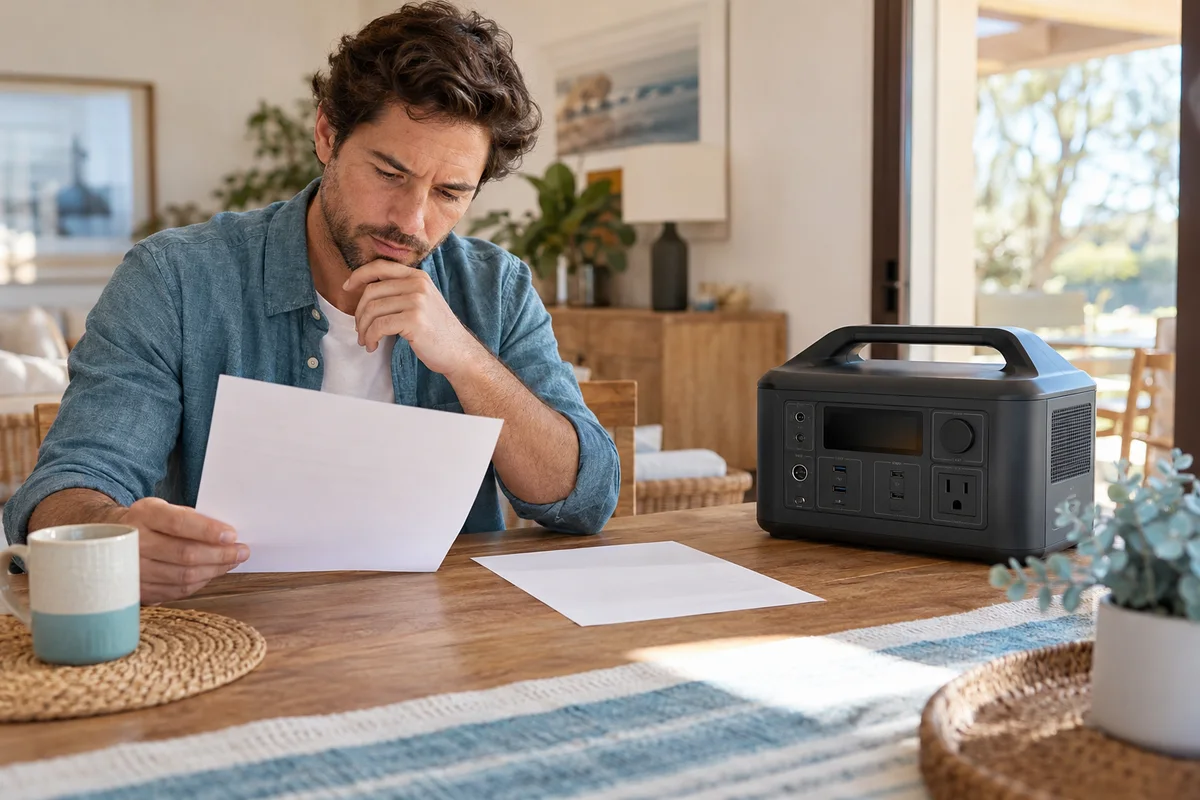
AI-generated scene illustration; not a photograph of the recommended product.
Two shopping tabs show almost the same dark power station. One title says AC180; the other adds a P. A photograph may not make the difference obvious, but copying the larger model’s battery capacity into the smaller model’s shopping decision would change the entire backup plan.
The short answer
BLUETTI lists AC180 at 1,152 Wh and AC180P at 1,440 Wh. Both US product descriptions list 1,800 W AC output. The P suffix changes the listed stored-energy capacity; it does not turn the unit into a higher-output class simply because the watt-hour number is larger.
The capacity difference is 288 Wh, or 25 percent of AC180’s listed capacity. That is a nameplate comparison, not a measured runtime improvement. The partner link on this page is for AC180, not AC180P. Confirm the selected model before checkout.
Contents
- The short answer
- Read watts and watt-hours in separate columns
- Calculate the nameplate difference without promising runtime
- Inspect the selected package rather than the hero image
- Keep availability separate from specifications
- Compare the complete ownership task
- Use a model-confirmation card
- Decide whether the linked AC180 fits
- Frequently asked questions
- Sources and verification
Read watts and watt-hours in separate columns
Watts describe power. Watt-hours describe energy. A device can have a larger energy store while keeping the same output ceiling, much as a larger fuel tank does not by itself make an engine more powerful.
Use the AC180 product page and AC180P page as separate model records. Do not rely on a combined family title whose selected option changes underneath it.
For a household appliance, first establish whether the required running and startup behavior is supported. Then consider how much useful energy the planned session requires. Extra battery capacity does not remove an incompatible outlet, unsuitable load or prohibited application.
Our AC180 refrigerator guide addresses a specific load-budget task. This article addresses a different decision: identifying which capacity you are actually buying before doing any runtime calculation.
Calculate the nameplate difference without promising runtime
Subtracting 1,152 from 1,440 gives 288 Wh. Dividing that difference by 1,152 gives 0.25. Those are arithmetic results from the published capacities, not measurements taken from either device.
Avoid converting the result into “25 percent longer for everything.” Usable runtime also depends on conversion losses, self-consumption, battery conditions, operating settings and the load’s behavior. A cycling refrigerator and a steady small electronic load do not produce identical comparisons.
If you need a fixed session completed, define its demand first and preserve a suitable margin. Do not buy exactly to an idealized calculation and label the outcome guaranteed. If continuity is critical, seek a solution qualified for that role rather than relying on a shopping-page estimate.
For comparing offers, write the model and Wh value together in the same row. That simple habit prevents a lower-priced AC180 option being evaluated against an AC180P energy claim.
Inspect the selected package rather than the hero image
A family page may present standalone units, panel bundles or additional charging equipment. The largest hero photograph is not a packing list for every selected option.
Before paying, record:
- Exact model name, including any suffix.
- Listed battery capacity and regional AC output specification.
- The selected standalone or bundled configuration.
- Included cables and separately sold accessories.
- Seller identity and the actual delivery estimate.
- Applicable return and support terms.
Use the order summary as the final check. If the title, option selector and packing list disagree, ask the seller to reconcile them. Do not choose the interpretation that makes the apparent bargain more attractive.
A solar panel in a bundle does not automatically mean a second battery or a larger AC output. Conversely, an accessory photograph does not establish that the accessory is included at all.
Keep availability separate from specifications
On October 22, the direct AC180 product page displayed an out-of-stock notice with a late-November restock expectation. It also showed separate panel timing. These are dated direct-store observations, not promises about another seller’s inventory or delivery.
New York’s October 25–31 winter-awareness week provides a timely reason to check household readiness. An expected future shipment is not equipment available for that week.
If you need backup immediately, confirm an actual seller-specific delivery commitment and have an appropriate interim plan. Do not let a faster accessory shipment make you assume the power station will arrive with it. This is purchasing logistics, not a forecast that your home will lose power.
Compare the complete ownership task
The larger listed capacity can be useful when energy, rather than output compatibility, is the limiting factor. It is less relevant when the main problem is carrying the unit, safely placing it, obtaining a compatible charging source or receiving it on time.
Do not infer weight, dimensions or accessory compatibility from the suffix alone. Check each current regional specification and confirm any material difference with the seller. Similar-looking housings are not proof that every internal or external part is interchangeable.
A useful shortlist includes a reason to buy the smaller capacity as well. If the planned noncritical task fits comfortably and the actual offer is suitable, additional nameplate energy may not justify changing the purchase. No current price comparison is supplied here.
The AC180 home-wiring guide explains why neither a capacity upgrade nor an extra outlet permits feeding electricity backward into a wall socket.
Use a model-confirmation card
| Decision | AC180 record | AC180P record |
|---|---|---|
| Listed stored energy | 1,152 Wh | 1,440 Wh |
| Listed US AC output | 1,800 W | 1,800 W |
| Nameplate comparison | Baseline | 288 Wh more |
| Actual task compatibility | Verify independently | Verify independently |
| Seller, package and arrival | Record selected offer | Record selected offer |
Do not add estimated operating hours unless the assumptions are visible. A blank field is preferable to a confident number copied from an unrelated appliance example.
Keep this card with the saved order details. When the package arrives, verify the label before first use and follow the supplied instructions. Do not use a guide for another regional variant just because the number on the box begins with AC180.
Decide whether the linked AC180 fits
Choose the linked AC180 only if its own capacity, supported outputs, package and arrival date fit the intended task. Consider AC180P separately if the additional nameplate energy addresses a real requirement and its complete offer is suitable.
Pass on either when the purchase depends on unsupported critical-equipment use, improvised home wiring or a delivery assumption that nobody has confirmed. A clear “not for this job” decision is more valuable than treating a larger Wh figure as universal insurance.
Frequently asked questions
Does AC180P mean more AC output?
The listed US AC output is 1,800 W for both models. The prominent difference discussed here is stored energy.
Is 288 Wh a measured usable-energy difference?
No. It is the difference between published nameplate capacities. This article reports no discharge test.
Is this page’s partner link for AC180P?
No. It is for AC180. Check the exact selected model at the destination.
Does the restock date guarantee my delivery?
No. The direct-store notice is dated and seller-specific. Verify the actual order’s delivery terms.
Sources and verification
Checked October 22, 2026. No runtime, charging or side-by-side hardware test was performed. Arithmetic is explicitly nameplate-based.
- BLUETTI AC180 specifications and direct-store availability.
- BLUETTI AC180P specifications.
- NWS Buffalo winter-awareness week.
Keep reading
Related guides
 Power & Outdoors
Elite 100 V2 Noise: Read the 30dB Condition
Read Elite 100 V2's conditioned 30dB claim alongside its manual maximum, then assess charging, placement and realistic home-office noise needs.
Read guide → Power & Outdoors
AC180 in Cold Weather: Charging Has a Different Limit
Separate AC180 charging temperature from discharge and storage limits, then plan a suitable winter recharge location before buying.
Read guide → Power & Outdoors
Elite 100 V2: What 4,000 Battery Cycles Does Not Mean
Read Elite 100 V2's cycle-life endpoint without turning it into guaranteed years, unchanged runtime or invented lifetime savings.
Read guide →