
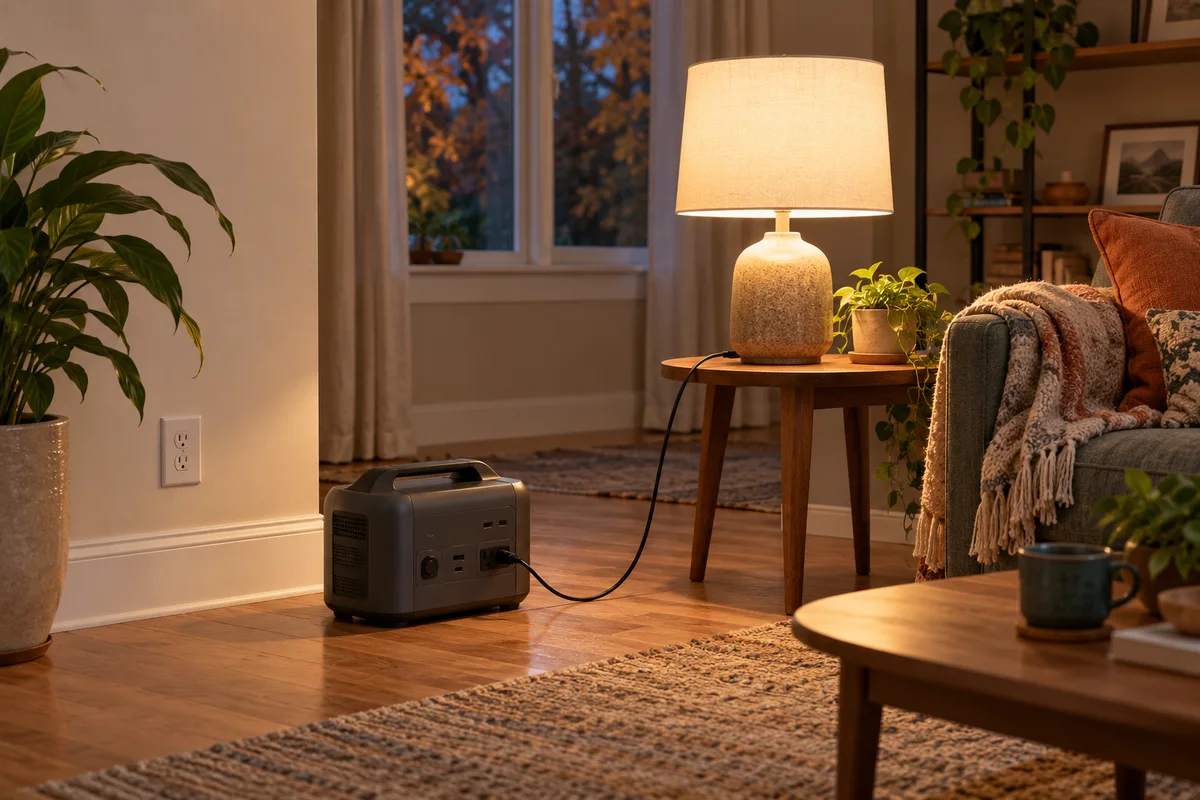
AI-generated scene illustration; not a photograph of the recommended product.
The lights go out, and a portable battery looks like a way to make the whole room work again. The refrigerator has an ordinary plug, but the ceiling lights, furnace controls, and some other loads belong to the building’s wiring. That difference decides whether an AC180 is the right purchase.
Start with the connection path, not the largest wattage number on a sales page. A station that can supply selected appliances does not automatically become an approved household electrical installation.
The short answer
Use the AC180 only through its documented connections. Never feed its AC output into a household wall outlet. Do not buy or improvise a male-to-male cable, and do not assume turning off a breaker makes an undocumented arrangement acceptable.
For fixed building loads, ask a qualified electrician and the equipment manufacturer about a complete, permitted solution before purchasing. For suitable plug-in appliances, evaluate direct appliance power separately. This is a buying boundary, not wiring instructions.
Contents
- The short answer
- Sort the loads before shopping
- Understand why wall outlets are not battery inputs
- Separate four questions that marketing can blur
- Build a direct-appliance plan
- Evaluate fixed loads as a different project
- Compare complete solutions rather than box prices
- Check duration without promising continuity
- Buying decision
- Frequently asked questions
- Sources and verification
Sort the loads before shopping
Walk through the home while normal power is available. Make two lists: equipment you can operate through an accessible ordinary appliance plug, and equipment connected to the building in another way. Do not open covers, detach fixed wiring, or move heavy appliances just to complete the list.
A table lamp and a hardwired ceiling fixture can serve similar human needs but require different power arrangements. “Keep the kitchen usable” is therefore too vague. “Power this accessible lamp and this supported plug-in appliance” is a more useful starting requirement.
Put uncertain connections in a third column. An unclear appliance does not belong on the direct-power list until its instructions establish the connection. A convenient-looking socket is not evidence that a reverse connection is safe.
Understand why wall outlets are not battery inputs
Household receptacles normally supply connected equipment. They are not an invitation to energize the building from a portable source. CPSC’s generator guidance identifies backfeeding through a wall outlet as dangerous and calls for properly installed transfer equipment when connecting applicable generators to house wiring.
That guidance concerns generators; it is not an approval of any AC180 installation. The purchase lesson is the same boundary: do not invent an electrical integration because a portable source has AC outlets.
BLUETTI’s AC180 safety instructions also warn against connecting the AC output to the grid. Follow the exact regional manual supplied with the unit. A charging input receiving power and an output supplying an appliance have different roles, even when both involve familiar-looking plugs.
Separate four questions that marketing can blur
| Question | What a positive answer does not prove |
|---|---|
| Can the station run this supported appliance? | It can supply the home’s fixed circuits |
| Is there enough stored energy? | The inverter can handle every starting load |
| Can the battery recharge from an outlet? | Its output may be connected back to that outlet |
| Is transfer equipment available somewhere? | It is approved for this exact station and installation |
This distinction prevents a common budget error: purchasing a portable station first and discovering afterward that the desired loads require a different architecture. A cheaper adapter does not resolve the mismatch.
Our AC180 overview covers the broader product. The question here is not whether its advertised capacity looks attractive; it is whether the intended connection is supported.
Build a direct-appliance plan
For each genuinely suitable plug-in load, record the appliance model, ordinary running requirement, any starting demand, intended duration, and the applicable instructions. Keep the total within the station’s documented limits.
Use an accessible, dry, stable position with the ventilation and environmental clearances required by the manual. Plan cable routes so they do not cross a doorway, become trapped under furniture, or invite someone to reconnect them incorrectly.
Do not improvise extension arrangements. Where a cord is permitted, it still needs to satisfy the appliance and source instructions, its rating, environment, and condition requirements. An inconvenient distance may mean the proposed setup is unsuitable, not that several extra leads should be joined.
Evaluate fixed loads as a different project
A furnace, well pump, or other building-connected load can turn a portable shopping decision into an installation decision. Ask an appropriately qualified professional what the actual equipment needs and which complete systems meet those requirements.
Useful questions include whether the proposed source supports the specific load, whether integration is manufacturer-approved, and what permits, inspection, isolation, grounding, and transfer arrangements apply. Those answers are location- and equipment-specific.
Do not purchase a transfer device solely because its connector resembles the station’s outlet. Nor should a general video replace an assessment of the actual building. This guide deliberately does not give breaker sequences, bonding changes, or installation steps.
Compare complete solutions rather than box prices
One household may be satisfied with a lamp and a few directly powered devices. Another needs an automatic, professionally designed arrangement for fixed loads. Comparing only portable battery prices hides the difference between those tasks.
For the first household, include the supported station, necessary permitted accessories, handling, storage, and replenishment. For the second, compare the installed system and its ongoing requirements, not an unfinished collection of compatible-looking parts.
If professional integration costs make the project unaffordable, reduce the task honestly. A smaller direct-appliance plan can still be useful. Do not preserve an unrealistic whole-home promise by substituting an undocumented connection.
Check duration without promising continuity
A supported connection does not settle runtime. Appliances cycle, starting demand varies, and conversion losses affect usable energy. Use the refrigerator runtime framework for that separate calculation rather than treating nameplate battery capacity as delivered appliance energy.
Keep essential-service requirements outside casual estimates. Medical equipment and other critical loads need suitable equipment-specific planning; this article does not certify continuity or emergency adequacy.
Recharging is another independent task. Our generator recharge guide discusses its own source hazards. A battery indoors does not make a fuel-burning generator safe indoors.
Buying decision
Consider an AC180 when your priority is a defined set of suitable, accessible plug-in loads and the documented output, energy, placement, and replenishment plan all pass.
Pause when your real requirement is fixed-circuit backup, automatic whole-room operation, or a load whose connection remains unclear. Obtain the complete-system answer first. Check the current partner offer only after the supported use matches your household; stock and packages vary by seller.
Frequently asked questions
Can I plug AC180 output into a wall outlet during an outage?
No. Do not backfeed a household outlet or improvise a reverse-feed cable. Follow the manufacturer’s supported connections.
Does switching off the main breaker make a homemade setup acceptable?
No. This guide does not authorize that arrangement. Isolation and integration require a properly designed, permitted system.
Can a hardwired light be treated like a plug-in lamp?
Not without an appropriate professional solution. Similar lighting tasks do not establish identical electrical connections.
Is a portable station useless without whole-home integration?
No. Suitable directly powered appliances can be a practical, narrower task. Establish supported loads and realistic duration.
Sources and verification
Checked October 19, 2026. This is a connection-scope analysis based on published information, not an installation assessment or hands-on electrical test.
- BLUETTI AC180 product information
- AC180 US official manual and safety restrictions
- CPSC portable-generator guidance on backfeeding and transfer equipment
Keep reading
Related guides
 Power & Outdoors
Elite 100 V2 App Access: Plan for a Router Outage
Separate nearby Bluetooth control from home-network and internet access before relying on the Elite 100 V2 app during a power outage.
Read guide → Power & Outdoors
AC180 and B80: Check the Expansion Path First
Compare B80 power-bank feeding with native modular expansion before buying an AC180 system for a longer energy reserve.
Read guide → Power & Outdoors
Elite 100 V2 UPS: Read the Sensitive-Load Restriction
Separate a published switching time from high-performance UPS suitability before buying backup power for data-sensitive equipment.
Read guide →