
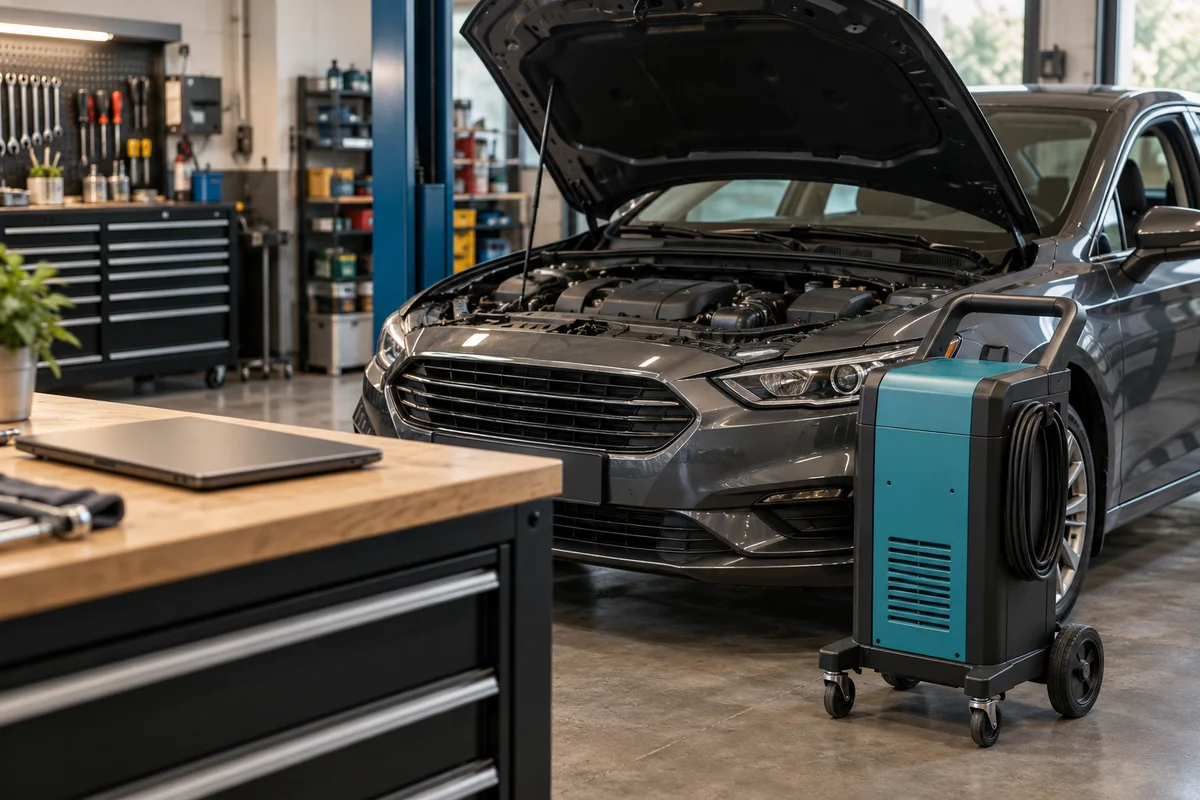
AI-generated scene illustration; not a photograph of the recommended product.
An independent workshop has a Windows laptop and is comparing an RLink J2534 interface. A small charger and a jump pack already sit on the shelf, so vehicle power support is marked “covered” in the budget. That assumption needs checking before the interface order.
Communication with a vehicle and maintaining suitable vehicle supply during a programming procedure are different jobs. Buying the first tool does not establish the second.
The short answer
TOPDON RLink is a J2534 communication interface, not a regulated vehicle battery-support unit. Before buying it for a programming task, identify the exact OEM procedure’s supply requirements and the complete supported equipment.
A jump starter, ordinary charger, portable AC station, and workshop battery-support unit are not interchangeable categories. This guide helps qualify a purchase; it does not supply flashing steps, voltage settings, clamp instructions, or universal equipment approval.
Contents
- The short answer
- Start with the exact vehicle job
- Give each device one job
- Understand why sustained support is a separate requirement
- Ask suppliers for the missing specification
- Include the workshop environment
- Avoid solving only the laptop side
- Compare buying with a service quote
- Write an acquisition gate
- Frequently asked questions
- Sources and verification
Start with the exact vehicle job
Record the vehicle, module, intended operation, OEM software, and current procedure. “Program cars” is too broad to establish either interface coverage or power support.
The OEM procedure determines what must remain powered and which conditions must be maintained. Obtain that procedure through the appropriate legitimate service route before treating a generic tool bundle as sufficient.
A workshop doing occasional programming may be better served by outsourcing a particular operation than buying an incomplete system. A tool purchase is useful only when the complete job can be performed within the shop’s actual competence and requirements.
Give each device one job
| Equipment category | What not to assume |
|---|---|
| J2534 interface | It supplies the required regulated vehicle support |
| Jump starter | Starting assistance proves sustained programming suitability |
| Battery charger | Every charge mode is a suitable support mode |
| Portable AC station | AC output directly establishes approved vehicle DC support |
| Battery-support unit | Its category alone meets every OEM procedure |
These are category boundaries, not claims that all products within a category behave identically.
A multifunction workshop unit may provide an appropriate supply function, but it must be assessed by its exact documented mode, capacity, regulation, and OEM suitability. Do not choose it from the largest number printed on the case.
Understand why sustained support is a separate requirement
CTEK’s technical discussion distinguishes stable voltage, sufficient output capacity, and response to changing loads during ECU programming. Those are different from demonstrating that an engine can start once.
This supports the need to qualify a regulated support arrangement. It does not establish that a particular CTEK model is approved for your OEM procedure or that a specified current rating works for every vehicle.
Keep the manufacturer’s explanation in its proper role: evidence about the equipment category, not an independent test or universal prescription. The actual service procedure remains the purchase gate.
Ask suppliers for the missing specification
Send the exact intended job and the relevant OEM requirements to the equipment supplier. Ask which current model and operating mode meet that specification and what limitations remain.
A useful response identifies the supported equipment and documentation. “Professional charger” or “works for programming” without a model-specific match is not enough to complete the budget.
Do not ask the J2534 interface supplier alone to approve every other device in the chain. Each component needs its own documented suitability, and any unclear integration should remain unresolved until the responsible technical source answers it.
Include the workshop environment
A support unit also needs an appropriate location, suitable electrical supply, handling, cable management, and maintenance according to its instructions. Check whether the shop can provide those conditions repeatedly.
Do not plan around improvised adapters, shared leads of unknown rating, or equipment stored where it is difficult to inspect. A recurring professional workflow should not depend on finding an unidentified cable at the last minute.
This is planning, not installation guidance. Have electrical and workshop-safety questions assessed by appropriately qualified people. Do not use the article’s generic illustration as a connection diagram.
Avoid solving only the laptop side
A laptop can have its own power and operating-system requirements while the vehicle has a separate support requirement. Keeping one powered does not establish the other.
Our RLink Windows laptop checklist covers the host side. Our complete J2534 setup budget includes subscriptions and ownership costs.
This article narrows the previously mentioned power-support line into an equipment-category decision. Do not add another portable battery to the shopping cart until you know which part of the workflow actually needs energy and in what documented form.
Compare buying with a service quote
Obtain a current quote for having the intended operation performed by a qualified service provider. Compare that with the complete in-house arrangement: interface, legitimate software access, suitable host, approved support equipment, training, and time.
Use actual quoted amounts, not a guessed repair price or an assumed subscription. Keep unknown items visible. A comparison that prices the interface precisely but leaves the required support equipment blank is unfinished.
If repeated verified work justifies the system, buying may make sense. If one uncertain job drives the purchase, a professional service can be the more economical route without making the tool itself a poor product.
Write an acquisition gate
Before ordering RLink for programming, require a completed record of interface coverage, OEM procedure, host requirements, software access, and vehicle support.
Mark each item confirmed with its source and date. Do not turn an unanswered field into “probably fine” because the interface is on promotion.
The RLink overview provides product context. Consider the current partner offer when the full system is justified. Postpone when the plan depends on a jump pack, an unspecified charger mode, or an undocumented DIY supply substitution.
Frequently asked questions
Does the RLink interface replace a battery-support unit?
No. Communication and suitable vehicle power support are different tasks. Confirm the complete OEM procedure’s requirements.
Is a jump starter enough because it can start the engine?
Starting capability does not establish sustained regulated supply suitable for programming. Qualify the exact equipment and mode.
Can a portable AC battery be treated as approved vehicle support?
No automatic equivalence exists. Its AC output does not establish the required vehicle-side supply arrangement.
Can this article tell me the correct voltage for every job?
No. Use the current exact OEM procedure and qualified technical guidance, not a universal setting from a buying guide.
Sources and verification
Checked October 19, 2026. This is equipment-scope research, not a programming tutorial or completed compatibility test. No ECU work was performed.
- TOPDON RLink J2534 product information
- CTEK technical explanation of programming supply stability and capacity
- CTEK professional battery-support equipment category
Keep reading
Related guides
 Garage & Workshop
A229 Plus Cabin Camera: Choose the Interior View
Decide whether an A229 Plus interior camera solves a real passenger-area recording need before paying for a third channel and installation.
Read guide → Garage & Workshop
A329S Wi-Fi Station Mode: Download on Your Home LAN
Assess A329S home-network file access without mistaking Station Mode for cloud backup, internet tracking or guaranteed driveway Wi-Fi coverage.
Read guide → Garage & Workshop
A229 Plus GPS: Recording a Route Is Not Live Tracking
Use Teen Driver Safety Week to separate dash-cam route evidence from live location expectations and agree on a transparent family plan.
Read guide →