
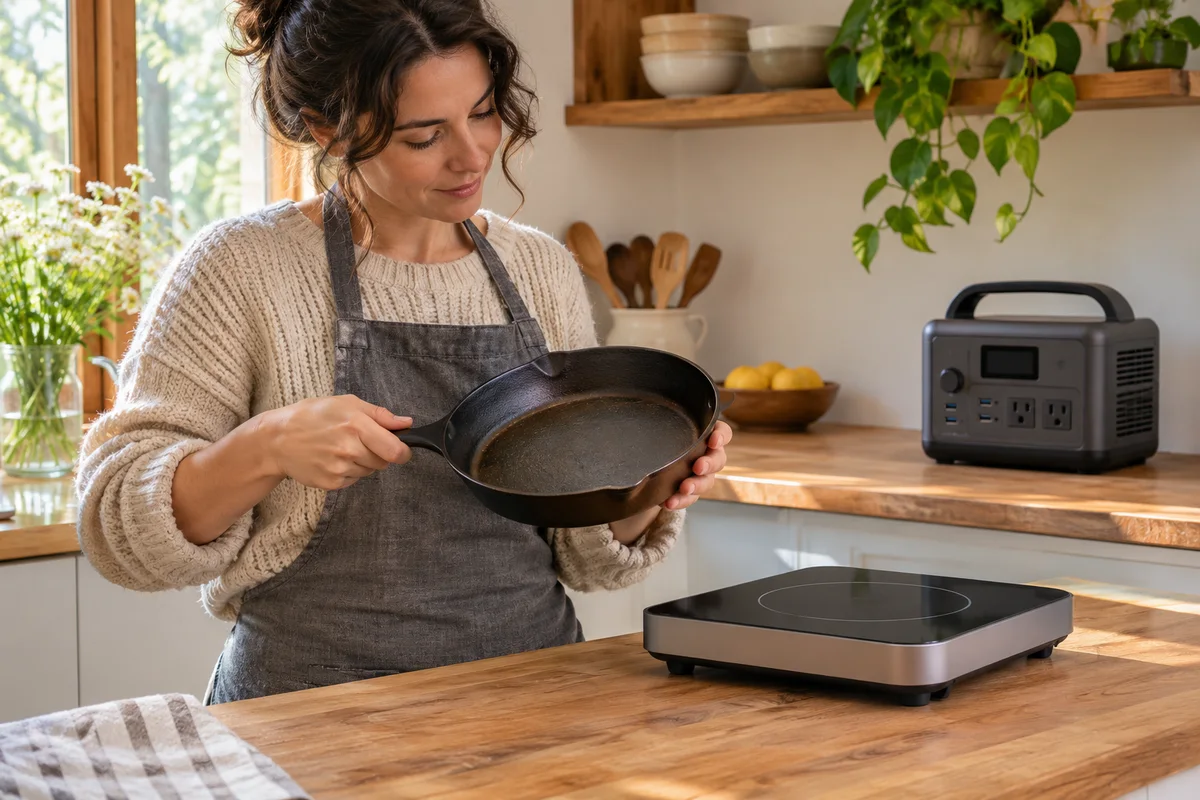
AI-generated scene illustration; not a photograph of the recommended product.
A household is planning a single-pan meal during a possible interruption to mains power. The shopping list contains an AC180, a portable induction hob and a pan already sitting in the cupboard. Comparing the two electrical wattage labels is only the first check. If the hob cannot detect that pan, buying a larger battery will not fix the meal plan.
The useful purchase is a supported cooking arrangement, not three individually plausible products. Check the cookware, working surface and appliance instructions before assigning money or backup energy to this task.
The short answer
Screen an induction hob against AC180’s exact regional output, but qualify the cookware separately. BLUETTI lists the US AC180 at 120V and 1,800W total AC output with 1,152Wh nominal capacity. Those figures do not certify a particular hob or promise a meal count.
An illustrative appliance manual, Secura’s Duxtop 9600LS guide, requires suitable magnetic cookware with a flat base and a minimum five-inch bottom diameter. Its supply and ventilation requirements are additional gates. WideLore has not tested this hob with AC180; unresolved power-source approval is a reason to postpone, not to experiment during an outage.
Contents
- The short answer
- The pan comes first
- Supply is a separate gate
- A real working surface
- Budget the whole task
- The purchase worksheet
- Buying advice
- Frequently asked questions
- Sources and verification
The pan comes first
Take the actual pan out of the cupboard before selecting the rest of the purchase. A product described as stainless steel does not automatically have the magnetic base required by every induction appliance. Equally, a pan that works on a conventional electric burner has not thereby passed an induction check.
The 9600LS manufacturer manual gives model-specific cookware conditions. Its magnet check is a useful first screen, but the base geometry and the other applicable instructions still matter.
Read the cookware maker’s own compatibility information as well. Do not add an improvised metal plate or use an adapter accessory simply because a marketplace photograph shows one. An accessory would add another component requiring its own applicable approval.
Measure the actual flat base, not the wider rim of a flared pan. Passing a magnet check alone does not settle the required base dimensions or flatness.
For a shopper who would need to replace several existing pans, that discovery changes the real purchase. Compare the complete supported arrangement with retaining another suitable meal option. The station’s price alone does not describe what this cooking task would cost.
Supply is a separate gate
The US AC180 specifications state a shared AC rating. Four outlets do not provide four independent allowances at that rating. Other equipment remaining connected still belongs in the assessment.
The example 9600LS instructions specify a dedicated 120V, 15A supply. A plug fitting AC180 is not manufacturer confirmation that the proposed portable-source arrangement satisfies all appliance requirements. Ask about the exact models and operating arrangement when the documents do not settle it.
Do not classify an induction hob as a simple resistive heater merely because it heats food. The AC180 manual limits Power Lifting to suitable pure-resistive loads; it is not universal higher rated output.
If a control setting appears lower than the appliance’s maximum, do not assume that the label establishes peak electrical demand in every operating state. Obtain applicable information before using that setting to justify a smaller source.
Our microwave input guide explains a different specification trap. It does not establish induction compatibility or answer whether the household’s pan is suitable.
A real working surface
An extra hob needs a legitimate operating position, not just a space where its box can sit. The example Duxtop manual calls for a dry, stable, level, non-flammable, non-metallic surface and at least four inches of ventilation clearance around the unit. Follow the exact guide for the appliance actually selected.
Map that position alongside the station’s separately supported dry location. Filling a pan, moving food and clearing dishes should not take spills or hot cookware across electrical connections. If the supplied leads cannot reach an acceptable arrangement, resolve the layout rather than improvising a connection.
A small kitchen may have ample storage but insufficient operating space once clearances and ordinary movement are included. Check the arrangement with the equipment switched off and without hot contents; a planning exercise should not introduce the very hazards it is meant to identify.
If the only available location is inappropriate, choosing a different supported meal arrangement is a better decision than buying more output capacity. A larger battery cannot create counter clearance.
Budget the whole task
A purchase worksheet should include preparation, the actual cooking program and any supported cooling stage. It should not stop at the moment food leaves the pan.
For illustration only, a hypothetical constant 900W input over twenty minutes would request 300Wh at the appliance. This is arithmetic, not a measured 9600LS program or AC180 result. Conversion losses and station operation would require additional battery energy.
Do not divide nominal capacity by that example and promise several meals. Actual behavior, remaining charge, conditions and other loads remain unresolved. Likewise, do not copy a hob’s claimed cooking efficiency into a claim about station runtime.
The example appliance manual describes continued fan operation after cooking while the unit cools. Follow its actual shutdown and cooling procedure rather than treating the cooking timer as permission to abruptly remove power. No extra duration or energy figure is invented here.
Decide what the reserve is primarily for. A meal task competing with communications can be optional even if its equipment is otherwise supported.
The purchase worksheet
| Gate | Record before ordering |
|---|---|
| Cookware | Exact pan, applicable induction compatibility and base dimensions |
| Hob | Exact model, market version and current manual |
| Supply | Applicable approval for the proposed source and all operating states |
| Workspace | Supported surface, ventilation and dry station location |
| Session | Cooking task plus instructed shutdown and cooling |
| Reserve | Other loads, starting charge and household priorities |
| Order | Required components, seller terms and actual delivery |
Treat an unanswered field as an unanswered question, not an invitation to fill it with a favorable guess. Keep the manufacturer’s response with the model details so a later substitution does not silently inherit approval.
A different pan or hob can reopen the assessment. An apparently interchangeable item in a sale bundle may change both the cookware condition and the source requirement.
Buying advice
Consider AC180 when the household already has a defined need for portable backup, the exact cooking arrangement is appropriately supported and the complete setup fits its space and reserve priorities. Buying a station solely to rescue one incompatible pan is not a proportionate first step.
Postpone when the plan depends on Power Lifting, a guessed low-setting demand, an unapproved adapter or an unsuitable counter. Also compare retaining an existing workable arrangement rather than purchasing a station and hob together.
Check the selected partner seller’s actual stock, package, delivery and return conditions. BLUETTI’s direct-store notices do not establish inventory for another seller. No current discount, arrival date or comparative value ranking is claimed.
Read the AC180 overview for broader ownership considerations. The partner offer below is for station hardware, not cookware, a hob bundle or a verified cooking system.
Frequently asked questions
Does a matching wattage prove compatibility?
No. It is an initial electrical screen; the exact supply requirements and operating arrangement still need applicable confirmation.
Will any stainless-steel pan work?
Do not assume so. Check the actual cookware and the exact induction appliance’s base requirements.
Can Power Lifting qualify the hob?
Do not treat that feature as a general solution for induction electronics. Follow the station’s documented load restrictions.
Has this pairing been tested?
No. This guide explains published requirements and a purchase worksheet. The energy example is explicitly hypothetical.
Sources and verification
Checked November 26, 2026. Published requirements reviewed; no cooking, electrical compatibility, runtime or thermal test.
- BLUETTI AC180 US product specifications
- BLUETTI AC180 manual and Power Lifting restrictions
- Secura Duxtop 9600LS manufacturer manual
Keep reading
Related guides
 Power & Outdoors
AC180 and Vacuum Charging: Budget the Charger, Not the Motor
Qualify a cordless vacuum's approved charger before budgeting AC180 reserve; motor watts and recharge demand are different quantities.
Read guide → Power & Outdoors
AC180 Capacity: Compare Watt-Hours, Not Bare mAh
Normalize AC180 and power-bank capacity labels using watt-hours, documented nominal voltage and a clear separation from delivered runtime.
Read guide → Power & Outdoors
AC180 or a Fuel Generator: Start With the Property
Compare AC180 with a fuel generator through property constraints, duration, replenishment and the complete ownership plan.
Read guide →