
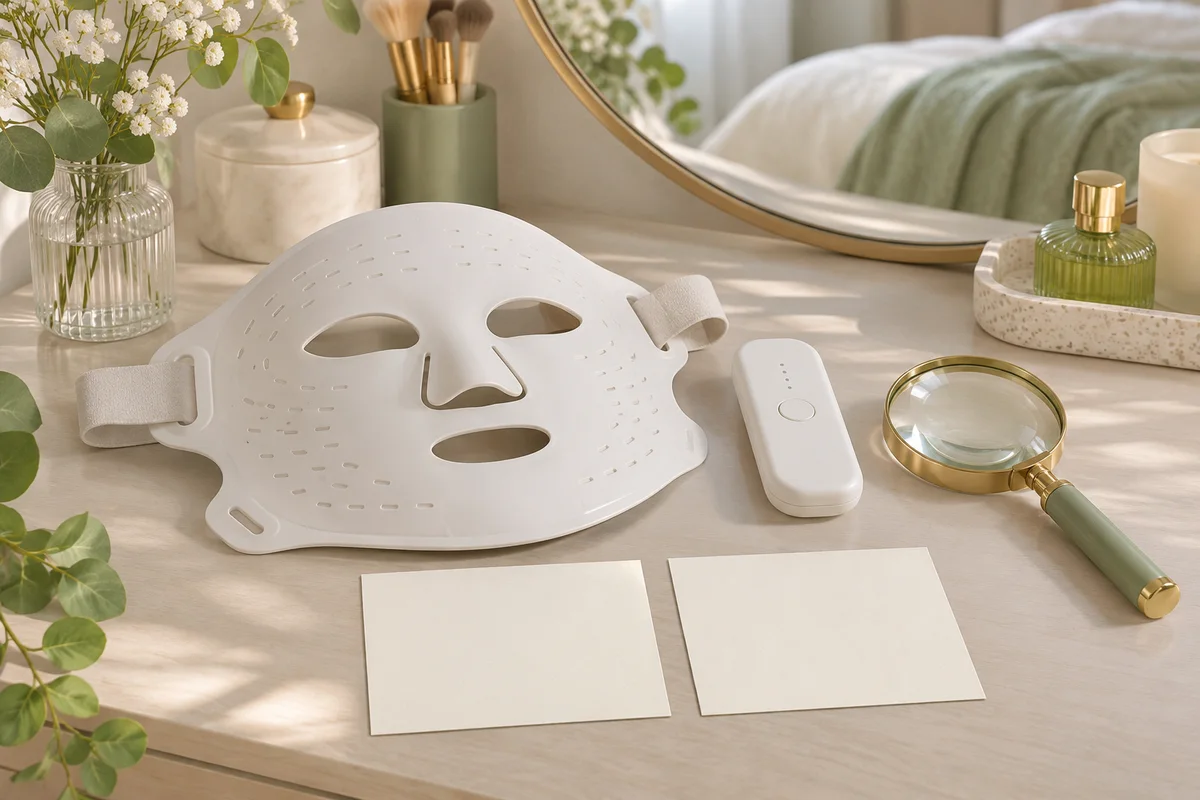
AI-generated scene illustration; not a photograph of the recommended product.
Two LED mask listings show different numbers of lights. The larger number looks like an obvious advantage until one seller counts complete bulbs and another counts the emitters inside them. A comparison can become misleading before anyone asks about the light actually delivered.
For Nanoleaf’s face mask, the manufacturer’s current specification provides both counts. Use them to align the comparison, not to calculate a promise of better skin or a personal exposure schedule.
The short answer
Nanoleaf currently describes 432 LEDs arranged as 108 bulbs with four LEDs each. Those are two ways of describing the same stated construction, not two different face-mask sizes or evidence of four times the treatment benefit.
Compare like units first. Then separately assess applicable wavelengths, output evidence, coverage, supported use, suitability and seller terms. LED count alone does not establish delivered dose, personal safety or clinical effectiveness.
Contents
- The short answer
- Define what is counted
- A comparison with aligned units
- Keep the evidence categories separate
- Count is not delivered dose
- General evidence is not model proof
- Buying advice
- A useful question to send
- Frequently asked questions
- Sources and verification
Define what is counted
A shopping comparison needs a unit. “Lights” can refer to housings, bulbs, emitters or another grouping. Unless the seller defines the term, putting two headline numbers beside each other may produce an invalid conclusion.
For the current Nanoleaf listing, the arithmetic is explicit: 108 groups multiplied by four emitters equals the stated 432 LEDs. That multiplication reconciles the labels. It does not create a new performance measurement.
Do not dismantle a device or illuminate it near the eyes to verify a count. Ask the manufacturer for the construction definition and applicable documentation.
Keep the exact product identity beside the number. A count copied from a neck device, panel or later revision should not silently become a specification for the selected face mask.
A comparison with aligned units
Imagine one hypothetical listing says “120 bulbs” but does not state how many emitters each contains. Another says “400 LEDs” but does not identify the grouping. Neither number alone establishes which design provides the relevant supported output.
Write “unit unclear” in that row and ask for clarification. Do not assume each bulb in every mask contains the same components.
Likewise, a bulb with several emitters does not prove that every emitter operates in every selected mode. The actual product’s mode and electrical arrangement need their own evidence.
This example uses invented listing descriptions to explain the comparison error. It is not a claim about a named competitor or a verified superiority ranking.
Keep the evidence categories separate
| Field | What to ask | What the answer does not prove |
|---|---|---|
| Construction count | Bulbs or individual emitters? | Better results |
| Wavelengths | Exact applicable mode specification | Personal suitability |
| Output | Test basis, settings and measurement conditions | A universal session |
| Coverage | Intended body area and fit | Uniform delivered exposure |
| Clinical claim | Applicable device evidence and limitations | Guaranteed individual outcome |
| Seller terms | Exact purchase and assessment conditions | Medical appropriateness |
A complete table may still contain unknown fields. That is preferable to inventing a performance score from the rows that happen to be available.
Do not add all attractive numbers together as if more always means better. A count, a wavelength and a timer setting describe different properties, with different units and different evidentiary requirements.
The face-versus-neck guide addresses a separate category error: buying a product for an area it is not documented to cover.
Count is not delivered dose
The number of emitters is not a measurement of energy arriving at a particular user’s skin. Output, geometry, distance, setting and time are distinct factors. A marketing count does not settle them.
Do not derive a personal session by dividing another device’s recommended time by the ratio of LED counts. That arithmetic has no established basis in the product information reviewed here.
Similarly, a brighter-looking photograph is not a calibrated optical measurement. The invisible-NIR guide explains why visible appearance does not establish all optical output.
This article supplies no irradiance measurement, treatment dose or modification procedure. If a purchase depends on precise output evidence, request the applicable report and an explanation of its conditions rather than substituting the emitter count.
General evidence is not model proof
The American Academy of Dermatology discusses at-home red-light therapy with limitations, emphasizes following device directions and notes that results vary. That general guidance is not a Nanoleaf-specific clinical trial.
Keep a study’s device, purpose and conditions attached to the claim. Do not use a paper about another device to promise the same result from this mask simply because both descriptions include red light.
Personal suitability also remains separate from construction. Review the manufacturer’s safety information and obtain qualified dermatological advice where appropriate, including questions about sensitivity, medications or a skin concern.
Our light-sensitivity purchase guide develops that safety-information task. A reconciled LED count does not clear an individual for use.
Do not extend duration, add repeated sessions or increase intensity to compensate for a lower-looking number. Follow the exact supplied instructions; this guide does not set a regimen.
Buying advice
Consider the Nanoleaf format when its actual documented design, use requirements and ownership routine suit the intended buyer. Evaluate it as a whole device rather than a competition for the largest component count.
Pass when the purchase only makes sense if 432 is assumed to guarantee a superior outcome over every lower number. The evidence reviewed does not establish that ranking.
If two otherwise suitable products use different counting definitions, ask for alignment before paying. If the definitions remain unclear, remove the count from the decisive comparison rather than selecting the largest ambiguous label.
The Nanoleaf mask overview supplies broader context. Confirm the exact model, supplied accessories, selected seller’s stock, delivery, hygiene-related return conditions and support route.
The partner offer below is for hardware, not a treatment plan, output certification or promise of results. Manufacturer-store promotions and the actual partner seller’s conditions must be checked separately.
A useful question to send
Ask: “Does this number count complete bulbs or individual emitters, how are they grouped, and which document describes the exact model being sold?” That question resolves a real specification issue without requesting a speculative benefit claim.
If output is important, ask a separate question about the applicable measurement conditions. If personal use is uncertain, take the device information to a qualified professional rather than asking a salesperson to determine suitability.
Keep answers with the order record. Distinguish a manufacturer’s construction description from an independent test report. Both can be useful, but they are not interchangeable.
An unresolved question is a valid reason to wait. A short-term sale does not turn missing evidence into a positive finding.
Frequently asked questions
Are 108 bulbs and 432 LEDs contradictory here?
Not in the current specification. Nanoleaf describes four LEDs per bulb, so the two figures describe different counting units.
Does four times the count mean four times the benefit?
No such relationship is established. Component count is not a clinical outcome measurement.
Can I calculate a session from the count?
No. Do not create a regimen by comparing component numbers. Follow the exact device instructions and appropriate professional guidance.
Is this an independent optical test?
No. It reconciles published terminology and gives a buying framework. No light-output or clinical testing was performed.
Sources and verification
Checked November 21, 2026. Manufacturer construction claims are attributed. No independent efficacy ranking or personal-use recommendation.
- Nanoleaf face-mask construction specification
- American Academy of Dermatology: at-home red-light guidance
Keep reading
Related guides
 Health & Wellness
Nanoleaf Mask and Skincare: Check the Order First
Place the Nanoleaf mask within its documented clean-skin and later-skincare order without inventing a personal treatment routine.
Read guide → Health & Wellness
Nanoleaf Yellow Mode: Read the Wavelength Combination
Read Nanoleaf Yellow mode as its listed wavelength combination, not a single color-based specification or proof of equivalent outcomes.
Read guide →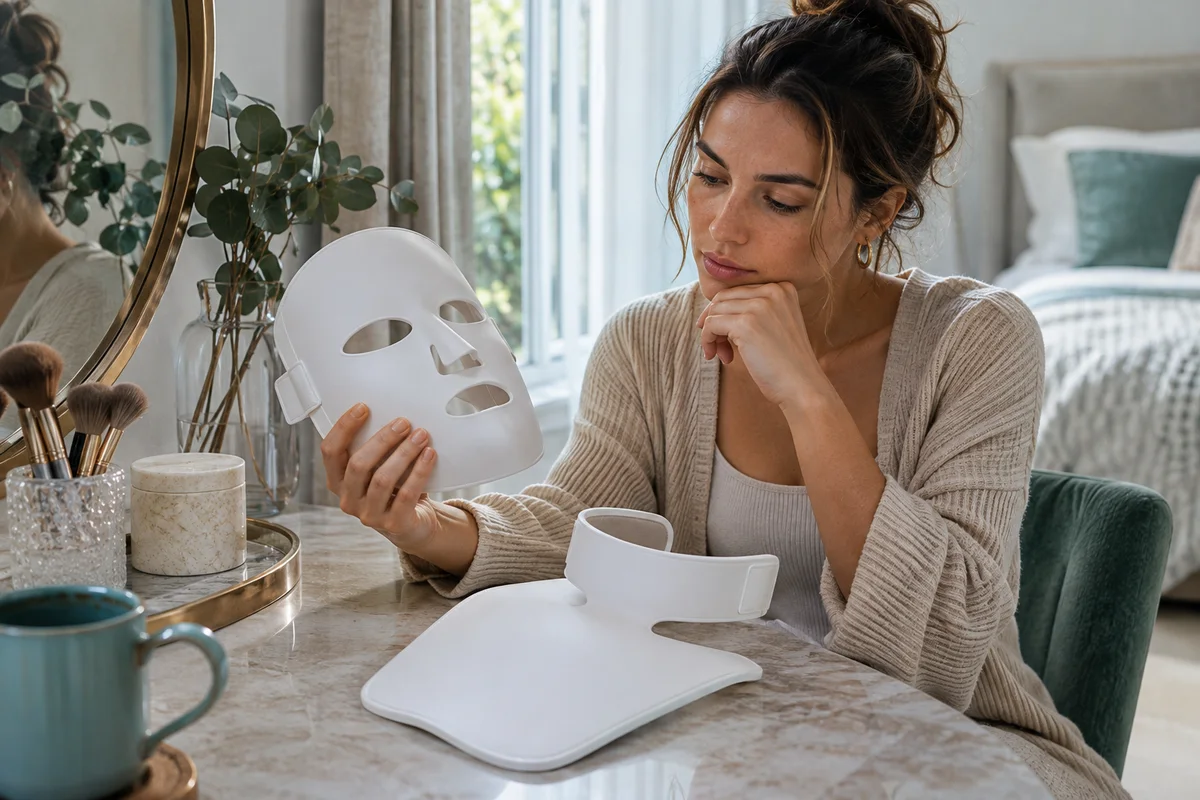 Health & Wellness
Nanoleaf Face or Neck Mask: Check the Target Area
Compare Nanoleaf face-mask and neck-mask target areas and actual bundle contents before buying one device for two different skincare tasks.
Read guide →