
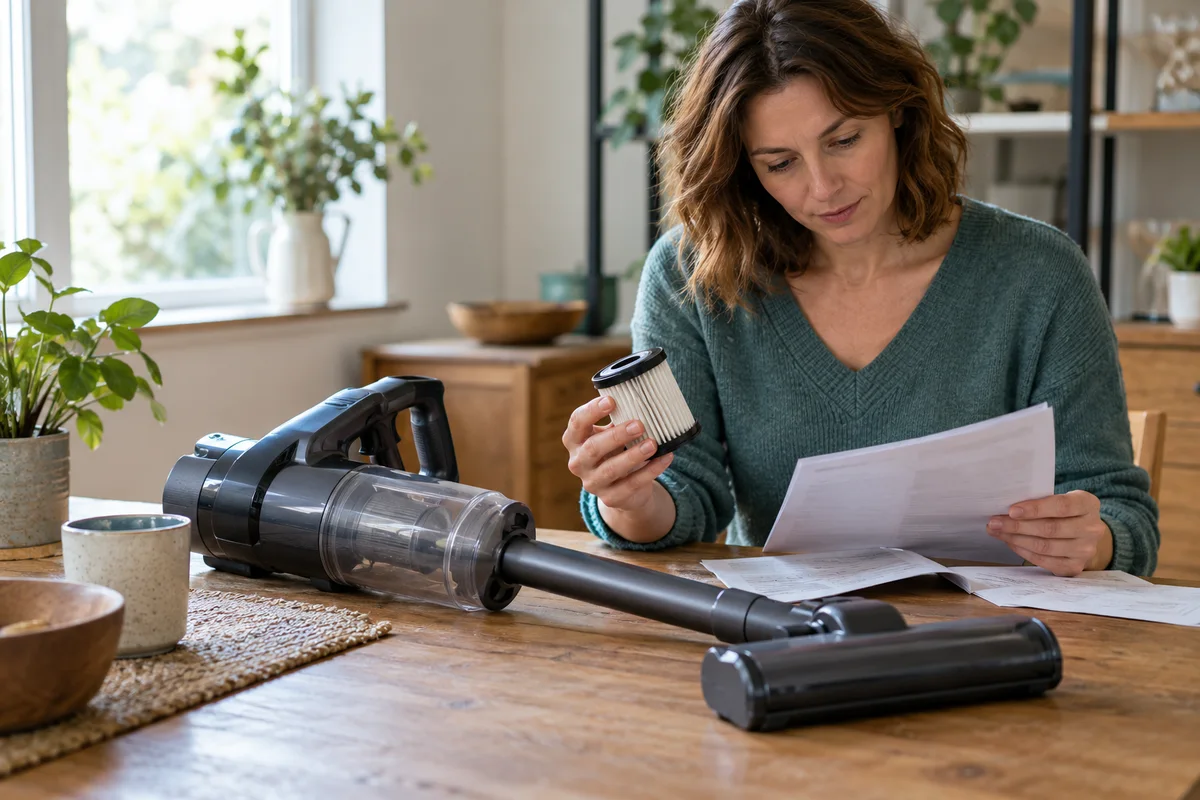
AI-generated scene illustration; not a photograph of the recommended product.
A vacuum listing promises HEPA filtration and clean exhaust air. For a household comparing Eureka NEC440BK with another cordless model, that sounds like one simple checkbox. In practice, a filter claim, a complete-machine test, the dust-emptying routine, and a person’s health needs are different questions.
The useful purchase decision is to identify what evidence the claim actually provides. That avoids paying for a number that answers a narrower question than the one the household is trying to solve.
The short answer
Eureka’s current ReactiSense 440 page advertises HEPA filtration with complete-seal wording and capture of over 99.95% under stated laboratory conditions for particles as small as 0.3 microns. Treat that as a manufacturer claim, not our independent test or a clinical outcome.
EPA’s general HEPA explanation uses a 99.97% reference at 0.3 microns. Do not silently rewrite one figure into the other, invent a certification grade, or conclude that a single number establishes whole-home air quality.
Contents
- The short answer
- Read the exact claim
- Filter and machine
- The evidence card
- Ownership conditions
- Buying advice
- Frequently asked questions
- Sources and verification
Read the exact claim
Begin with the exact model and the original source. Marketplace summaries can shorten conditions or mix wording from related products. Save the claim with its model, source URL, and check date so it can be compared fairly.
The Eureka product page supplies the percentage and laboratory qualification summarized above. It also says actual performance can vary with use and environment. Those conditions belong with the claim rather than being dropped from a shopping comparison.
The EPA explanation of HEPA filters describes the general filter concept. Its reference percentage is not a test result for this vacuum, nor an EPA approval of the NEC440.
A difference between these two numbers should prompt a precise question about test scope and terminology. It is not enough evidence by itself to accuse the manufacturer of a defective product or to claim equivalence to an unverified standard.
Avoid decimal-point shopping without context. A number can be accurately copied yet still be irrelevant to the buyer’s actual need if the tested component, operating arrangement, or intended material differs.
Filter and machine
A filter is one part of an airflow system. A complete vacuum also has collection components, seals, joints, and a path for exhaust. Ask whether a stated result concerns a filter sample, a particular assembly, or the complete machine under defined conditions.
EPA’s separate guidance for HEPA vacuums in renovation work emphasizes the machine’s design and air passing through its final filter. It also recommends asking about testing. That source illustrates why system evidence matters; it does not certify this household vacuum for renovation cleanup.
Do not repurpose a household product claim into permission to collect lead, asbestos, ash, or any other specialist material. The intended-use instructions and applicable cleanup requirements still matter independently.
Likewise, no filtration number here establishes a medical result for an individual. A household making decisions around a diagnosed condition should seek appropriate professional guidance rather than treating a shopping article as a treatment recommendation.
Our new ash-cleanup limits guide addresses one unsuitable inference separately. The present article asks how to read filtration evidence before comparing household products.
The evidence card
Use a short card for each candidate, with the exact product identity at the top. Keep manufacturer statements and independent evidence in different fields. Do not relabel marketing language as a test conducted by the publication.
Include these questions:
- What percentage and particle size are actually stated?
- Which component or complete assembly was evaluated?
- What test method, operating conditions, and configuration apply?
- Is a full report or relevant written explanation available?
- Does the evidence apply to the exact model and market version?
- What maintenance conditions are required?
- What useful evidence remains unavailable?
Send missing questions to the manufacturer rather than filling the blanks with another model’s specifications. A report for a related vacuum or replacement filter may not apply to the proposed purchase.
If independent evidence is important to your decision, define that requirement before checkout. This review has not obtained or performed a complete-machine particle test. A blank field should remain blank.
Comparisons become more useful when both products are described at the same evidence level. A documented complete-machine result and an unqualified retailer percentage should not be presented as directly interchangeable measurements.
Ownership conditions
The tested configuration, if supplied, is not the only practical question. A household still needs to install the correct parts, follow maintenance instructions, and manage collection and emptying.
The NEC440 manual requires the relevant filters to be in place. It identifies washable components and requires full drying before reassembly. Those instructions are operational requirements, not proof that every future use will reproduce a laboratory result.
Our washable-parts guide covers the specific maintenance boundary. Do not operate without a filter while another one dries, and do not substitute an unconfirmed part merely because it fits the opening.
Emptying a bagless container is a separate event from filtering exhaust during operation. Our bin-emptying checklist focuses on that task. A filtration claim should not be expanded into a promise that handling collected debris is dust-free.
Assess the person who will do the maintenance and where it will happen. If a household cannot comfortably manage the required routine, a different supported collection format may be more suitable even when a cordless model looks convenient.
Buying advice
Consider NEC440BK for ordinary supported household cleaning when the cordless format and maintenance arrangement meet the actual need, and the available filtration evidence is sufficient for the buyer’s criteria.
Pass when a purchase depends on certification, specialist cleanup approval, or a complete-machine test that has not been established. A seller’s confident adjective should not replace a required document.
Compare cleaning tasks, collection format, serviceable parts, storage, and seller terms alongside filtration wording. Do not turn this into an unsupported ranking of the healthiest vacuum or a claim that another brand will prevent symptoms.
Before ordering, confirm the exact model, installed filters, replacement-part route, current seller, and return conditions. The PartnerBoost listing is a place to inspect the current NEC440BK offer. It is not a filtration laboratory report or a medical endorsement.
If the evidence card reveals a decisive unknown, ask for clarification before paying. That is a completed buying step, not a reason to purchase first and hope the missing evidence appears later.
Frequently asked questions
Same percentages?
No. Preserve the manufacturer’s stated figure and its qualification. Do not silently replace it with EPA’s general reference figure.
Whole-machine proof?
Ask what was tested. This article has not independently verified complete-machine particle capture.
Hazardous debris?
A HEPA label alone does not establish suitability. Follow material-specific requirements and the exact equipment instructions.
Health guarantee?
None is made. Filtration specifications and personal medical outcomes are different kinds of evidence.
Sources and verification
Checked October 28, 2026. Manufacturer claims are attributed; no laboratory or clinical testing was performed.
- Eureka ReactiSense 440 filtration claim
- EPA HEPA-filter explanation
- EPA complete-vacuum design and testing questions
- Eureka NEC440 care and safety manual
Keep reading
Related guides
 Cleaning
NEC440 Ash Cleanup Limits
Separate NEC440 household floor cleaning from ash removal, and check the manual's hot-ash prohibition before choosing a cordless vacuum for a hearth.
Read guide → Cleaning
NEC440 Charger: Match the Part, Not the Plug
Check Eureka NEC440 charger identity and the official replacement route before buying a lookalike adapter or replacing a serviceable cordless vacuum.
Read guide → Cleaning
ReactiSense 440 vs 410 and 451: Match the Exact Model
Compare Eureka 440, 410 and 451 by exact identity, supplied tools and task fit rather than transferring a family chart into the wrong order.
Read guide →