
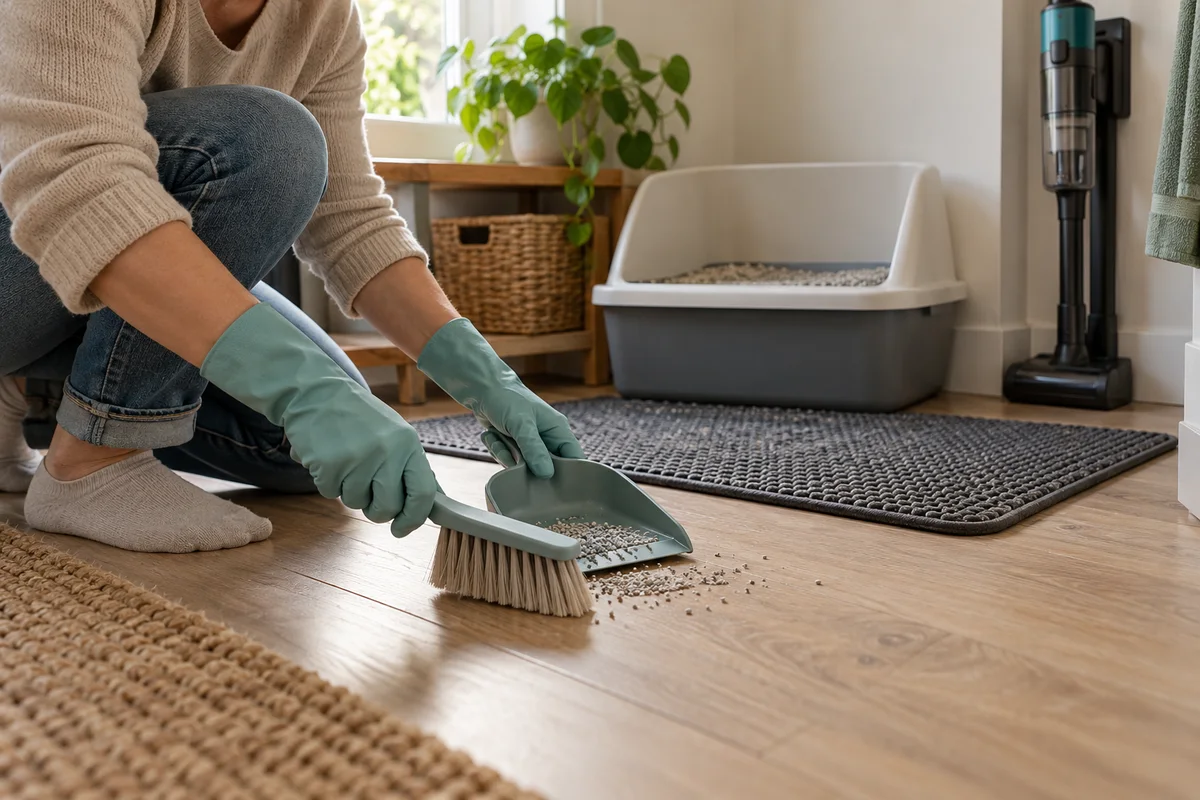
AI-generated scene illustration; not a photograph of the recommended product.
Cat litter appears along the hallway even though the box is cleaned regularly. A cordless vacuum looks convenient for another quick pass, but buying one does not change how granules reach the floor in the first place.
For a household considering Eureka NEC440, separate prevention, collection and surface care. The vacuum should have a defined supported job after that separation, not become the default destination for everything found near a litter box.
The short answer
NEC440 is a household dry vacuum, not a litter-box washing system or a promise that every litter material is suitable for pickup. Reduce tracking at the source, collect unsuitable material separately and confirm the remaining debris and surface against the exact vacuum instructions.
ARM & HAMMER’s tracking guide discusses litter characteristics, placement, mats and cleaning habits. Those measures address dispersal. They do not certify NEC440 for wet waste, every granule type or concentrated fine dust.
Contents
- The short answer
- The tracking map
- Three separate jobs
- The material check
- Mats and rugs
- The cleaning station
- The household worksheet
- Buying advice
- Frequently asked questions
- Sources and verification
The tracking map
Observe where material first appears outside the box. A small concentration near the exit calls for a different arrangement from a trail crossing a doorway or landing on a delicate rug.
Record the litter type, box arrangement, normal exit path and nearby floor. Keep this an ordinary household observation. Do not create a spill to test a vacuum or alter a cat’s established arrangement abruptly for a product demonstration.
A mat may intercept some tracked material before it reaches the room. Choose a practical surface that the cat accepts and that can be maintained according to its own instructions. A loose mat that curls across the walking route creates another problem.
The objective is to reduce repeated dispersal, not promise a perfectly litter-free home. No tracking reduction was measured for this article.
Three separate jobs
The first job is maintaining the litter box using appropriate litter and pet-care instructions. The second is collecting material that does not belong in the vacuum. The third is ordinary dry floor cleaning where the exact supported conditions are met.
These jobs can occur in the same small area without using the same tool. A dedicated brush and dustpan can keep a spill from becoming a filter and floorhead problem. Use appropriate household handling practices and local disposal guidance.
Wet clumps, urine and other damp material are not ordinary dry-vacuum debris. Keep NEC440 away from wet surfaces and do not treat a wipe, wash or deodorizing product as permission to vacuum before everything is appropriately dry.
Fine powder requires its own caution. Do not assume that a machine promoted for everyday dust is qualified for a concentrated powder spill. Ask Eureka about the actual material when its suitability is unclear.
The material check
The NEC440 manual limits use to the described household application and recommended attachments, prohibits wet surfaces and requires filters to be in place.
Those instructions do not establish a blanket approval for cat litter. The ReactiSense product page also should not be interpreted as material-specific approval simply because it shows domestic cleaning.
Read the litter and floor-care instructions alongside the vacuum manual. Pellet size, dust, additives, moisture and the surface can change the task. A generic statement that another owner vacuums litter does not qualify this exact combination.
If the material remains unconfirmed, keep it out of the vacuum and use an appropriate alternative collection method. Do not experiment by removing filtration, modifying the intake or repeatedly forcing large pieces through the floorhead.
Mats and rugs
A litter-catching mat can have pockets, flexible layers or edges that behave differently from the surrounding hard floor. Maintain it by its own supported method rather than assuming a powered brush should pass over it.
Lift or empty a suitable removable mat only as its instructions allow, without spreading collected material through the room. Keep the vacuum away from a damp mat and return it only when the intended surface is ready.
For rugs, use the NEC440 care-compatibility guide. Low suction and Auto mode are not substitutes for an independently stopped brushroll when a rug requires brush-off cleaning.
Do not choose a mat purely because its color hides litter. A household needs to see when the collection area needs attention. Appearance and practical maintenance should support each other.
The cleaning station
Place the ordinary collection tools where they can be reached without carrying a spill across the home. Keep litter-area tools separate from food-preparation equipment and follow appropriate care instructions.
For NEC440, plan a dry charging and storage position away from wet cleaning and loose material. Its charger and battery are specific supported components, not interchangeable accessories chosen by connector shape.
Allow access to the bin and filters for the prescribed maintenance. Our washable-parts guide explains why some components can meet water while the powered floorhead cannot.
A short cleaning route matters more than placing the vacuum beside the box for a photograph. The docking spot should remain stable, suitable and unobstructed when the household is busy.
The household worksheet
| Observation | Decision |
|---|---|
| First visible spill | Identify the exit or scooping source |
| Dispersal route | Consider an accepted practical interception point |
| Wet or contaminated material | Keep out of dry-vacuum work |
| Fine powder or uncertain granules | Obtain exact material guidance |
| Mat or rug | Follow its own care requirements |
| Approved dry task | Choose the supported attachment and settings |
| Upkeep | Keep bin, filters and charging area serviceable |
Review the worksheet after a normal week. If source control removes most of the recurring trail, the existing suitable cleaning tools may be sufficient.
If a supported dry floor task remains frequent, a convenient cordless machine may earn its storage space. That conclusion depends on the actual job, not on expecting a vacuum to prevent tracking by itself.
Buying advice
Consider NEC440 for confirmed supported everyday dry cleaning across the relevant floors, with a suitable maintenance and charging plan. Its usefulness around a litter area is conditional on separating unsuitable material first.
Pass if the main requirement is wet waste, washing a box, collecting an unqualified powder spill or guaranteeing hygienic treatment. A vacuum purchase does not establish disinfection, allergen control or a veterinary outcome.
The partner CTA is for the NEC440BK listing, not litter, a mat or a specialized waste-handling system. Confirm the selected package and manufacturer guidance before purchasing for a material-specific task. No pickup, dust-emission or tracking test is claimed.
Frequently asked questions
Every litter type?
No blanket NEC440 approval is established here. Confirm the actual material and condition before vacuuming it.
Wet clumps?
Keep them and wet surfaces out of the dry-vacuum task. Use appropriate separate handling.
A tracking cure?
No. A vacuum collects supported debris after dispersal; source control addresses how material reaches the floor.
Mat cleaning?
Follow the mat’s own instructions. Its pockets, layers and edges are not automatically suitable for a powered floorhead.
Sources and verification
Checked November 2, 2026. Official household-cleaning and tracking guidance, not a pickup or hygiene test. The previously saved complete NEC440 manual was reread; no fresh PDF download is claimed.
- Eureka NEC440 official manual
- Eureka ReactiSense 440 product information
- ARM & HAMMER litter-tracking guidance
Keep reading
Related guides
 Cleaning
NEC440 Rug Care Compatibility
Compare NEC440 controls with the exact rug's suction and brush-care instructions before treating automatic floor sensing as material compatibility.
Read guide → Cleaning
NEC440 Battery Retirement
Plan an NEC440 battery's end-of-life route with manufacturer and local recycler guidance before discarding, shipping or replacing a cordless vacuum.
Read guide → Cleaning
NEC440 Recharge Planning
Plan NEC440 cleaning around the manual's four-to-six-hour charging window, actual household gaps and a supported single-battery routine.
Read guide →