
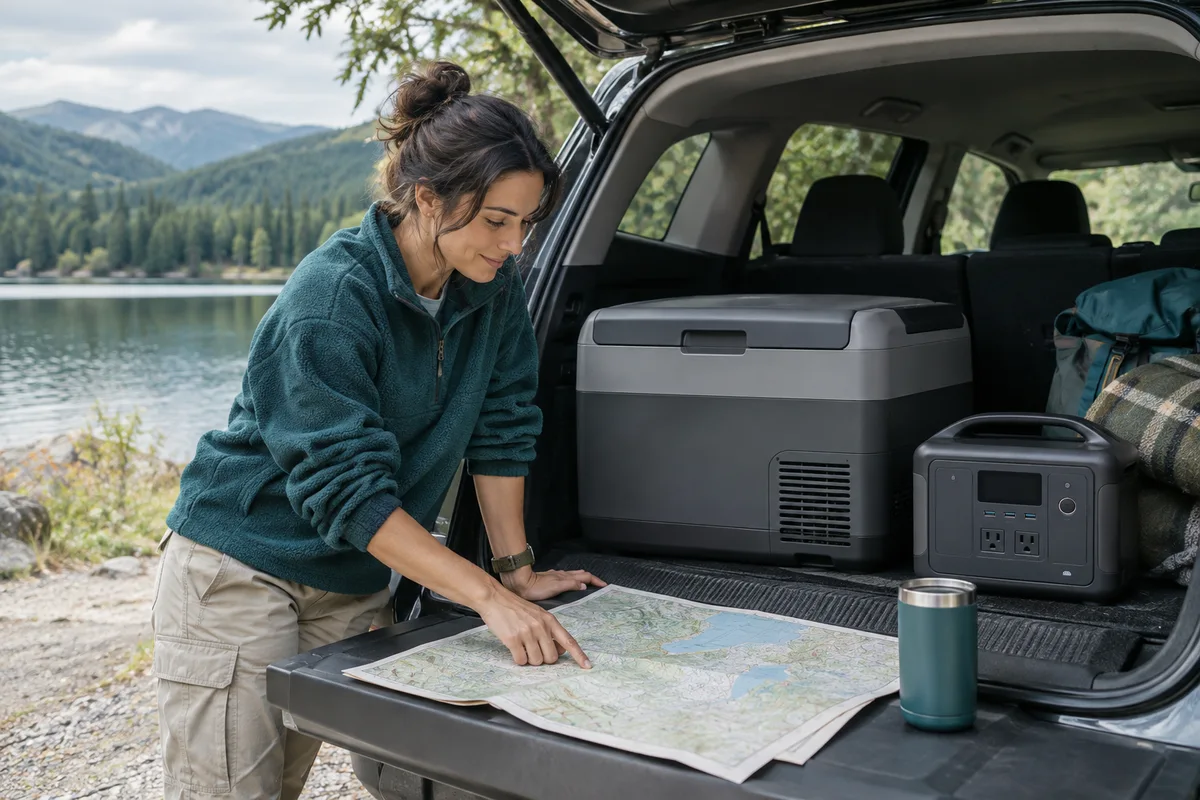
AI-generated scene illustration; not a photograph of the recommended product.
A family stops halfway through a drive and wants the portable cooler to keep running while the car is parked. The cooler’s DC plug fits the outlet on an Elite 100 V2. The next decision is not whether the plug fits; it is whether that outlet, the actual cooler and the expected stops form a supported arrangement.
The short answer
Check the cooler’s documented input, starting behavior and battery protection against the U.S. Elite 100 V2 manual. The station’s cigarette-lighter outlet is listed at 12V and 10A, and its DC5521 outlets share a combined limit with that outlet. A cooler can also stop because its own low-voltage protection has acted. Do not assume that every interruption means the station is empty or that changing the cooler setting is always appropriate.
Consider a station only if the supported connection and expected power use are confirmed. For a brief outing, a suitable passive cooler or a supported existing power arrangement may be simpler. If the cooling task cannot tolerate interruption, do not treat a generic estimate as a backup plan.
Contents
- The short answer
- Separate the car from the station
- Check the cooler’s own behavior
- Make a two part budget
- Make a stop card
- Consider the whole itinerary
- Buying advice
- Frequently asked questions
- Sources and verification
Separate the car from the station
The vehicle outlet, station input and station output are different parts of a system. A cooler running successfully in the car does not prove it will behave the same way on a station. The station may have different outlet limits and may be used when the vehicle is off. A vehicle-powered arrangement also needs the owner’s instructions for the actual vehicle and outlet.
For the station, check the exact regional manual and the delivered unit. BLUETTI’s U.S. manual distinguishes the cigarette-lighter outlet from two DC5521 outputs and describes their shared 10A maximum. The number is not a separate allowance for every jack. It also is not the station’s total AC output rating.
Use only the supported cooler cable and connection. Do not splice connectors, replace a fuse with a larger value or use an undocumented splitter to fit additional devices. If the recommended connection is uncertain, resolve it with the makers rather than troubleshooting a live setup in a parked car.
Check the cooler’s own behavior
Dometic’s CFX3 support explanation describes a protection feature that monitors the incoming DC voltage and can stop the cooler when voltage is low. That is an example of a model family, not a compatibility endorsement for the Elite 100 V2 or a setting recommendation for a different cooler.
When an approved setup stops, note what each device actually displays. A cooler warning and a station shutdown are different observations. Preserve the information and follow the model-specific troubleshooting directions. Do not repeatedly restart an abnormal setup or lower a protective setting simply because someone else used that setting with a different supply.
If startup demand is not documented clearly enough, ask the cooler manufacturer. A running figure and a maximum outlet rating do not establish how the devices behave together at startup, through a long cable or while other outputs are active.
Make a two part budget
First check current and voltage compatibility at the time the cooler runs, including any supported simultaneous loads. Then account for energy over the whole stop. Our shared DC outlet guide covers the outlet arithmetic in more detail. The distinction here is that the cooler can introduce its own cutoff as well as a load.
For a hypothetical example, a cooler averaging 30W over six hours would use 180Wh at the load. That is not a measured average or a predicted runtime for a Dometic model. Initial cooling, ambient conditions, lid use and the intended contents can change actual demand. The Elite 100 V2 product page lists 1,024Wh nominal capacity, which is not a measured quantity delivered to this cooler.
Where a supported AC adapter exists, compare the two approved supply methods rather than assuming one is always more efficient. An adapter adds equipment and an outlet requirement, but may be the appropriate documented path. This article did not measure either route.
Make a stop card
| Check | Record before leaving |
|---|---|
| Cooler | Exact model, input and supported cable |
| Station | Exact outlet and shared limit |
| Warnings | What each device reports and how to respond |
| Placement | Ventilation and secured equipment |
| Stop | Expected duration and ordinary demand |
| Fallback | Supported alternative if cooling stops |
Secure equipment for travel according to vehicle and equipment guidance. Avoid unsuitable temperatures, blocked ventilation, wet conditions and routing that can trap a cable under luggage. A photo of a parked vehicle does not show an approved driving arrangement. Treat placement and power as separate requirements.
Do not use the station’s battery display to infer the temperature of the contents. Follow the applicable storage guidance and keep an independent plan when temperature matters. This is a purchase and connection check, not food safety or medical storage guidance.
Consider the whole itinerary
For an ordinary trip, mark where you can start with an appropriate charge, where the cooler runs and where neither source is available. Keep a separate line for parking with the vehicle off. An installation supported while driving may need a different plan at a long stop; the car’s outlet behavior is specific to the actual vehicle.
The cost comparison should include the cooler’s supported cable and any additional equipment that the confirmed arrangement requires. If the alternative is an approved passive setup, consider the volume it leaves for contents and how often it needs replenishment. A power station can be useful beyond a cooler, but do not credit other household loads twice when you are budgeting a simultaneous stop. The right option is the one that works across the whole route, not just at departure.
Buying advice
Consider Elite 100 V2 if the exact supported connection, power budget and storage arrangement serve recurring stops. Skip it if the cooler’s electrical requirements are unresolved, a suitable passive option meets the job or the household is relying on an unverified continuous supply. The Elite 100 V2 overview covers broader use. Confirm the selected seller’s package and delivery independently of a manufacturer page.
Frequently asked questions
Does every 12V cooler work on the station?
No. Confirm input, starting demand, supported cable and protection behavior.
Is 10A available separately from every DC outlet?
No. The cited U.S. manual describes the relevant shared output limit.
Does a low-voltage warning mean the station is empty?
Not necessarily. Check the cooler and station observations under the applicable instructions.
Can I use nominal watt-hours to promise cooling time?
No. It is a planning input, not a measured duration or a temperature guarantee.
Sources and verification
Checked November 6, 2026. Published outlet limits and the example cooler’s protection behavior were checked. No cooler, cable, startup, temperature or runtime test was performed.
- BLUETTI Elite 100 V2 product details
- BLUETTI Elite 100 V2 U.S. user manual
- Dometic CFX3 battery protection support
Keep reading
Related guides
 Power & Outdoors
AC180 Black Friday: Check the Exact Order
Compare the exact AC180 package, seller, dispatch date and price protection before ordering during the 2026 holiday sale season.
Read guide → Power & Outdoors
AC180 Retirement and Recycling Plan
Check support and local acceptance for an intact AC180 before replacing or retiring a portable power station with a built-in battery.
Read guide → Power & Outdoors
AC180 and a Corded Leaf Blower
Check outlet protection, dry placement, motor demand and cord routing before considering AC180 for a corded blower during fall cleanup.
Read guide →