
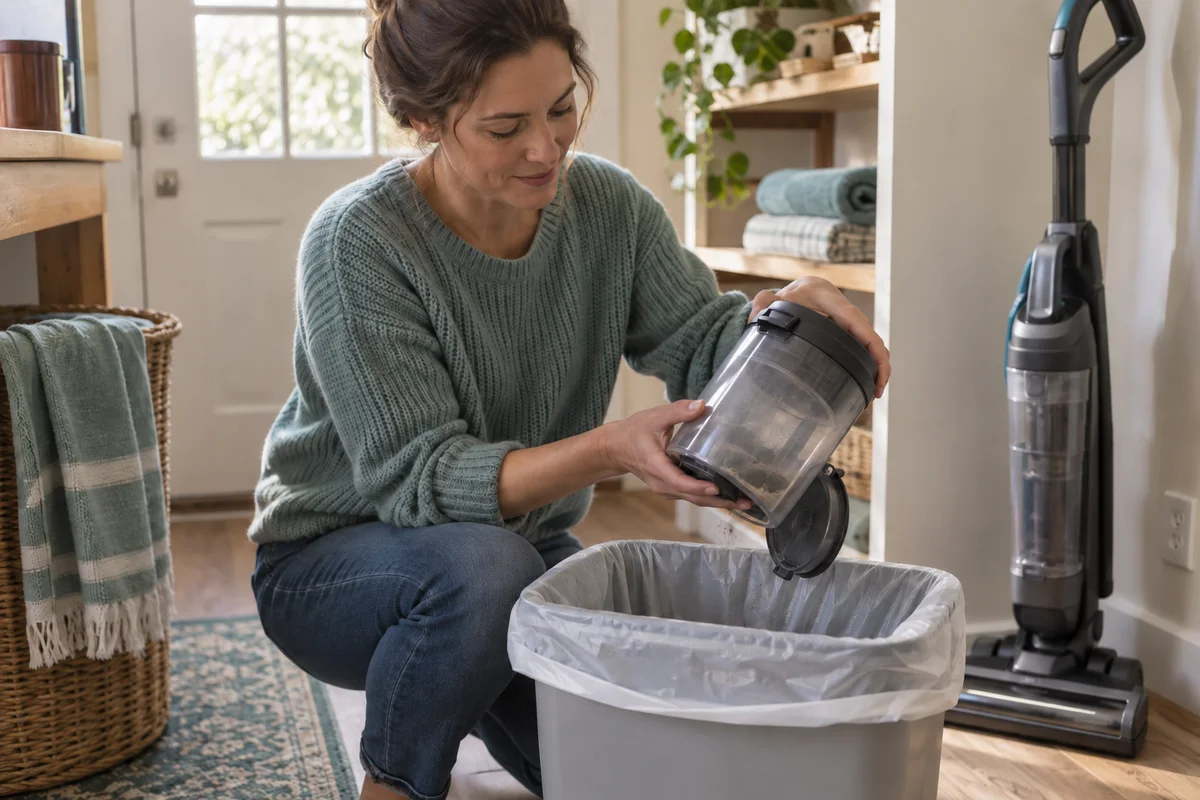
AI-generated scene illustration; not a photograph of the recommended product.
The floor cleanup is finished, but the last step happens beside the kitchen waste bin. The vacuum cup needs opening, the bin lid will not stay out of the way, and loose hair is caught where you expected everything to fall. A bagless vacuum can save one consumable while adding a handling routine that the household dislikes.
For a Dreame Z30 shortlist, evaluate that final step before buying. The question is not whether a detachable cup exists. It is whether the person using the vacuum can empty it correctly into the waste container available at home.
The short answer
The Z30 manual identifies a dust-cup bottom-cover release separately from the control that removes the cup from the vacuum. Learn the distinction from the correct component diagram, with the appliance switched off and disconnected as directed.
Check control reach, waste-bin clearance, containment, reattachment, and the cleanup that follows. Do not interpret “bagless” as mess-free or as a health guarantee. Compare a suitable bagged alternative if handling loose debris is an unacceptable part of the routine.
Contents
- Separate daily emptying from scheduled washing
- Check the two releases before lifting
- Use your real waste bin as the acceptance test
- Write a shared-household completion card
- Compare bagless and bagged ownership honestly
- Make the buying decision
- Frequently asked questions
- Sources and verification
Separate daily emptying from scheduled washing
Ordinary emptying and component washing solve different problems. One removes collected debris at the end of a cleaning session. The other involves disassembly, permitted washing, and complete drying before the appliance returns to service.
Do not wash parts simply because the cup was emptied. Follow the actual maintenance instructions and condition of the components. Equally, do not repeatedly compress debris into a full cup to avoid emptying. Use the appliance’s own guidance rather than an arbitrary household timetable.
Our Z30 filter-drying plan covers the wet-maintenance interruption. This guide focuses on the dry disposal task that happens much more often in many homes. A buyer should be comfortable with both, but they should not be confused.
Check the two releases before lifting
Read the component diagram while the machine is off, not while balancing it over an open bin. Identify the cup-removal control and the bottom-cover control. Similar-looking buttons can have very different effects.
Confirm a secure approved grip for handling the assembly. Avoid holding the machine by a release control, carrying it in an unstable position, or guessing which latch will open. If the controls are hard to distinguish, ask for an authorized demonstration before purchase.
Check whether each user can operate the required control without an awkward reach. A design that feels obvious in a product video may be difficult for a particular hand, waste-bin position, or handling preference. That is a legitimate reason to choose another format.
Use your real waste bin as the acceptance test
Write down the bin’s opening, lid behavior, location, and the room around it. A small bathroom-style opening presents a different task from a wide utility bin. The waste container is part of the vacuum’s ownership setup.
During a permitted demonstration or evaluation, assess whether the approved emptying position works without collision. Can the cover open fully? Is the appliance stable in your hands? Can you see what has happened without placing your face close to the debris?
Do not stage a dusty experiment just to create a convincing test. Use an authorized evaluation arrangement and follow the appliance and waste-handling instructions. If suitable evaluation is unavailable, obtain clear dimensions and a demonstration from the seller, and keep the remaining uncertainty in the buying decision.
Consider where a small escaped mess would land. A cleanable dry utility area may be more practical than a narrow space beside food preparation. Do not assume that moving the task outdoors is permitted for the appliance or appropriate for the waste.
Write a shared-household completion card
A useful completion card contains a few concrete checks: correct appliance state, correct release, suitable receiving bin, cover secured, cup correctly fitted, and no unresolved damage or blockage. Keep it beside the manual rather than hiding it in an order email.
Make “finished” mean ready for the next person. An open bottom cover or incompletely attached cup should not be left beside the charger as if the vacuum were usable. If something will not seat normally, pause and consult support.
Decide who handles a problem that cannot be resolved by approved ordinary maintenance. A short note describing the issue helps more than another user trying the same latch repeatedly. Do not force a component or improvise a repair to avoid admitting that the routine needs assistance.
Compare bagless and bagged ownership honestly
Bagless collection removes the need for a disposable collection bag in that part of the system. It does not remove filters, replacement parts, cleaning effort, or the need to handle debris. Include those in a multi-year comparison.
A bagged alternative has a different consumable and disposal routine. Check genuine bag availability, actual closure instructions, the frequency appropriate to your use, and storage. Neither format should be called maintenance-free.
If dust handling concerns a household member for health reasons, seek appropriate professional guidance rather than expecting an article or a filtration label to establish suitability. We have not measured airborne dust during Z30 emptying and do not claim an exposure advantage.
For an ordinary convenience decision, consider which repeated step causes less friction. Paying for bags may be worthwhile if the alternative is a bagless vacuum that sits full and unused. Avoid choosing by a consumable-saving slogan alone.
Make the buying decision
The Z30 is a candidate when supported dry cleaning and cup handling both fit your home. Check attachment storage, suitable surfaces, and replacement support alongside the emptying routine; a convenient cup cannot make an incompatible floor brush appropriate.
Pass if control reach or waste-bin handling remains unacceptable after a proper demonstration. Compare another bagless arrangement, a suitable bagged model, or the vacuum already owned. A purchase should resolve the whole cleanup, including disposal.
Create an order note naming the exact model, demonstrated handling method, unresolved questions, seller conditions, and any required approved replacement parts. Check the current partner listing only after those fields are clear. Do not add accessories without a task they actually solve.
Frequently asked questions
Is removing the dust cup the same as opening its bottom cover?
No. The manual labels separate controls. Identify them before use and follow the appropriate procedure for the intended task.
Is bagless emptying dust-free?
Do not assume that. We have not measured it. Consider your handling needs and obtain appropriate advice for any health-related concern.
Can I force a cover that does not latch?
No. Stop, check the approved instructions, and contact support if the problem remains. Do not leave an uncertain assembly ready for somebody else to use.
Sources and verification
Checked October 14, 2026. Handling acceptance is an original buying framework, not a product test or dust-exposure measurement.
Keep reading
Related guides
 Cleaning
Buying a Cordless Vacuum for Stairs: Check the Grip
Evaluate a cordless vacuum for stairs using handheld weight, reach, compatible attachments, floor materials, and a safe cleaning sequence.
Read guide → Cleaning
Dreame Z30 Filter Cleaning: Plan for Drying Time
Plan Z30 filter maintenance around approved cleaning, full drying, spare-part compatibility, and the next household cleanup.
Read guide → Cleaning
Can the Z30 Clean Wet Mud? Separate the Entryway Jobs
Separate wet mud, hazardous debris, and ordinary dry grit before choosing a Z30 for the indoor part of an autumn entryway routine.
Read guide →