
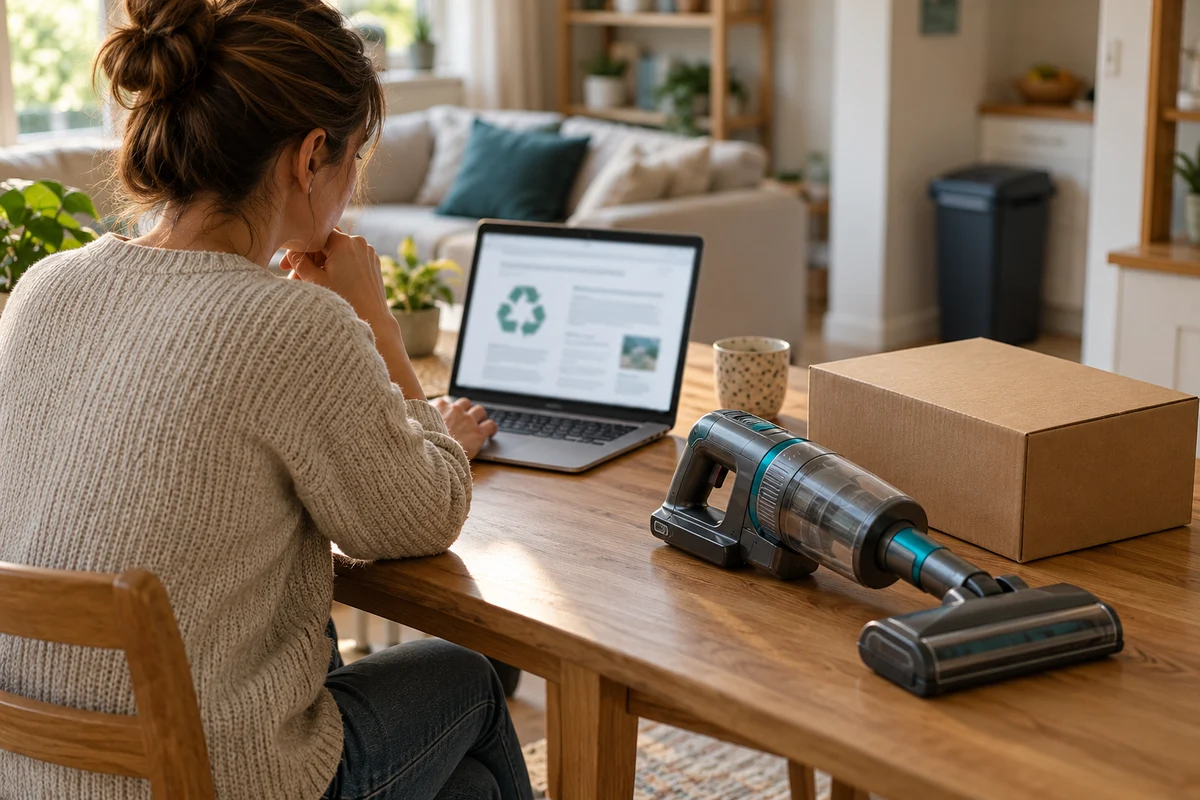
AI-generated scene illustration; not a photograph of the recommended product.
An older cordless vacuum has stopped earning its place in the cleaning cupboard. The owner orders a replacement and then discovers that the retired machine contains a lithium-ion battery. The ordinary trash and curbside recycling bins are not the appropriate next destinations for that battery.
For an NEC440 purchase or replacement decision, include the end-of-life route in the ownership plan. This is not a reason to discard a serviceable machine sooner. It is a reason to understand how a failed or retired product can leave the home without shifting the problem to waste workers.
The short answer
The NEC440 manual says the lithium-ion battery must be disposed of properly rather than with regular household trash, and directs owners to local waste guidance. EPA likewise says lithium-ion batteries and devices containing them should not enter household garbage or municipal recycling bins.
Confirm a local facility’s acceptance conditions before taking or sending the item anywhere. A damaged, defective, or recalled battery needs specific advice, not a generic drop-off assumption. This guide does not instruct readers to dismantle a pack, discharge it deliberately, or package it for shipping.
Contents
- The short answer
- Retirement and diagnosis
- Why the ordinary bins differ
- An acceptance-first plan
- Damaged-item boundaries
- Shipping is a separate decision
- Buying advice
- Frequently asked questions
- Sources and verification
Retirement and diagnosis
A disappointing cleaning session does not establish that a battery has reached the end of its life. Mode, maintenance, blockage, and other faults can affect performance. Follow the manual’s troubleshooting and use official support before deciding what needs replacement.
Our NEC440 spare-battery guide addresses exact replacement compatibility and sourcing. The different task here begins when a battery or whole machine has actually been identified for retirement or professional handling.
Keep the original purchase and support information where relevant. A warranty or service route may apply, but this article does not promise a remedy. Do not discard an item before obtaining the instructions needed for an active support case.
A product that still meets the household’s needs may not need replacing at all. Responsible retirement planning should not become an affiliate-driven excuse to sell another appliance. Identify the actual limitation before considering a new vacuum.
Why the ordinary bins differ
EPA’s used lithium-ion battery guidance explains that batteries can become damaged or crushed during waste collection and processing, creating a fire hazard. A household recycling symbol is not permission to place every battery-powered device in the curbside stream.
The NEC440 manual identifies the battery chemistry and gives its own disposal warning. Read that model information alongside the local collection provider’s requirements.
Do not generalize from a facility accepting ordinary alkaline batteries. A program can have different rules for lithium-ion packs, complete appliances, business waste, and damaged items. Ask about the actual object and its condition.
This page is not a survey of every jurisdiction or collection service. Availability, fees, accepted categories, and preparation requirements must be confirmed locally. A national information page identifies the problem but cannot promise a particular counter will accept the item today.
An acceptance-first plan
Before travelling, describe the item accurately to the provider: a household cordless vacuum or its manufacturer-identified battery, the exact model, and any known damage or recall status. Do not minimize the condition to obtain a convenient appointment.
Ask whether the facility accepts that category, whether an appointment or fee applies, and which preparation and handling instructions it requires. Keep the answer with the date and provider contact. An online locator is a starting point, not proof of current acceptance.
If removal is required, obtain the exact manufacturer-approved process and qualified assistance when appropriate. Do not open the battery casing or separate cells. This guide intentionally supplies no disassembly sequence.
Confirm what should happen to the remaining appliance and charger as separate objects. An accepted battery does not mean every other component belongs in the same collection box. A clear handover plan avoids arriving with items the provider is not prepared to receive.
Damaged-item boundaries
A battery that is damaged, defective, or recalled should not be treated as an ordinary intact item. EPA’s page directs readers toward additional guidance on these categories and the risks associated with transportation.
Do not charge an apparently damaged pack to see whether it still works, try to flatten it, open it, or make it fit a convenient container. Contact the manufacturer and the appropriate local professional service for handling instructions.
If there is immediate danger, follow local emergency guidance rather than relying on a shopping article. The photographs on this page show an intact generic scene, not a demonstration of damaged-battery handling.
Keep condition details private where they include serial numbers or purchase identifiers, but disclose the relevant condition to the receiving professional. A provider needs accurate information to decide whether and how the item can be accepted.
Shipping is a separate decision
A product return, warranty shipment, and local recycling handover are different processes. Permission from a merchant to discuss a return does not independently establish that a particular battery can be shipped through an ordinary parcel service.
Obtain applicable instructions from the manufacturer, receiving organization, and carrier before arranging transport. State the actual item and condition. Do not assume an old retail carton or a printed label supplies every required condition.
This guide does not give shipping classifications, packaging recipes, or a universal mailing method. Those details depend on the actual item and route. A damaged battery in particular should not be sent simply because a general returns portal produced a label.
For a new purchase, knowing the support route can make ownership less uncertain. It does not guarantee free disposal, free shipping, or a particular future service option. Record confirmed terms rather than using them as an unqualified environmental claim.
Buying advice
Consider NEC440BK when its permitted cleaning tasks, charging routine, and support arrangements fit the home. Include the availability of genuine maintenance parts and a workable retirement route in the comparison.
A confirmed supported repair or battery replacement may be more appropriate than a whole new machine when the rest of the vacuum remains suitable. Conversely, do not keep buying parts to compensate for an unresolved fault or an unsuitable cleaning category.
If replacement is justified, compare the complete ownership arrangement of the next machine. Current availability, accessories, seller support, and local handling options are more useful than a vague promise that a product is greener.
The partner link below concerns the NEC440BK vacuum. It does not purchase a recycling service or approve disposal of an existing battery. Complete the old item’s safe-handling plan independently of the new order.
Frequently asked questions
Can an NEC440 battery go in curbside recycling?
Do not put lithium-ion batteries in municipal household recycling bins. Confirm an appropriate separate collection route.
Does a battery collection point accept every cordless vacuum?
Not necessarily. Ask about the exact category, condition, and whether the complete appliance or a separately handled battery is accepted.
Should I open a pack to make it easier to recycle?
No. Do not dismantle the battery casing or separate cells. Obtain manufacturer and professional handling instructions.
Does a returns label prove ordinary shipping is appropriate?
No. Confirm the applicable battery and condition requirements with the relevant manufacturer, receiver, and carrier before shipment.
Sources and verification
Checked October 29, 2026. No battery condition assessment, disassembly, shipping approval, or local collection acceptance was performed. This is an ownership and purchasing framework.
- Eureka NEC440 manual, battery disposal and service guidance
- EPA used lithium-ion battery consumer guidance
Keep reading
Related guides
 Cleaning
NEC440 Recharge Planning
Plan NEC440 cleaning around the manual's four-to-six-hour charging window, actual household gaps and a supported single-battery routine.
Read guide → Cleaning
NEC440 Ash Cleanup Limits
Separate NEC440 household floor cleaning from ash removal, and check the manual's hot-ash prohibition before choosing a cordless vacuum for a hearth.
Read guide → Cleaning
NEC440 HEPA Claims
Read Eureka NEC440 filtration wording against the exact test scope instead of treating a HEPA label as whole-home or clinical proof.
Read guide →