

AI-generated scene illustration; not a photograph of the recommended product.
An afternoon outage leaves a laptop and a small lamp running from a battery station. A solar panel is connected outside, so it is tempting to assume the battery must be filling. The screen may show input power while the stored charge is still falling.
For BLUETTI AC180, simultaneous charging and use is a supported capability, not a promise of a positive energy balance. Before buying a solar bundle for a working afternoon, separate the ability to accept energy from the amount left after the equipment consumes it.
The short answer
AC180 supports pass-through charging, according to its official manual. That means charging and discharging can occur together. It does not mean solar input always exceeds demand, that the battery percentage must rise, or that the arrangement becomes uninterrupted critical-equipment power.
Build a time-based budget using actual accepted input and actual device demand. Include losses and operating conditions. Choose the station and a supported replenishment plan together rather than treating an attached panel as unlimited energy.
Contents
- The short answer
- Three different observations
- A deliberately simplified example
- An afternoon worksheet
- Keep panel qualification separate
- Separate AC bypass from solar use
- Buying advice
- Frequently asked questions
- Sources and verification
Three different observations
A connected panel, a displayed input reading and a rising charge percentage are different observations. The first describes a connection. The second describes power entering the unit at that moment. The third concerns the change in stored energy over time.
A short glance cannot establish the whole afternoon. A cloud may pass, a laptop may start charging its own battery, or another household member may switch on a device. Keep the observation period and the load arrangement beside any number you record.
Likewise, a battery percentage is not an instrument for certifying panel output or battery health. Use normal documented monitoring and obtain manufacturer support when behavior seems abnormal. Do not open the unit or improvise electrical measurements.
A deliberately simplified example
Imagine an accepted input of 150 watts and connected equipment requiring 250 watts for one hour. Ignoring losses only to explain the arithmetic, the equipment needs 250 watt-hours and the source supplies 150 watt-hours. The missing 100 watt-hours comes from stored energy.
Reverse those figures and there is an idealized 100 watt-hours left before losses and other operating demands. That is still not a guaranteed amount added to the battery. Charge control and conditions affect the outcome.
These numbers are invented calculation inputs, not AC180 measurements or a forecast of a particular panel. Their purpose is to show why seeing some input does not settle whether the battery is recovering. Do not calculate an exact percentage increase from this example.
An afternoon worksheet
| Period | Record | Decision it supports |
|---|---|---|
| Before starting | Charge level and equipment list | Establish the starting condition |
| Each meaningful change | Accepted input and connected demand | Spot a developing deficit |
| Cloud or shade | Duration and observed input | Avoid assuming all-day sunshine |
| Added appliance | Operating and starting requirements | Recheck supported output |
| End of work | Remaining charge and next recharge opportunity | Decide whether the plan is sustainable |
Use sensible observation intervals without constantly interrupting work. A changed condition matters more than collecting dozens of identical readings. Do not claim a laboratory result from the screen’s rounded values.
Put unknown figures in an unknown column. An unanswered input question should not silently become the panel’s largest advertised wattage. Equally, a device’s adapter rating is not necessarily its continuous actual consumption.
Keep panel qualification separate
First establish that the exact panel arrangement is supported by AC180. Electrical compatibility comes before an energy estimate. Our solar-array qualification guide covers that different decision.
Once the arrangement is qualified, estimate what it can actually contribute where it will be used. A panel’s headline rating is not a delivery schedule. Shadows, orientation and available daylight can change the contribution during the working period.
Do not use this worksheet to redesign a string, bypass an input limit or place the station outdoors outside its permitted conditions. A useful budget is built on a supported setup. Good arithmetic cannot make an unsuitable connection acceptable.
If your real plan involves a panel behind glass, read the separate window-solar discussion. Confirm that route exists and suits the task rather than treating every sunny window as equivalent to outdoor conditions.
Separate AC bypass from solar use
Charging from an AC outlet and accepting solar input are not the same source situation. Do not transfer an observation made while grid power is present into a claim about what happens after that source disappears.
Similarly, pass-through support does not by itself establish a no-break transfer time, compatibility with sensitive equipment, or a particular charging rate with every load. Those are separate specifications and assessment questions.
Our UPS and grid-enhancement article examines that boundary. Keep medical, life-critical and other continuity-dependent requirements outside an informal household estimate. Obtain an appropriate equipment-specific backup plan.
For an ordinary laptop task, consider what happens when stored energy becomes insufficient: save work and use the computer’s supported shutdown process. Planning an orderly finish can be more realistic than promising an indefinite working day.
Buying advice
Consider AC180 when the supported devices, initial reserve and realistic replenishment opportunity form a workable whole. A bigger panel bundle is not automatically preferable if there is no appropriate place to deploy it.
Compare three complete arrangements: charging beforehand with modest loads, compatible solar replenishment during use, and another supported charging opportunity when available. List the work and limitations of each, not only the price of the battery.
Delay the purchase when its justification depends on unverified all-day input or an essential load that cannot tolerate interruption. Reducing optional demand may solve more than adding an accessory. A smaller suitable source may suffice when the only job is one laptop.
The AC180 overview provides broader context. The partner offer below is for the station, not a verified solar installation or a particular day’s generation. Check the selected package, seller stock, delivery and returns.
BLUETTI’s own store currently carries package-specific availability notices. Those do not establish the partner seller’s inventory. Do not treat an unconfirmed shipment as a completed backup plan.
Frequently asked questions
Does input on the display mean the battery is charging upward?
Not necessarily. Connected demand and losses can use the incoming energy and more. Observe the arrangement over time rather than interpreting one symbol as a net gain.
Can a larger panel eliminate every deficit?
No. Compatibility, accepted input, conditions and demand still matter. A panel rating is not a guarantee of continuous generation.
Are the example wattages measured AC180 results?
No. They are simplified arithmetic inputs. No panel output, conversion loss or runtime measurement was performed.
Is pass-through the same as guaranteed uninterrupted backup?
No. Continuity, switching behavior and equipment suitability require separate verification.
Sources and verification
Checked November 21, 2026. Documentation-based purchasing analysis; no electrical or solar-generation test.
- AC180 official manual, pass-through FAQ and operating requirements
- BLUETTI AC180 product information and package availability
Keep reading
Related guides
 Power & Outdoors
AC180 or a Fuel Generator: Start With the Property
Compare AC180 with a fuel generator through property constraints, duration, replenishment and the complete ownership plan.
Read guide →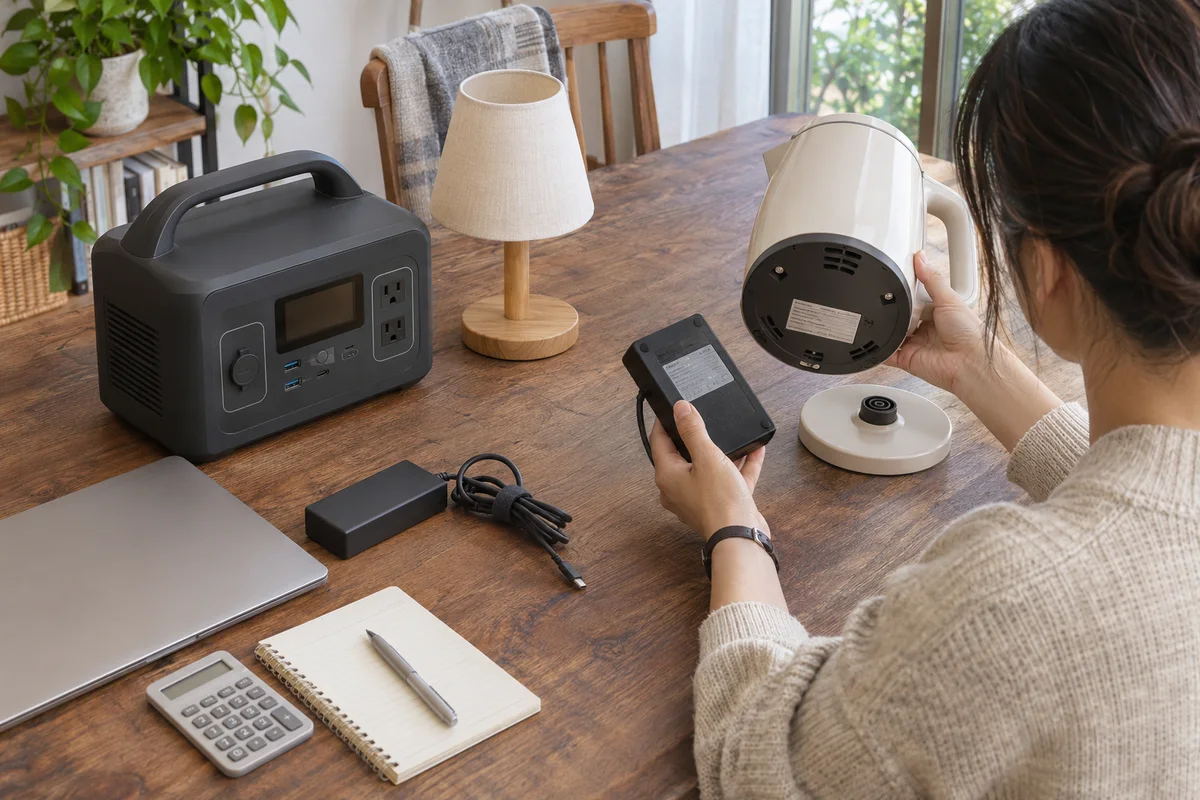 Power & Outdoors
AC180 AC Outlets: Share the Wattage, Not the Rating
Build an AC180 simultaneous-load budget before using several AC outlets; socket count does not multiply available inverter power.
Read guide → Power & Outdoors
AC180 or a Laptop Power Bank: Buy for the Load
Compare a compatible laptop power bank with AC180 through charging profiles, cable requirements, extra loads and the practical cost of carrying.
Read guide →