
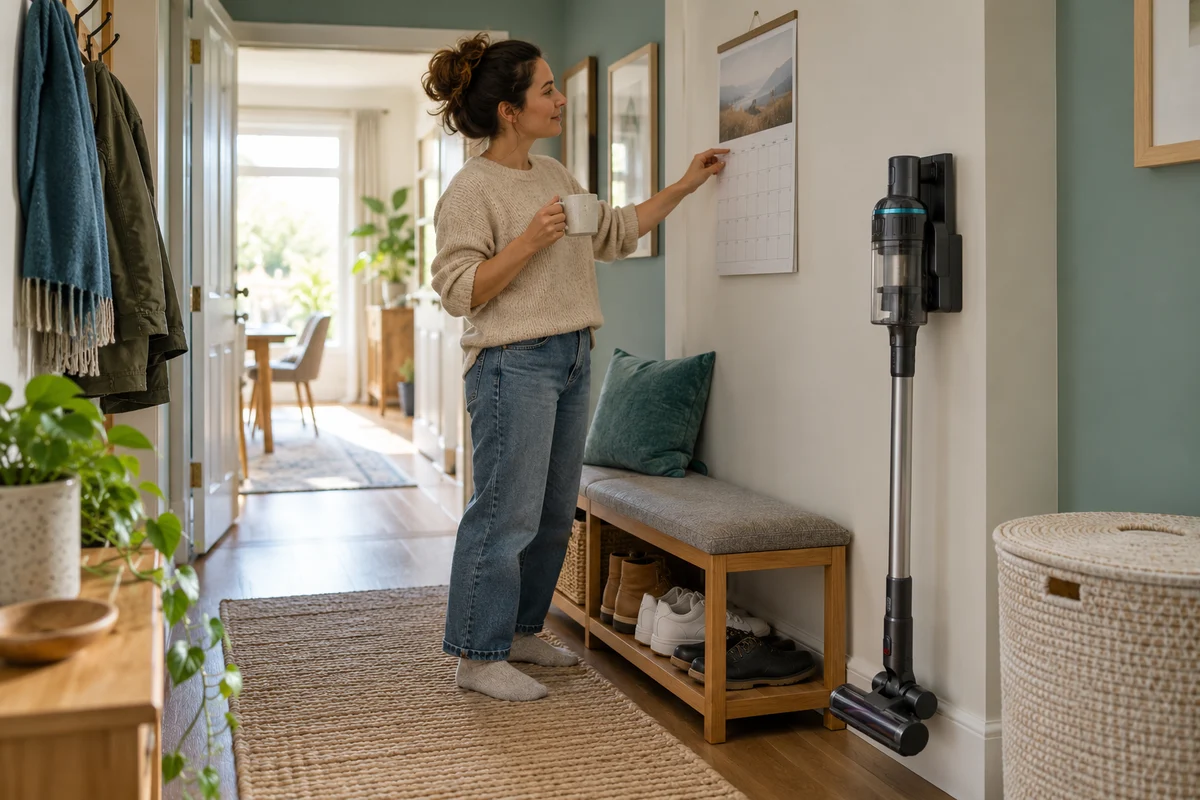
AI-generated scene illustration; not a photograph of the recommended product.
The cordless vacuum finishes the kitchen but not the rooms planned for the afternoon. The household has another cleaning window later, so the next shopping question is not simply how long the vacuum can run. It is whether the battery can be ready again when the next task actually happens.
For Eureka NEC440BK, put recharge time on the household schedule before assuming that a quick break creates another full session. This guide addresses the interval between cleaning tasks. The separate runtime and spare-battery guides remain relevant, but neither turns a rechargeable appliance into continuous power.
The short answer
The NEC440-series manual lists a charging time of four to six hours. Treat that as published model information, not a stopwatch guarantee for your battery, starting charge, temperature, or equipment condition. Follow the exact battery and supplied-charger instructions.
If the normal gap between household tasks is shorter, do not assume the next session will start fully charged. Compare a different cleaning schedule, an appropriate corded tool, or a genuinely confirmed supported battery arrangement. Do not substitute an unapproved fast charger to make a schedule work.
Contents
- The short answer
- Runtime and turnaround
- The two-window household
- A weekly timing card
- The charging boundary
- Alternatives before accessories
- Buying advice
- Frequently asked questions
- Sources and verification
Runtime and turnaround
Runtime asks how long the machine may operate under a particular mode and load. Turnaround asks when it can be ready for another task after that use. A good value for one does not automatically provide a good value for the other.
The NEC440 manual places charging time in the specification section. Its runtime figures are mode-dependent. Read the fields separately instead of treating the longest runtime as a statement about the whole day’s work.
Our Auto-mode runtime guide explains why variable demand matters during one session. Here, the different question is the gap available before the next session. Both should be acceptable before the product is chosen for a particular household routine.
A detachable battery is another separate feature. It does not prove that a spare is included, available, approved for the machine, or charged simultaneously. Do not build the turnaround plan around equipment that has not been confirmed.
The two-window household
Consider a fictional household with a morning opportunity and another before guests arrive. There are only two hours between the end of the first task and the beginning of the second. That gap is shorter than the manual’s published four-to-six-hour charging window.
The conclusion is not that the vacuum cannot do any cleaning later. The conclusion is narrower: the household cannot assume a fully recharged battery from that gap. Remaining charge and the next task’s demand have not been established.
Avoid assigning a made-up percentage to partial charging. This guide has no measured charge curve or validated relationship between minutes connected and minutes of cleaning. Half of a published time is not proof of half a useful session.
Describe the second task instead of just calling it another clean. A few ordinary dry crumbs and an entire mixed-floor route are different demands. Neither has a universal battery requirement supplied by this article.
A weekly timing card
For each ordinary cleaning window, write the start time, intended rooms or task, expected mode, and time available afterward for supported charging. Keep the record descriptive until the actual machine has been assessed under the household routine.
Add the charging location and who is responsible for restoring the supported setup. A plan depending on someone remembering an unassigned task can fail even when the product’s electrical specification is perfectly adequate.
Leave space for maintenance and unresolved problems. A full bin, blockage, or dirty filter can affect the experience. Do not diagnose every short session as a battery that needs replacing or compensate with an unsupported charging arrangement.
For an existing owner, record actual observations honestly: charging began at this time, the documented indicator showed this state, and the next ordinary task began later. A small owner log can help compare expectations without claiming an independent laboratory test.
The charging boundary
Use the approved battery and charger for the exact model. A similar connector, voltage label, or online compatibility claim is not enough to approve a different charger. Ask Eureka when the correct part or arrangement is uncertain.
Follow the supplied charging and placement instructions. Do not place cables across a route used by the household or improvise a charging position merely because it is closer to the next room. Convenience should not replace the appliance’s stated requirements.
Our replacement-charger guide addresses exact part identification. This page deliberately does not provide a faster-charging accessory or an alternate electrical procedure.
If charging behavior differs from the documented process, preserve the relevant observation and seek support. Do not repeatedly try unrelated chargers or open a battery pack to shorten the wait. A deadline before visitors arrive is not a reason to bypass a safety boundary.
Alternatives before accessories
Changing the cleaning schedule can be the least complicated option when the single-pack machine otherwise suits the home. That may mean separating ordinary tasks into different days rather than expecting several full sessions close together.
A suitable corded vacuum is another category to consider when uninterrupted cleaning matters more than cable-free handling. Assess the actual route, floor suitability, outlet access, and permitted use. A corded product is not automatically the best answer for every home.
A supported spare arrangement is worth considering only when the exact available parts, package contents, and approved charging method are established. Our spare-battery guide handles that qualification rather than treating a detachable component as stocked inventory.
Compare the complete arrangements, not the vacuum’s headline price against an imaginary spare. Include actual accessories, support, storage space, and the household’s willingness to manage charging. Do not invent a universal cost or a number of rooms the battery will clean.
Buying advice
NEC440BK belongs on a shortlist when its permitted dry-cleaning tasks, variable operating demand, and published recharge window fit the routine. Sensor-assisted operation does not remove the need for a realistic return-to-ready plan.
Pass if the purchase requires repeated full sessions separated only by a short break, with no evidence that the intended arrangement can support them. An appropriate different category or a changed schedule may answer the actual need more simply.
If you already own the vacuum, do not buy a replacement solely because a fully depleted battery is not ready on an optimistic timetable. Compare actual behavior with the manual, check permitted maintenance, and obtain support for a genuine fault.
Check the exact current partner listing for package contents and seller conditions. The commercial offer concerns the NEC440BK vacuum, not a promise of an included spare, a fast charger, or guaranteed same-day cleaning capacity.
Frequently asked questions
Is the published charging time a guarantee for every session?
No. The manual lists four to six hours, but this article has not measured a charging curve or every relevant condition.
Can I calculate useful runtime from a partial charge time?
Not from the figures here. A simple fraction of the charging window does not establish available cleaning minutes.
Does a detachable battery guarantee continuous cleaning?
No. Confirm an actual compatible spare and supported charging arrangement before relying on a swap.
Should I use a faster-looking charger?
Only an explicitly approved arrangement for the exact model is appropriate. Connector shape or a promotional claim is not approval.
Sources and verification
Checked October 29, 2026. Charging specifications were read in the complete official manual retained locally. Household schedules are illustrative; no charge or cleaning test was performed.
- Eureka NEC440-series manual, charging specifications and precautions
- Eureka ReactiSense 440 official model information
Keep reading
Related guides
 Cleaning
NEC440 Battery Retirement
Plan an NEC440 battery's end-of-life route with manufacturer and local recycler guidance before discarding, shipping or replacing a cordless vacuum.
Read guide → Cleaning
NEC440 Ash Cleanup Limits
Separate NEC440 household floor cleaning from ash removal, and check the manual's hot-ash prohibition before choosing a cordless vacuum for a hearth.
Read guide → Cleaning
NEC440 HEPA Claims
Read Eureka NEC440 filtration wording against the exact test scope instead of treating a HEPA label as whole-home or clinical proof.
Read guide →