
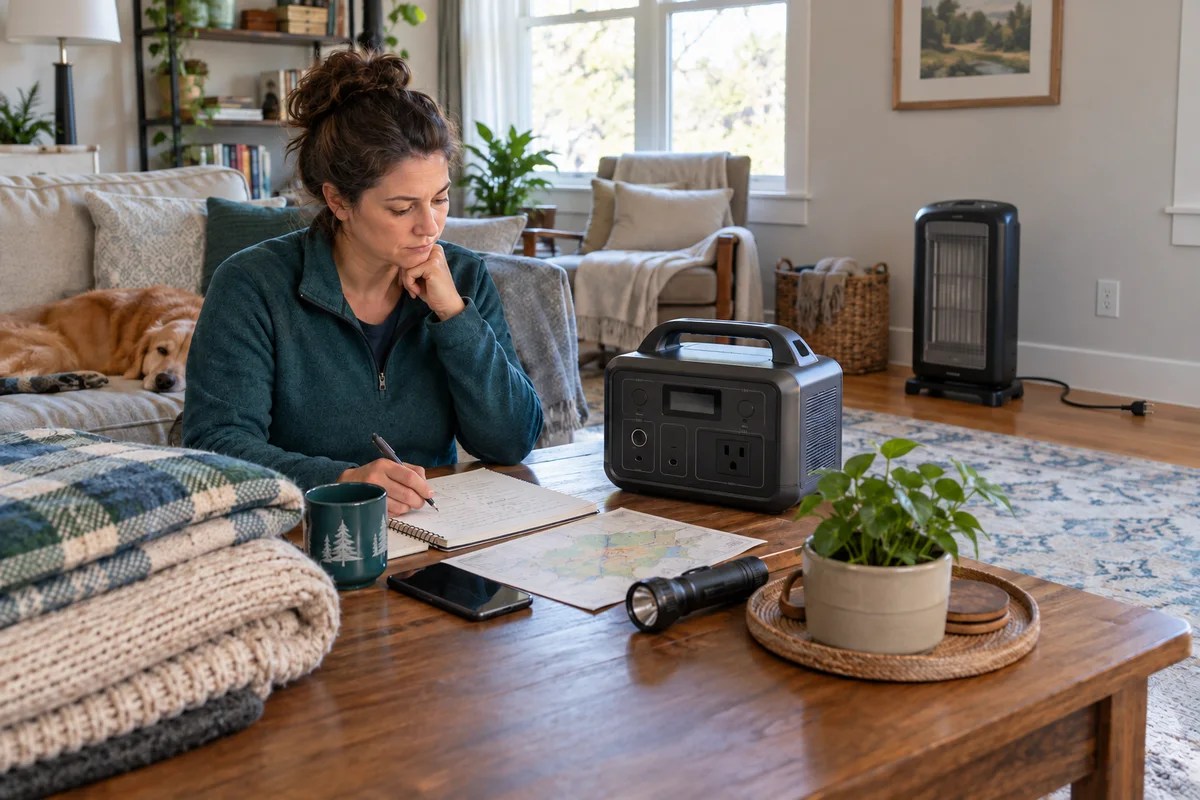
AI-generated scene illustration; not a photograph of the recommended product.
A cold-weather outage plan often starts with a tempting comparison: the space heater says 1,500 watts and the power station says 1,800 watts, so the numbers appear to fit. What the comparison leaves out is time. The output rating tells you something about instantaneous load, not how long a stored battery can deliver it.
October 13 is the International Day for Disaster Risk Reduction. The UN’s 2026 message emphasizes preparedness at home. One useful household action is to separate an electrical backup purchase from a plan for staying warm.
The short answer
BLUETTI publishes 1,152Wh capacity and 1,800W rated AC output for the AC180. Even before losses or reserve, 1,152Wh divided by a continuously operating 1,500W load is only 0.768 hours, about 46 minutes. That is a theoretical energy ceiling, not tested heater runtime or a recommendation to connect a heater.
Do not purchase the AC180 as an overnight room-heating solution. CPSC advises plugging electric space heaters directly into wall outlets, not extension cords or power strips. Follow both manufacturers’ safety instructions; a power rating alone does not establish that a proposed connection is appropriate.
Contents
- Separate watts from watt-hours
- Calculate a ceiling, not a promise
- Do not turn a mode into extra energy
- Build the warmth plan separately
- Use the battery for a defined task
- Compare the purchase with the real need
- Frequently asked questions
- Sources and verification
Separate watts from watt-hours
Watts describe the rate at which a load uses energy. Watt-hours describe an amount of energy. A station can have enough rated output for a demanding appliance and still have a limited duration because its battery holds a finite amount.
Think about an ordinary evening: a lamp uses energy slowly, while a high-power heating element uses it quickly. The two loads may both fit an output specification, but they do not leave the same energy available for the rest of the household plan.
Record the appliance’s actual supported operating demand rather than guessing from its size. A small heater can still be a substantial continuous load. The heater’s instructions and electrical requirements matter independently of any arithmetic.
Calculate a ceiling, not a promise
For a continuous example load, divide rated stored energy by the load’s watts. The AC180’s published 1,152Wh divided by 1,500W gives the idealized 46-minute figure above. It ignores conversion losses, the station’s own consumption, usable-energy limits, starting charge and any reserve.
For another illustrative load, 1,152Wh divided by 750W is 1.536 hours, about 92 minutes before those deductions. The 750W figure is a hypothetical input for comparison, not a verified mode on your heater. Halving demand improves duration but does not transform a roughly one-kilowatt-hour battery into an all-night heating system.
Real thermostat cycling can change average demand, but you cannot assume a favorable duty cycle in a cold room. How a heater cycles depends on its controls, room conditions and the required temperature. This article does not measure room heating or establish a safe overnight arrangement.
A conservative purchase decision should not depend on the most favorable unverified assumption. If your plan works only when the heater barely turns on, the plan has not addressed the reason you wanted heat.
Do not turn a mode into extra energy
A boosted or lifting-mode number does not increase battery capacity. It also does not establish universal compatibility with every electrical load. Read the current manual’s supported uses instead of treating the largest number on a sales graphic as the ordinary operating specification.
Keep combined loads visible. If a household assigns part of the battery to one demanding appliance, it leaves less for communications, light and other permitted equipment. Those competing tasks are often omitted from a product-only comparison.
Do not use a calculator result as permission to improvise cables or adapters. Electrical suitability, operating environment and manufacturer instructions must be satisfied before any load is considered. The math can identify a mismatch; it cannot certify a safe connection.
Build the warmth plan separately
List how the household will respond if indoor conditions become unsuitable, including appropriate local guidance, assistance and an alternative place to stay when needed. Do not wait until the battery is exhausted to decide what happens next.
Keep ordinary blankets, suitable clothing, communications and accessible emergency information in the plan. They are preparations, not a guarantee that remaining at home is safe in every weather event. Follow local emergency instructions, especially for vulnerable household members.
CPSC’s heating guidance emphasizes clearance from combustible materials and avoiding unsafe electrical arrangements. Never use a grill or improvised combustion appliance indoors as a substitute for lost heating. A battery purchase should not encourage another hazard when its limited energy runs out.
The UN’s home-resilience message concerns buildings, risk awareness and collective preparation, not endorsement of a particular product. A portable station can be one component of a plan; it does not make a dwelling resilient by itself.
Use the battery for a defined task
Write the limited compatible tasks for which the AC180 is actually being considered. Keep critical or medical equipment on a purpose-designed plan confirmed with the equipment provider. Do not infer medical suitability from ordinary backup marketing.
For noncritical equipment, check the supported outputs, total load, ventilation and charging arrangement. Carry out a supervised ordinary-use check only within approved instructions. Record observed consumption rather than labeling a manufacturer example as your own measurement.
Maintain a practical reserve and a recharge plan. If the grid remains unavailable, an energy store cannot replenish itself. Solar or another supported charging method introduces separate compatibility and real-condition constraints, not guaranteed unlimited power.
For the different task of refrigerator backup, our AC180 refrigerator energy guide explains why compressor startup and measured cycling need separate attention. That is not the same calculation as a continuous heating element.
Compare the purchase with the real need
The AC180 can be a candidate for a household seeking a portable reserve for defined compatible equipment. Its buying case is clearer when the outage plan specifies tasks, duration, recharge, carrying and maintenance.
Pass if the main expectation is whole-house heat, overnight room heating from this capacity, or indefinite backup. A higher output number within the same energy class does not solve those requirements. Appropriate building, heating or larger professionally specified backup options belong in a separate assessment.
Check the current partner listing only after the limited use case is clear. Do not pay for a product whose main appeal depends on confusing watts with hours. Preparedness is improved by recognizing the limit before an outage, not by discovering it during one.
Frequently asked questions
Does 1,800W output mean 1,800 hours or a full night?
No. Output is a rate, not duration. Stored energy and the actual load determine an energy estimate.
Is the 46-minute result tested AC180 heater runtime?
No. It is an idealized arithmetic ceiling using the published capacity and a hypothetical continuous 1,500W load, before deductions.
Does a higher power mode create more battery capacity?
No. Do not confuse load-handling modes with stored energy or universal appliance compatibility.
Sources and verification
Checked October 13, 2026. No heater connection, room-temperature or runtime test was performed.
- BLUETTI AC180 official capacity and output information
- CPSC 2026 heating safety guidance
- UN Secretary-General’s October 11, 2026 home-resilience message
Keep reading
Related guides
 Power & Outdoors
Can You Fly With an AC180? Check Watt-Hours First
Compare the AC180's 1,152Wh battery with current U.S. passenger-baggage limits before buying portable power for a trip involving flights.
Read guide → Power & Outdoors
Elite 100 V2 ECO Mode: Check Small-Load Shutdown
Check Elite 100 V2 ECO behavior under low or intermittent demand before relying on small lights, chargers, or networking devices.
Read guide → Power & Outdoors
Elite 100 V2 Solar Panels: Check Voltage Before Watts
Compare solar panels by open-circuit voltage, current, connectors, real placement, and recharge needs rather than headline wattage.
Read guide →