
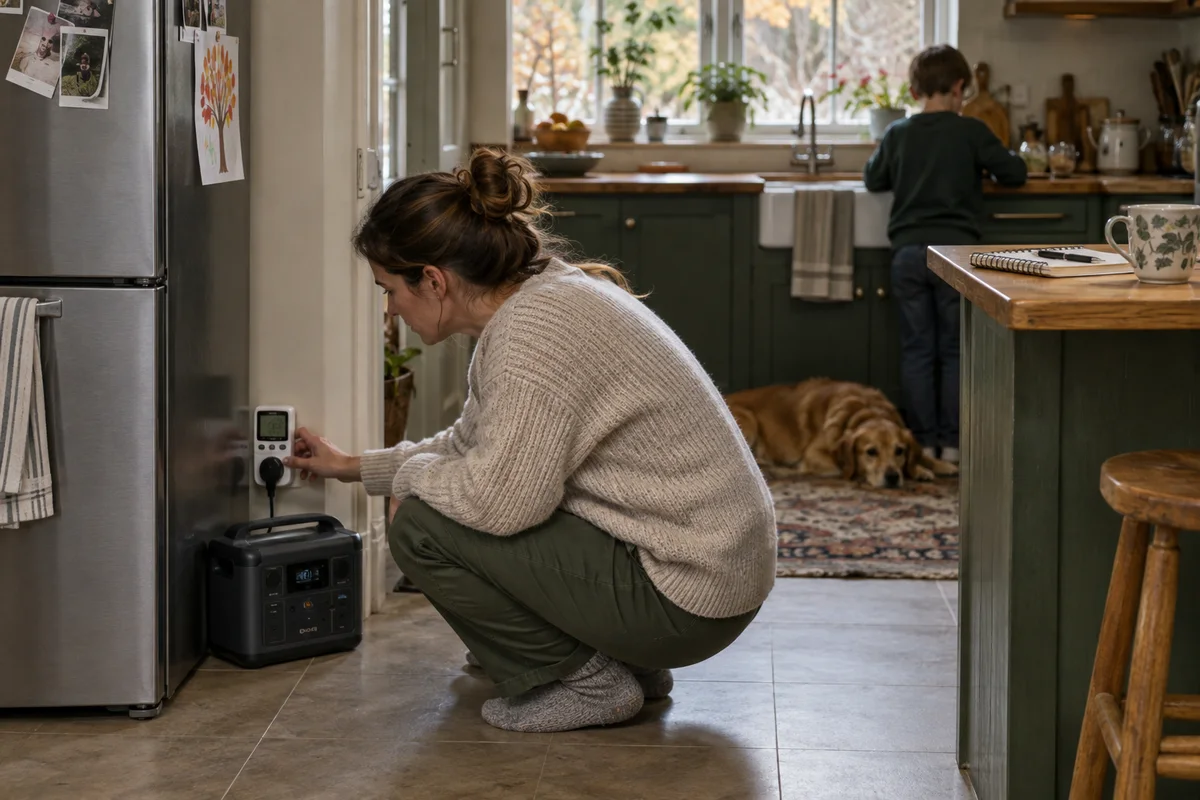
AI-generated scene illustration; not a photograph of the recommended product.
The kitchen lights go out while dinner is cooling. The refrigerator is still full from the weekend grocery trip, and the household has one question: will a portable battery cover the evening, or only the next hour? That question is more useful than asking how many appliances a power station can power at once.
October is still within the Atlantic hurricane season, which NOAA defines as June through November. That makes this a sensible preparation task, not evidence that a particular storm is heading toward your home. Measure the refrigerator before an outage, while you have time to discover problems calmly.
The short answer
A BLUETTI AC180 may run a compatible refrigerator for several hours, but there is no honest universal runtime. Its published battery capacity is 1,152Wh and rated AC output is 1,800W. Capacity determines the energy budget; output power determines whether a load can run. Neither number alone tells you the refrigerator’s daily consumption or startup requirements.
For an illustrative estimate, assume 850Wh reaches the load after reserves and losses. An average 60W demand would suggest about 14 hours; 120W would suggest about seven. These are arithmetic examples, not AC180 measurements, guarantees, or food-safety deadlines.
Measure energy instead of guessing from the label
A refrigerator cycles between quiet intervals and active cooling. The electrical label may describe a rated demand, not the average across a warm afternoon. Opening the door repeatedly, adding warm groceries, room temperature, defrost cycles, and the appliance’s condition can all change consumption.
Where the appliance and local electrical rules permit it, use a suitably rated plug-in energy meter over a representative day. Record total kWh rather than only the momentary watts. If the meter reports 1.2kWh over 24 hours, the corresponding average is 50W: 1,200Wh divided by 24 hours. That is a starting estimate, not a promise that every future hour will look the same.
Measure with your normal household routine. A test made with an empty fridge and a cool room is not representative of a summer garage refrigerator. If you cannot safely access the plug, do not move a heavy appliance or improvise electrical work just to collect a number.
Keep startup power separate from runtime
The compressor can require a brief higher demand when it starts. A battery that has enough stored energy may still fail to start a particular refrigerator. Read both manuals and check the appliance’s startup requirements against the station’s supported output behavior.
Do not treat a boosted-output mode as permission to run any appliance. Suitability depends on the load, voltage behavior, and the manufacturer’s instructions. A high advertised peak number is not an independent demonstration that your compressor will start reliably.
During a supervised, noncritical trial, connect only the refrigerator through an approved arrangement and observe several normal cycles. If there is an overload warning, unexpected shutdown, abnormal noise, or repeated restart, stop and resolve compatibility. Avoid testing first during an actual emergency.
Build a conservative energy budget
Start with the energy available at the battery’s actual starting charge. Reduce the budget for the reserve you want to keep, conversion losses, and station self-consumption. Then divide by the refrigerator’s representative average demand.
For example, a homeowner might deliberately plan around 850Wh rather than all 1,152Wh. If their measured refrigerator averages 80W, the simple calculation is 850 divided by 80, or about 10.6 hours. A practical plan would stop short of promising that duration because conditions and equipment behavior vary.
Write the assumptions beside the result. A useful note says “one refrigerator, measured cool-weather average, fully charged station, no other loads.” An unqualified “ten hours of backup” is easy to misunderstand when someone later adds a coffee maker.
Choose one priority appliance
The temptation is to connect a lamp, phones, the television, and a microwave because the station has several outlets. Every additional load reduces the refrigerator’s share of the stored energy. A short burst from a high-power appliance can consume a meaningful part of the reserve.
If refrigerator backup is the purchase’s main purpose, keep a dedicated plan for it. Charge small devices separately where possible and decide beforehand which loads you will decline. A whole-house backup system is a different project involving installation and electrical design; this portable station is not a substitute.
For a separate communications plan, see our router and laptop outage budget. The point is to allocate power deliberately, not to build an optimistic list of everything with a plug.
Buying checks that matter more than a discount
Check the exact regional model, socket type, continuous output, battery capacity, weight, and the distance between the safe battery position and appliance plug. Keep the unit dry, upright, and ventilated according to its manual. Do not block a doorway or create a cable trip hazard.
Also check how you will recharge it if the outage outlasts the stored energy. Solar charging depends on compatible panels, weather, placement, and supported input limits. A panel in a photograph does not prove that the advertised bundle includes it.
Never connect a portable station to household wiring through an improvised outlet arrangement. Do not use indoor combustion generators, and do not bypass appliance or station protections. If your needs involve medical equipment, essential temperature control, or extended outages, obtain a purpose-designed plan instead of relying on this shopping estimate.
When the AC180 is a reasonable candidate
It is worth considering when one compatible appliance is the priority, you can move and store the unit safely, and a limited energy reserve solves a specific outage gap. Its published capacity gives a concrete basis for comparison with smaller batteries.
Skip it if the only acceptable outcome is indefinite backup, several large appliances simultaneously, or unattended operation without verifying compatibility. Compare alternatives by usable energy and your measured load rather than choosing the largest outlet count.
Before buying, make a small worksheet: refrigerator average, startup requirement, desired reserve, target hours, charging method, and safe location. If any box remains unknown, the worksheet tells you what to investigate. It is a better buying tool than a universal runtime claim.
Frequently asked questions
Can I calculate runtime from the refrigerator’s watts?
Only if the number represents an appropriate average and you account for available energy and losses. A single active-cycle reading can misrepresent a cycling appliance. Measured consumption over time is more useful.
Does 1,800W mean the battery lasts longer?
No. Watts describe power at a moment; watt-hours describe stored energy. A higher output rating can support a larger compatible load, but that larger load generally consumes the battery faster.
Is a successful power test proof that food will remain safe?
No. A runtime trial verifies electrical behavior, not food temperature or safety. Use authoritative local food-safety guidance and actual temperature information; do not infer a safe deadline from this article.
Sources and verification
Checked October 12, 2026. Product specifications are manufacturer claims; examples above are our stated planning assumptions, not hands-on test results.
- BLUETTI AC180 specifications and operating information
- NOAA explanation of the Atlantic hurricane season
Keep reading
Related guides
 Power & Outdoors
Power a Router and Laptop Through an Outage
Build a small backup-power budget for your modem, router, and laptop, and check the weak links that a bigger battery cannot fix.
Read guide → Power & Outdoors
BLUETTI Elite 100 V2 Review: A Lightweight Power Station for Storms
A single lightweight power station for apartment renters and weekend campers who need fast, quiet backup power without a garage generator or a slow-charging alternative.
Read review → Power & Outdoors
Olight PL-X Dual-Beam Rail Light: Specs, Fit, and Range Guide
For pistol owners who need one rail-mounted light that switches between a focused spotlight for distance and a wide floodlight for close-range identification, this guide breaks down the fit.
Read review →