
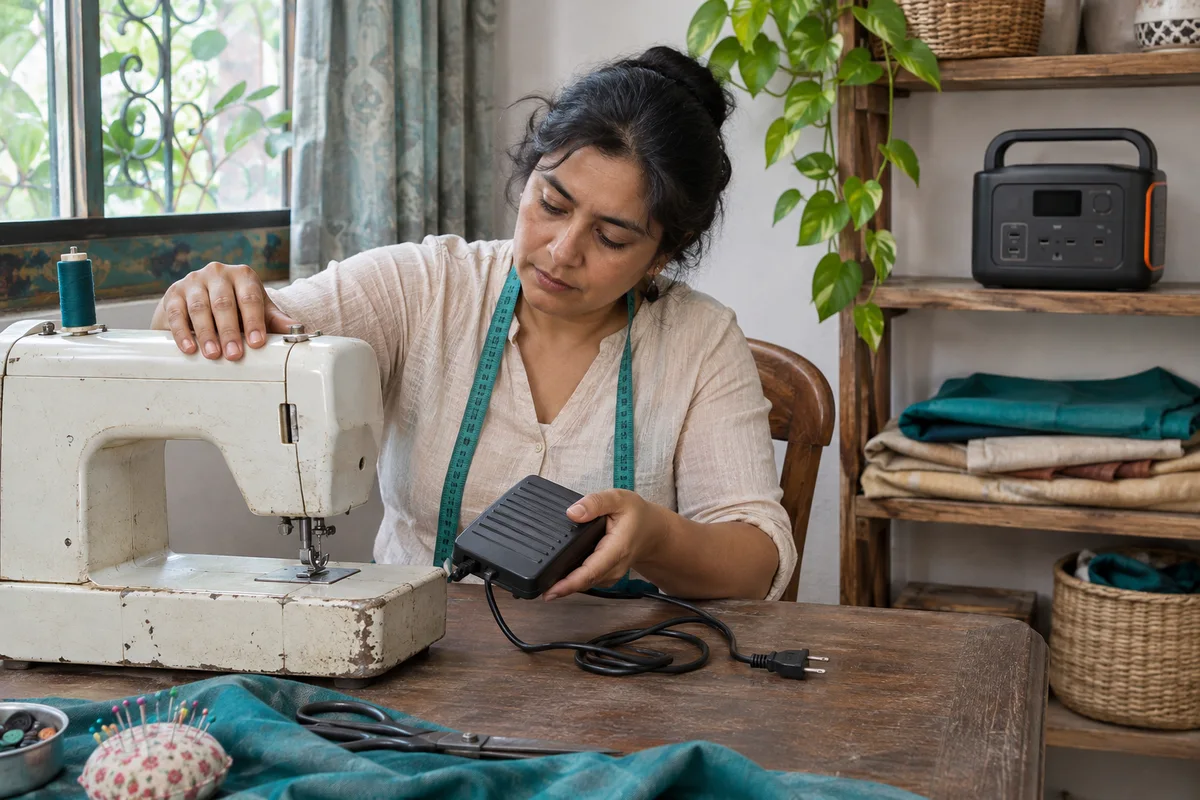
AI-generated scene illustration; not a photograph of the recommended product.
The repair pile fits on a kitchen table, but the electrical outlet does not reach the end where the sewing machine and work light sit. A portable power station looks like a way to move the work closer to a window. The mistake is to check only the machine’s wattage and treat the pedal, fabric and placement as details to solve later.
The short answer
Consider an AC180 only after the sewing machine manufacturer confirms that the proposed power arrangement is allowed. The U.S. AC180 has a published 1,800W AC output and 1,152Wh battery capacity. Those are station specifications, not approval for a particular machine or a measured sewing-session runtime. Check the pedal route and where the fabric goes before assigning a spot to the battery.
For occasional mending, a suitable existing wall outlet and a rearranged table can be the better purchase decision. A portable station earns its space when the need to work away from an outlet is real, the equipment is approved for that source, and the whole layout works without a cord under a chair or fabric covering vents.
Contents
- The short answer
- Start with the machine label
- Follow the foot controller
- Make room for cloth and light
- Budget a session rather than a shift
- Save a worktable card
- Buying advice
- Frequently asked questions
- Sources and verification
Start with the machine label
Copy the model and electrical input from the machine, not the machine name from an old listing. A mechanical model with a combined cord and controller can be different from a computerized model with separate connections. A similar-looking plug does not answer whether the source or controller is supported.
Brother’s CS7000X manual directory is one example of a model-specific place to start. Read your own operation manual and ask the manufacturer if the permitted source is unclear. Do not infer portable-inverter approval from a description of household use.
An inherited sewing machine adds a separate question: whether its cables and controller are in serviceable condition. A modern battery is not a fix for a worn cord, cracked plug or undocumented controller replacement. Get the machine assessed before planning any power change.
Follow the foot controller
Lay out the proposed station with everything switched off and disconnected. Put the foot controller where the operator naturally sits, then check whether the chair’s normal movement or a loose garment can cross the cable. Think about walking into and out of the work area as well as sitting still.
Brother’s controller instructions show why a foot controller is not merely another outlet load. On the supported models listed there, the controller changes how the machine starts and stops. The manufacturer says to switch off the machine before connecting it and to keep material from accumulating at the pedal.
Follow the actual instructions for your machine rather than borrowing those steps for a different brand. Do not connect the pedal to a power station or use the power station’s controls as the machine’s stop control.
Make room for cloth and light
A table that looks spacious with a folded shirt can look different with curtains or a quilt laid out. Consider where material hangs when turned, where the operator sets scissors, and whether someone can reach both controls without leaning over a running machine.
Give the station its own stable, dry, ventilated spot within the maker’s placement requirements. Keep loose cloth, lint and other obstructions away. If the only location is under the edge of a falling blanket or in the path of the pedal, reject the layout instead of relying on someone to watch it continuously.
Treat the lamp separately. Daylight might be enough for measuring and pinning but not for a later repair. Conversely, an existing independent lamp may solve the problem without requiring the main work area to depend on a second AC device.
Budget a session rather than a shift
Start with an ordinary task such as sewing one seam, winding a bobbin and turning the machine off while pressing the fabric elsewhere. A session can include idle time, light and machine use in different proportions. Multiplying the machine’s maximum input by the entire afternoon can be a misleading estimate, while ignoring other equipment can underestimate the need.
For arithmetic only, suppose a setup draws 60W during a combined 20 minutes of work and a separate lamp draws 12W for one hour. That is 20Wh plus 12Wh, or 32Wh at the loads, before conversion and idle losses. Those figures are hypothetical, not observations of a Brother machine or a promise of AC180 runtime.
Do not include an iron or heater as if it were part of the low-power estimate. Each has separate electrical requirements, placement and safety instructions. If the plan becomes a complete pressing and sewing station, revisit the list instead of extending the smaller example.
Save a worktable card
| Check | Record before ordering |
|---|---|
| Machine | Exact model and approved source |
| Controller | Matching part and clear route |
| Work light | Separate supply and use time |
| Fabric | Largest item’s movement and drop |
| Station | Stable, dry, ventilated location |
| Session | Ordinary loads and stop point |
| Fallback | Existing approved wall setup |
Put the card with the machine instructions so a second household member knows what has been confirmed. It is more useful than a note saying that the power station has enough watts. Recheck it if the table moves or a larger project changes how cloth and cables pass through the space.
Our sewing workspace guide covers the chair and pedal reach from another angle. A comfortable seat does not resolve electrical compatibility; electrical compatibility does not make an awkward pedal route comfortable.
Buying advice
Consider the AC180 if the compatible sewing setup is one recurring use for a station you can also recharge and store appropriately. If the location is occasional, test the table arrangement with disconnected gear first. The trouble may be a lamp or table position, not lack of battery capacity.
Pass when the machine’s permitted source is unresolved, cables would cross a walkway, or the unit cannot be placed as directed. The AC180 overview provides broader purchase context. The manufacturer showed a later expected restock on November 5; verify the selected seller’s actual delivery independently, especially if a project has a deadline.
Frequently asked questions
Does a low machine wattage prove compatibility?
No. Check the machine’s permitted power arrangement as well as voltage, demand and the rest of the equipment.
Is a foot controller a separate AC appliance?
Not necessarily. Check the exact machine and controller instructions. Do not adapt the connector or transfer instructions from another model.
Can I use the worked example as a runtime estimate?
No. The values only illustrate energy accounting. The guide did not measure the setup or the station’s losses.
Should I also count an iron?
Yes, as a separate proposed load and workflow, if its use is approved. Do not bury it in a sewing-machine estimate.
Sources and verification
Checked November 5, 2026. We verified published station ratings and the example machine’s support information; no sewing, motor startup or runtime test was performed.
Keep reading
Related guides
 Power & Outdoors
AC180 and a Corded Leaf Blower
Check outlet protection, dry placement, motor demand and cord routing before considering AC180 for a corded blower during fall cleanup.
Read guide → Power & Outdoors
Elite 100 V2 and a Portable Monitor
Separate USB-C video, monitor power and laptop charging before buying Elite 100 V2 to support a portable dual-screen workspace.
Read guide → Power & Outdoors
AC180 Dehumidifier Backup
Assess AC180 dehumidifier backup through compressor demand, room conditions, drainage and a defined moisture-control task before buying a station.
Read guide →