
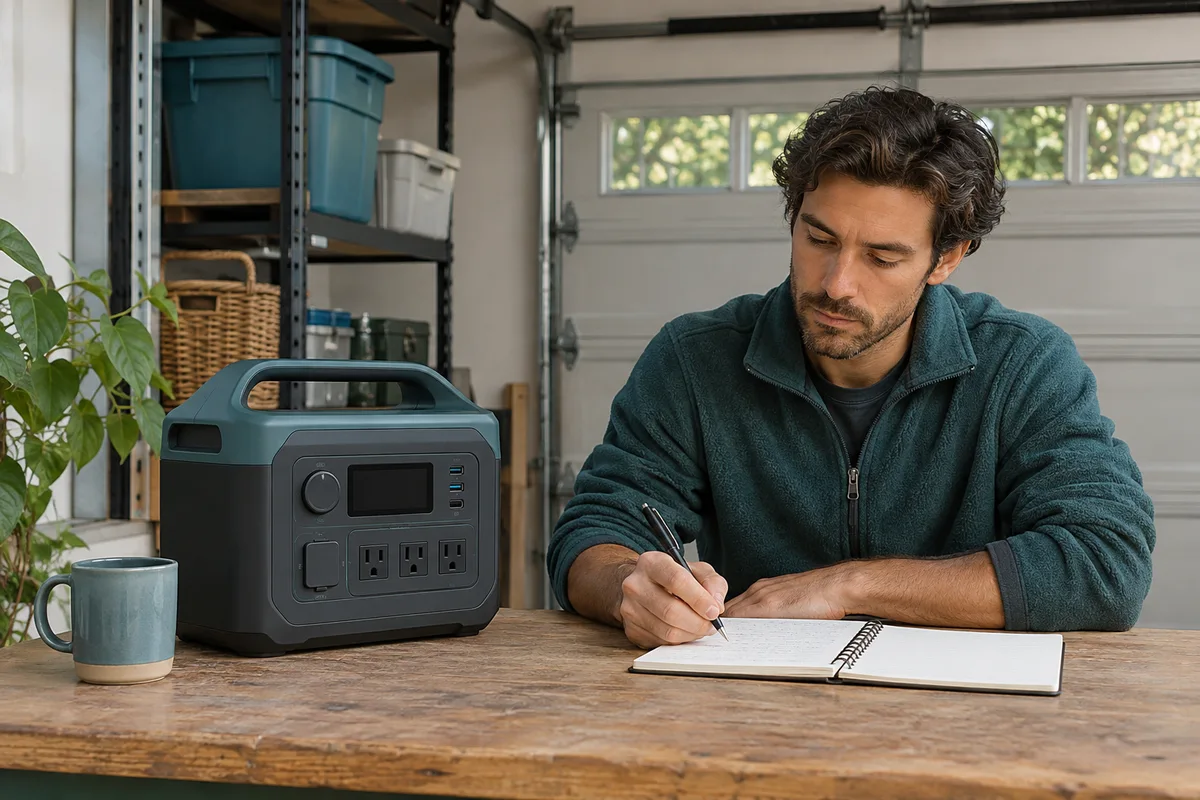
AI-generated scene illustration; not a photograph of the recommended product.
A portable station has spent several years on a garage shelf. Now its owner is comparing a replacement and wondering whether the old unit goes to the same drop-off bin as a handful of household batteries. That question matters before the new carton arrives. A power station contains a battery inside a larger piece of equipment, and the practical task is finding a recipient that accepts the complete unit in its actual condition.
The short answer
Do not put a retired AC180 in household trash or curbside recycling, and do not open the housing to extract its lithium battery. Start with BLUETTI support if the unit might be serviceable. If it is being discarded, call a suitable battery or electronics recycler or household hazardous waste program and ask about the intact model, capacity and condition before transporting it.
A working station that no longer meets your needs is not automatically waste. A damaged or recalled station is not automatically suitable for donation or ordinary drop-off. Keep the purchase, repair and disposal decisions separate until you know which situation applies.
Contents
- The short answer
- Identify the equipment without opening it
- Check service before replacement
- Find a facility that accepts the whole unit
- Save a handoff card
- Plan the replacement handoff
- Buying advice
- Frequently asked questions
- Sources and verification
Identify the equipment without opening it
Find the exact model on the outer label and compare it with the purchase record. BLUETTI lists the U.S. AC180 at 1,152Wh and identifies its battery chemistry in the official product information. The nearby AC180P designation has a different published capacity. Use the label and manual for the unit you actually own rather than copying a similar listing.
Write down the condition using simple descriptions. A unit that functions but is too small for new loads presents a different problem from a unit that is physically damaged, has been exposed to water or behaves abnormally. Do not turn the unit on just to complete the form if its condition makes operation inappropriate.
Keep the serial number for a private support request if asked. It does not belong in a public comment or a photo shared with a potential buyer who has not established a reason to receive it.
Check service before replacement
Use the AC180 support page to locate the current manual and manufacturer assistance. Describe the symptom, the approximate purchase date and the model. If there was a visible warning during ordinary use, preserve that information rather than forcing the unit to produce it again. Our support record checklist covers evidence for a fault report; this guide covers what happens if the unit is no longer kept.
A decrease in the length of a session does not, by itself, tell you what failed. A different load, a different starting charge or changed settings can affect an observation. Support may recommend further checks, service or a different disposition. Follow the applicable instructions rather than treating a purchase guide as a troubleshooting procedure.
If the unit is unsafe to use or its condition is uncertain, do not charge it, deliberately discharge it or offer it as working to someone else. Get appropriate guidance. If there is smoke, fire or an immediate hazard, get away from it and contact emergency services rather than attempting to package or transport it.
Find a facility that accepts the whole unit
The EPA lithium-ion battery FAQ distinguishes specialized collection from household trash and municipal recycling. A recycling symbol does not establish that a curbside service or a small retail drop box accepts a portable power station.
Contact the facility or your local waste authority before making the trip. Say it is a complete portable power station with an internal lithium battery and give the exact capacity and condition. Ask whether the program takes this size of equipment, whether an appointment or proof of residency is needed, and how it handles units that are damaged or subject to a recall. Do not leave it outside a closed facility or assume an unattended box is suitable.
If support proposes a return, ask for the applicable instructions rather than independently mailing the battery. A facility’s acceptance is not permission to ship it by an arbitrary carrier. This guide does not give packaging or transport approval.
Save a handoff card
| Item | What to confirm |
|---|---|
| Identity | Exact model and marked capacity |
| Condition | Working, uncertain, damaged or recalled |
| Support | Applicable repair or return instructions |
| Recipient | Accepts complete model and condition |
| Appointment | Current hours, fees and prerequisites |
| Transport | Instructions from the appropriate recipient |
| Record | Keep a dated receipt or confirmation |
For an intact working unit that is merely undersized, first ask whether the existing station can serve a smaller supported task. If transferring it is appropriate, give the recipient the actual model, applicable instructions and honest history. Do not describe a fault as cosmetic without a basis. Do not include unrelated account information or private purchase details.
Plan the replacement handoff
Keep a separate reminder for the old device so it does not disappear behind the new box. The handoff plan should name the person who contacts the facility, the place where the intact unit can be kept under applicable guidance until collection, and any evidence the recipient requests. If you cannot confirm those details, pause the disposition rather than leaving the device where it may be mistaken for ordinary waste.
A working device repurposed for a smaller use still needs a documented supported setup. Decide which job changes and which limits remain. For example, replacing a station because it cannot support a larger planned load does not by itself invalidate the original ordinary task. Do not draw the same conclusion when the device has an unresolved fault.
Buying advice
Consider a replacement AC180 only if the supported equipment and ordinary session fit it. If the old station’s issue is unresolved, a support decision can be more valuable than a second unit with the same limitations. If the household’s need has changed, compare the AC180 buying guide with a suitable alternative instead of assuming the familiar model is still the best fit.
Before ordering, note how the replacement will be stored, recharged and eventually handled. A verified collection path is an ownership detail, not a claim of environmental savings. Availability, local acceptance and manufacturer return options require separate confirmation. We did not inspect or retire a physical unit for this article.
Frequently asked questions
Can I remove the cells for a small battery bin?
Do not open the station. Find a recipient that confirms acceptance of the complete unit.
Is curbside recycling appropriate for an intact station?
No. EPA directs lithium battery devices away from household garbage and curbside recycling.
Is a shorter session proof the battery has failed?
No. Document ordinary circumstances and seek model-specific support.
Can I use the same drop-off route for a damaged unit?
Do not assume that. Contact the appropriate authority, manufacturer or facility for handling instructions before moving it.
Sources and verification
Checked November 6, 2026. The manufacturer sources identify the model and support path; EPA explains U.S. collection boundaries. No local facility acceptance or shipping permission is implied.
Keep reading
Related guides
 Power & Outdoors
AC180 Black Friday: Check the Exact Order
Compare the exact AC180 package, seller, dispatch date and price protection before ordering during the 2026 holiday sale season.
Read guide → Power & Outdoors
Elite 100 V2 and a DC Compressor Cooler
Check cooler startup, the Elite 100 V2 shared 12V output and low-voltage behavior before buying power for a portable compressor cooler.
Read guide → Power & Outdoors
AC180 and a Corded Leaf Blower
Check outlet protection, dry placement, motor demand and cord routing before considering AC180 for a corded blower during fall cleanup.
Read guide →