
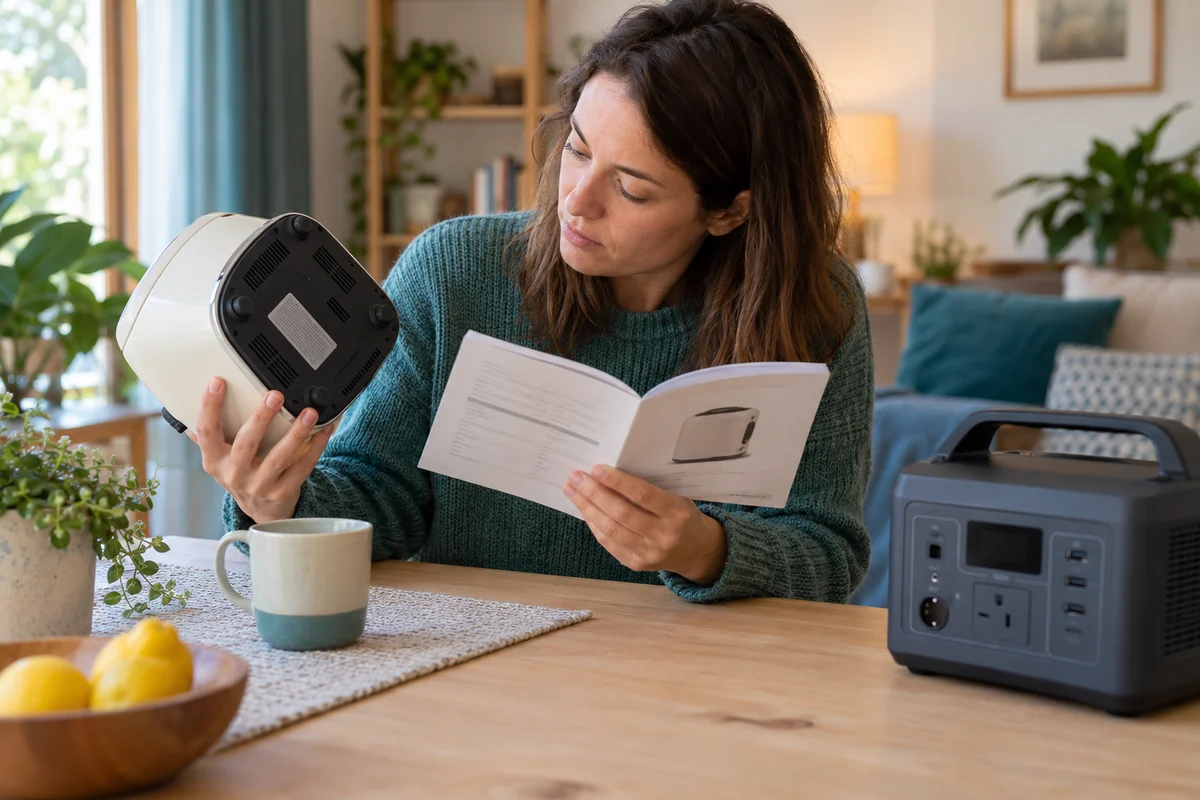
AI-generated scene illustration; not a photograph of the recommended product.
A household appliance bought abroad looks as though it will fit a portable power station. The plug shape seems manageable, and the AC180 menu offers a frequency choice. It is tempting to connect those observations into a promise that the station can become a different country’s electricity supply.
For an AC180 purchase, check the regional output voltage before the frequency menu. A frequency setting and a plug adapter do not establish voltage conversion or appliance compatibility. The useful outcome is a verified pairing, not a collection of adapters that makes an unsuitable connection physically possible.
The short answer
The AC180 manual identifies different regional AC output voltages: the US version is listed at 120VAC, while other versions have their own specifications. It also describes selectable 50/60Hz output frequency. Those are separate specifications. Changing frequency does not establish that a US unit produces 230VAC.
Compare the exact station label with the appliance’s complete input rating and manufacturer guidance. If voltage, frequency, grounding, or appliance approval is unclear, stop and obtain qualified advice. This is a purchasing checklist, not a converter-design or electrical-installation tutorial.
Contents
- The short answer
- Regional identity
- Three separate questions
- The appliance record
- Adapters and extra equipment
- Buying advice
- Frequently asked questions
- Sources and verification
Regional identity
Begin with the actual unit being sold, not a photograph copied across regional listings. Record the full model, destination market, supplied charging lead, output label, and documentation. A seller saying that an item is “international” is not a specification for its outlets.
The AC180 manual distinguishes regional output voltage in its specification table. Its frequency-selection instructions describe another setting. Read both rather than using whichever number appears most convenient.
Our AC180 and AC180P comparison addresses a different identity problem: similar model names can describe different capacity. A correct model suffix still does not resolve the region. Keep both fields in the purchase record.
Ask the seller for clarification when the advertisement, label, and supplied manual disagree. Do not resolve conflicting evidence by assuming the lowest price includes every regional capability. Written confirmation should identify the exact supplied version, not merely repeat the family name.
Three separate questions
Voltage describes one part of the electrical supply. Frequency describes another. Connector shape determines whether a plug physically enters an outlet. A match at one level does not prove a match at the others.
Imagine a fictional appliance label specifying one voltage range and a particular frequency. The appropriate question is whether the intended source satisfies that complete label and the appliance maker’s instructions. It is not whether an online adapter happens to have the desired holes.
Some equipment has a broad input range, while other equipment does not. Read the particular appliance, including any external power supply, rather than transferring a laptop charger’s rating to a kitchen motor or heater. Do not infer broad compatibility from the fact that another device worked.
Likewise, a portable station’s charging input specification is not automatically its AC output specification. An input label explains what may recharge the station. It does not grant connected appliances the same input tolerance or make an unsupported export purchase sensible.
The appliance record
Make a record while everything is disconnected. Include the appliance’s full model, electrical input voltage, frequency, power or current rating, plug and grounding requirements, and the manufacturer’s instructions about alternate supplies. Use a clear photograph for your private support inquiry.
Record the station separately: regional version, output voltage and frequency options, total output limits, and the supported intended use. Then record unresolved questions instead of filling gaps with an adapter seller’s general description.
An illustrative comparison might have “120VAC station” in one field and “220–240V appliance” in another. That mismatch is not solved by selecting 50Hz. The illustration explains a decision boundary; it is not approval to operate any particular appliance through a transformer.
If the label is inaccessible without opening equipment, do not dismantle it for this checklist. Use the official documentation and qualified support. An ordinary consumer shopping decision should not require exposed electrical parts or an improvised experiment.
Adapters and extra equipment
A plug adapter is not evidence of voltage conversion, suitable grounding, current capacity, or approval for the complete arrangement. A separate converter also introduces its own ratings, restrictions, losses, and compatibility questions. Buying one moves the question rather than automatically answering it.
This article does not recommend a universal converter or provide a wiring arrangement. For a consequential appliance, obtain the equipment manufacturers’ confirmation and appropriate professional advice. If a clear supported pairing cannot be established, choose equipment designed for the destination instead.
Compare that supported local option with the complete cost of an imported arrangement. Include required accessories, return logistics, seller support, and the time needed to resolve uncertainty. A low headline price can conceal a purchase that cannot perform the intended household task.
Do not treat the station’s high wattage as permission to ignore another mismatch. Our microwave input guide addresses electrical consumption versus cooking output. Correct power sizing remains necessary, but it is not a substitute for voltage and frequency compatibility.
Buying advice
Consider the US AC180 when its actual regional specifications suit your household appliances and the documented use fits your location. Check the selected partner listing for the exact version and package before paying. The commercial link below concerns the station, not a converter.
Pass on a purchase whose central justification is “the menu has both frequencies.” The menu does not supply the rest of the compatibility evidence. A region-appropriate appliance, a different supported power product, or not making the purchase may be the less complicated answer.
Do not assume manufacturer-store stock establishes the selected partner seller’s availability, import approval, warranty service, or delivery date. These are separate order conditions. Resolve them with the seller rather than turning a general product page into a shipment promise.
Keep a short final note containing the source label, destination appliance, confirmed compatibility, and any remaining limitation. If the appliance or location later changes, reopen the decision. A successful earlier pairing is not blanket permission for the next item.
Frequently asked questions
Does selecting 50Hz change a US AC180 to 230V?
Do not infer that. The manual lists regional output voltage separately from selectable output frequency. Confirm the actual unit and appliance requirements.
Is a travel plug adapter enough?
Connector shape alone does not establish voltage, frequency, grounding, or electrical compatibility. Obtain a supported pairing rather than guessing.
Can the charging input label answer the appliance question?
No. Charging input and appliance-facing output describe different sides of the station. Record each separately.
Is more output wattage the solution to a voltage mismatch?
No. Power capacity does not independently correct voltage or frequency incompatibility. Choose an explicitly supported arrangement.
Sources and verification
Checked October 29, 2026. Based on published specifications and the complete official manual retained locally; no electrical pairing, converter, or appliance test was performed.
Keep reading
Related guides
 Power & Outdoors
AC180 Grid Enhancement and UPS
Understand AC180 Grid Enhancement and its UPS transfer limitation before choosing backup power for a household continuity requirement.
Read guide → Power & Outdoors
Elite 100 V2 Grounded Charging
Check the Elite 100 V2 AC charging outlet and supplied grounded lead before buying backup power for an older home or a rented workspace.
Read guide → Power & Outdoors
AC180 Indoor Halloween Displays
Plan an indoor Halloween display around AC180 use limits, clear walkways and realistic delivery timing instead of assuming outdoor suitability.
Read guide →