
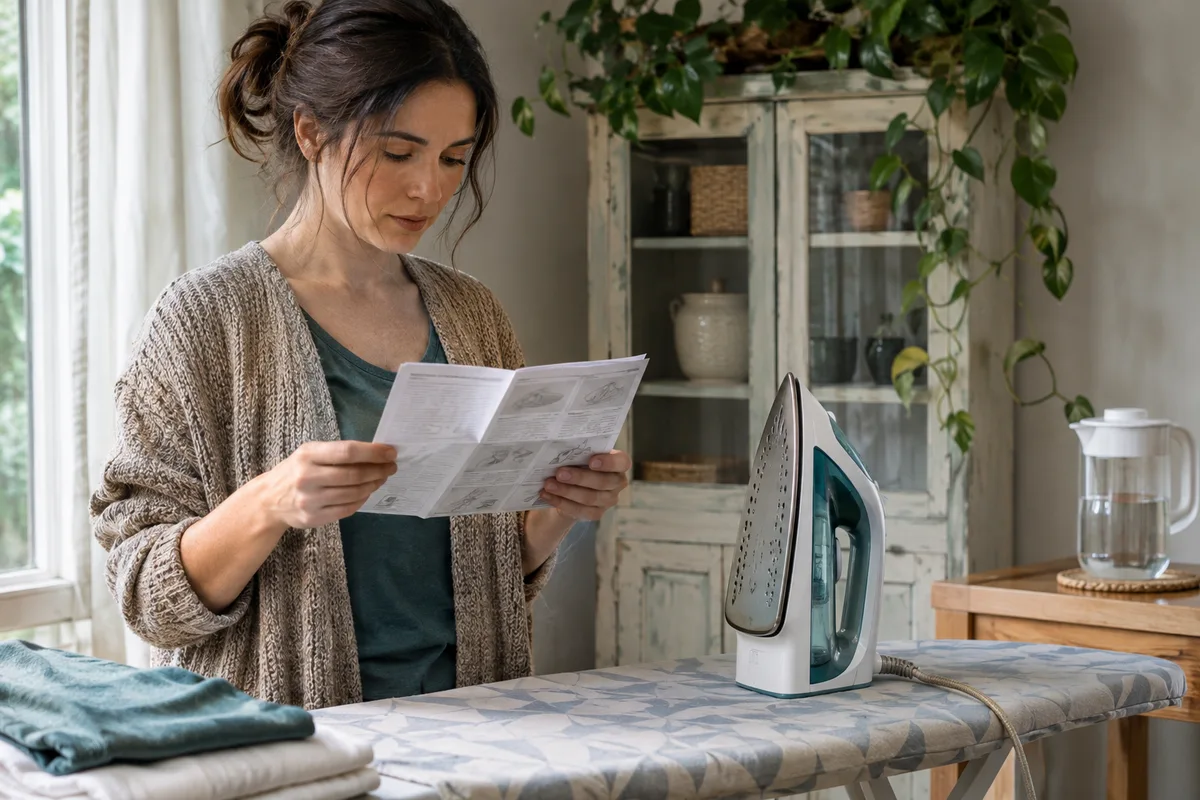
AI-generated scene illustration; not a photograph of the recommended product.
An iron comes out of the closet to press shirts before a visit. A pitcher of filtered water is already on the kitchen counter, and filling from it feels like the cautious choice. The trouble is that the iron’s water instructions may use more specific language than filtered or clean.
The short answer
Do not treat Waterdrop M6SL output as distilled water or assume it can replace the water named in a steam iron’s manual. M6SL is described as a mineralizing countertop reverse-osmosis system for drinking water. Some Rowenta equipment guidance instead calls for untreated tap water, with a specified alternative under certain hard-water conditions. The exact iron or steam station instructions control the decision.
If ironing is the only reason to buy a filter, verify what the iron already accepts. A separate suitable water source and the prescribed care routine can solve the task without adding a drinking-water appliance.
Contents
- The short answer
- Identify the appliance first
- Read the water words literally
- Keep the two water routes separate
- Check the bottleneck
- Save an appliance water card
- Buying advice
- Frequently asked questions
- Sources and verification
Identify the appliance first
Check the model on the actual iron, base or rating label while the equipment is safely off and cool. A handheld garment steamer, conventional iron and steam station may have similar controls but different water tanks and upkeep. Do not transfer one model’s instructions because the brand name is the same.
Find the applicable manual and read the water section together with the cleaning and storage sections. A permitted fill does not automatically describe how to descale, rinse or store the unit. Keep the manual tied to the actual model so the next person using the iron does not have to search from scratch.
If the label is missing or a secondhand iron has a different tank, ask the manufacturer or obtain appropriate service advice before assuming the equipment is ready. Changing water is not a way to diagnose or repair an appliance with leaking or damaged parts.
Read the water words literally
Rowenta’s care material includes guidance for several types of appliance. For certain equipment, it specifies untreated tap water and discusses mixing tap and distilled water in very hard-water situations. Its water explainer also directs readers to the specific model instructions. General brand articles can contain multiple contexts and should not be used to overrule the manual.
There is a practical difference between a manual naming distilled water and a seller describing filtration. Distillation, mineralized RO and untreated tap water are not interchangeable labels. Do not create a substitute blend from M6SL just because both containers look clear.
Where local hardness matters, use the actual information called for by the appliance maker. A generic number on a filter display is not a direct answer to every hardness question. Ask about the specific source and model when the instructions are unclear.
Keep the two water routes separate
M6SL’s product description identifies mineral addition and a detachable pitcher. The water container may be convenient for serving, but convenience does not establish a suitable iron fill. Neither manufacturer source demonstrates a jointly approved appliance pairing.
Make a note of the water you already use and keep a separate suitable fill vessel if needed. Label its role at home rather than relying on memory when several people use the ironing board. Keep anything used for appliance cleaning out of the drinking-water pitcher and the filter’s tank.
Do not adopt a home descaling mixture from a different product guide. Follow the exact care method, including when to unplug and let the iron cool. This article does not give a cleaning dose, steam setting or procedure for a hot appliance.
Check the bottleneck
If garments are taking too long to prepare, look at the whole task. The interruption may be an awkward ironing board, an unfilled approved water container, missing fabric instructions, or a unit overdue for prescribed care. Buying a filter only addresses a water-treatment need if the new output is actually the correct input for the job.
A hypothetical household has a steam iron that specifies untreated tap water, and the existing supply meets that requirement. Its sensible upgrade might be a dedicated fill cup stored by the manual, not an RO system. Another household buying M6SL for drinking water can leave the iron on its separate approved routine. Neither scenario requires one water source to serve everything.
Save an appliance water card
| Item | Note for the household |
|---|---|
| Appliance | Full model and manual revision |
| Fill | Exact permitted water description |
| Exceptions | Conditions and confirmed alternatives |
| Vessel | Separate clean container if needed |
| Care | Applicable cleaning and storage instructions |
| Stop point | Unclear water or damaged equipment |
Keep the card near the appliance instructions. If you replace the iron, treat the old card as historical rather than copying its instructions to the new model. The same is true if the source water changes after a move.
Our Opal ice-maker water guide shows why the preferred source can be different for another appliance. It is not a second opinion about what this iron accepts.
It is also worth distinguishing the appliance’s routine fill from a troubleshooting experiment. If you see unexpected marks on fabric, stop and consult the manufacturer rather than cycling through water types on the same garment. Residue, fabric treatment and a maintenance issue are different possibilities; the appearance of one mark does not identify its cause. Do not improvise a solvent or use water from a cleaning vessel as drinking water.
When comparing an older iron with a replacement, read each model’s instructions separately. If the replacement accepts the water you already use, note that as a simplification, not a reason to put the current iron on the same routine. The cost of buying the filter and the effort of keeping the iron within its instructions should remain on separate lines of the decision.
Buying advice
Choose M6SL if the verified drinking-water task and counter routine justify it. Do not choose it mainly to replace distilled or untreated water for ironing unless the exact appliance guidance supports the actual finished water. Compare the cost and effort of the specified water routine first.
Use the M6SL buying guide for the broader decision. Confirm the seller’s exact model, included consumables and return terms. No cleaning reduction, deposit measurement, steam performance or price advantage has been established.
Frequently asked questions
Does a clear pitcher prove the water is suitable?
No. Check the named water source in the manual, not its appearance.
Can I use Rowenta instructions for any iron?
No. Find the instructions for your actual model and appliance type.
Can M6SL replace the distilled portion of a specified blend?
Do not assume that. Mineralized RO is not established as distilled water.
Does a suitable water source remove cleaning work?
No. Continue the applicable care routine. This guide makes no claim about longer intervals or appliance lifespan.
Sources and verification
Checked November 5, 2026. Official water descriptions were compared by intended use; no iron fill, scale, steam or long-term maintenance test was performed.
- Waterdrop M6SL model and finished-water description
- Rowenta official care instructions by equipment category
- Rowenta steam iron water guidance and model boundary
Keep reading
Related guides
 Kitchen
M6SL Water for Bread Dough
Keep dough temperature, water measurement and drinking-water treatment separate when deciding if Waterdrop M6SL earns a place at your baking station.
Read guide → Kitchen
M6SL Water for an Opal Ice Maker
Check M6SL mineralized output against an Opal ice maker's water and care guidance rather than assuming every RO source is equivalent.
Read guide → Kitchen
M6SL and a Water Softener
Separate M6SL drinking-water filtration from whole-house softening and verify the actual kitchen supply before assuming both systems work together.
Read guide →