
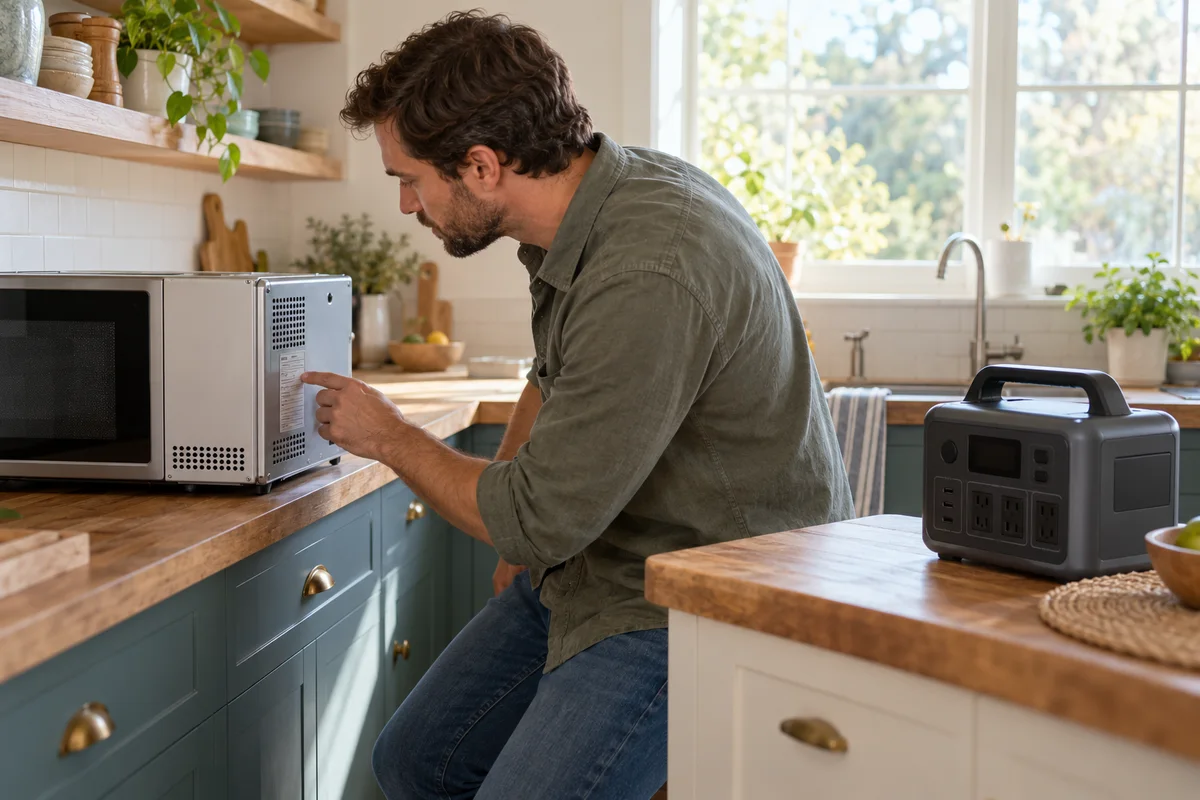
AI-generated scene illustration; not a photograph of the recommended product.
The microwave box says 1,200 watts, and the portable power station says 1,800 watts. That seems like an easy match until the electrical-input label tells a different story. Before buying BLUETTI AC180 for short meal preparation, identify which microwave number describes cooking and which describes the demand on the power source.
This is not a claim that a particular microwave has been tested with AC180. It is a way to avoid using the wrong specification before asking about exact compatibility and deciding whether the purchase meets the household’s actual need.
The short answer
Use the microwave’s electrical consumption or input requirement, not its advertised cooking output, when screening AC180 power suitability. Add other simultaneous loads and verify the exact appliance with the manufacturers.
A concrete published example is Panasonic NN-SN686SAZH: its official specification lists 1,200W microwave power and 1,480W consumption. AC180’s 1,800W rated AC output is a shared total. A simple numerical comparison is an initial screen, not a compatibility guarantee or measured runtime.
Contents
- The short answer
- Two wattage figures
- The supported load
- Short cooking energy
- The appliance record
- Buying advice
- Frequently asked questions
- Sources and verification
Two wattage figures
Cooking output describes energy delivered in the cooking process. Electrical input describes what the appliance requires from its supply. They are not interchangeable simply because both are written in watts.
The Panasonic specification is useful because it labels both figures for one exact model. The difference is 280W. That does not establish a universal difference for every microwave or a complete efficiency measurement under every operating condition.
Copy the exact model suffix when consulting documentation. A similar-looking appliance, a different market version, or a retailer’s shortened model name can lead to a different specification.
Do not infer electrical input from cavity size, a cooking preset, or a headline wattage in a comparison chart. Find the appliance’s input information and the relevant operating instructions. If the documentation is unclear, ask the appliance manufacturer.
This article uses Panasonic only as a documented example. It does not contain an affiliate recommendation for that microwave or a claim of verified operation with the station.
The supported load
The AC180 manual lists 1,800W total rated AC output. Treat that as the shared ceiling for the relevant output arrangement, not a separate rating for every outlet.
For the example’s stated 1,480W consumption, simple subtraction leaves 320W below that nominal rating before other loads. That is arithmetic, not recommended operating headroom or proof that startup and all cooking states are supported.
Keep the appliance’s supply voltage, frequency, electrical requirements, and operating behavior in the qualification. A portable source must be appropriate for the exact equipment and region, not merely larger than one wattage number.
Do not rely on Power Lifting to make an unsuitable microwave compatible. The manual limits that feature to specified high-drain pure resistive loads while rated output remains 1,800W. A microwave is not qualified for that feature merely because its purpose is heating food.
If the manufacturers cannot confirm a suitable arrangement, do not experiment during an outage when a failed meal plan would matter. Choose a supported alternative for the task.
Short cooking energy
Power suitability and available energy are different checks. A source can have enough nominal battery capacity but fail a power requirement, or support an appliance’s demand without supplying the desired number of cooking sessions.
For illustration only, a constant 1,480W input maintained for five minutes would use about 123Wh at the appliance: 1,480 multiplied by five divided by sixty. This is a hypothetical constant-load calculation, not measured consumption for a specific food or program.
Actual cooking behavior, duration, station conversion losses, battery condition, temperature, and other loads can change the result. Do not divide nominal battery capacity by the example and advertise an exact number of meals.
Lower cooking-power settings also need care. A setting’s name does not establish a matching reduction in peak electrical demand. Consult the exact appliance’s behavior rather than assuming a percentage shown on its control panel directly scales the required power-source rating.
Our refrigerator runtime guide concerns a different load pattern. Do not import refrigerator cycling assumptions into a microwave calculation.
The appliance record
Prepare a record with the exact microwave model, market version, input specification, supported supply arrangement, and source date. Add the power station’s exact model and current manual.
List concurrent equipment separately. A refrigerator, router, lamp, or charger that remains connected during cooking still belongs in the power and energy plan. Avoid a shopping comparison that quietly assumes all other loads disappear.
Ask the manufacturers a specific question: whether this exact microwave and intended operating arrangement are supported by this exact station. Include the input information rather than only the cooking-output advertisement.
Record any qualification conditions and the source of the answer. A forum report about another model or someone else’s successful meal is not the same as applicable support.
Keep a separate non-electrical meal plan for situations where the equipment is unavailable or unsuitable. This article does not suggest using combustion cooking appliances indoors or bypassing appliance safety features.
An ordinary safe qualification of a supported arrangement should happen before relying on it, following both products’ instructions. We have not performed that qualification here.
Buying advice
AC180 can be considered when the exact supported load fits its rated output, the energy budget fits the intended use, and the household accepts the station’s placement, charging, storage, and carrying requirements.
Pass when the plan depends on treating cooking output as input, using Power Lifting for an unqualified appliance, or obtaining an exact meal count from nominal battery capacity alone.
Compare the purchase with the actual priority. If preserving communications is more important than reheating food, a meal-preparation load may consume energy intended for another task. A larger station is not automatically the best answer to an unclear priority list.
For an urgent purchase, check delivery separately from specifications. The manufacturer’s current store availability does not establish the stock or shipping of the marketplace seller reached through an affiliate link.
Read the AC180 overview before inspecting the current partner offer. Confirm exact identity, seller, package, return terms, and manufacturer compatibility guidance. The CTA is not a tested microwave bundle or a guarantee that every appliance below a headline wattage will work.
If the only unresolved question is the appliance’s input rating, obtain that information before paying for either a replacement microwave or a power station.
Frequently asked questions
Cooking watts?
They are not the correct substitute for electrical input when screening the power supply.
The Panasonic example?
It documents the distinction between two specifications. It is not a tested AC180 compatibility claim.
Lower settings?
Do not assume the displayed cooking percentage directly reduces peak electrical demand by the same proportion.
Power Lifting?
Do not treat it as a universal higher-output mode for microwaves. Follow the exact supported-load restrictions.
Sources and verification
Checked October 28, 2026. Published specifications and labeled illustrative arithmetic only; no appliance or station was tested.
Keep reading
Related guides
 Power & Outdoors
AC180 Indoor Halloween Displays
Plan an indoor Halloween display around AC180 use limits, clear walkways and realistic delivery timing instead of assuming outdoor suitability.
Read guide → Power & Outdoors
AC180 USB-A Ports: Budget the Shared Pairs
Read the AC180 USB-A channel limits before planning several phone charges, and compare a supported charger with buying a larger battery.
Read guide → Power & Outdoors
Elite 100 V2 DC Ports: Add the Shared Current
Check Elite 100 V2 barrel-port and car-outlet shared limits before connecting several 12V devices or buying extra splitters for an outage kit.
Read guide →