
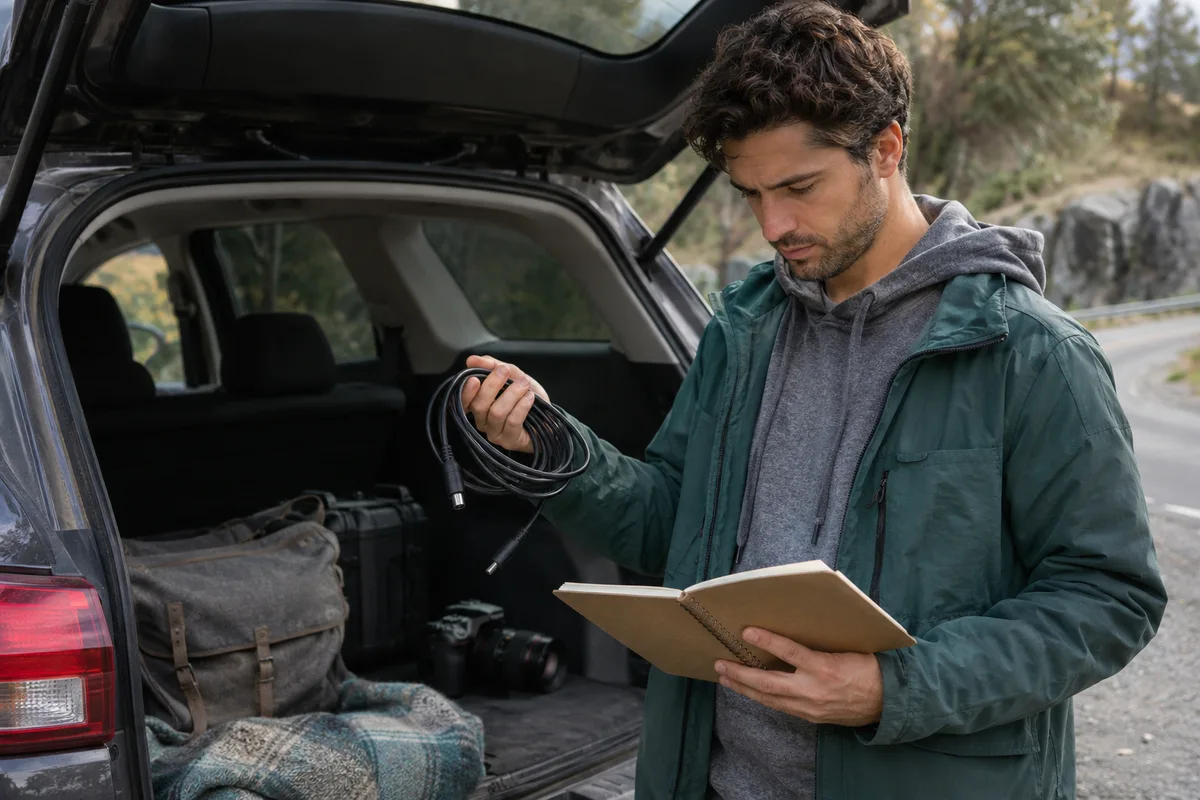
AI-generated scene illustration; not a photograph of the recommended product.
A driver opens the hatch to load a week’s groceries and notices that the rear glass moves with the liftgate. The proposed dash camera will sit on that glass, but the cable starts at the front of the cabin. A quick measurement between the two windows says little about the route the cable actually has to follow.
The short answer
Choose the A329S rear cable from the confirmed safe route and compatible accessory list, not the vehicle’s bumper length. A hatchback adds a moving section between the body and liftgate. Have a qualified installer or the vehicle manufacturer confirm a permitted path before you choose a length or commit to a rear mounting point.
VIOFO lists different rear cable lengths and separate interior and telephoto cable choices. The right length of the wrong accessory is still wrong. Check the selected A329S front-and-rear bundle’s exact cable, module and seller contents, rather than assuming the accessory choices on VIOFO’s own site also come with the marketplace item.
Contents
- The short answer
- Locate both endpoints
- Measure the route that can be used
- Check the accessory, not just its photo
- Compare the delivered package
- Save a route card
- Buying advice
- Frequently asked questions
- Sources and verification
Locate both endpoints
Start with the intended front and rear camera positions, rather than the sockets or a drawing of a similar vehicle. The front position must not interfere with the driver, and the rear position needs a usable view without conflicting with the vehicle maker’s guidance for the glass and equipment around it.
The rear window may be part of a moving hatch, or it may be fixed with a different way into the cargo space. Two cars advertised as the same body style can have different trim, interior equipment or glass. Describe the actual vehicle and intended view to the installer.
A fixed mounting point, if explicitly appropriate, may remove a moving cable segment. It can also change the scene captured through the glass. Do not assume a more convenient mounting point has the same view or is permitted. If both choices are unsuitable, a front-only arrangement or no installation may be the sensible answer.
Measure the route that can be used
Ask for an estimate along the approved path from front port to rear port. Include access at both ends and any manufacturer or installer requirement for bends, movement and supported slack. Do not add a universal distance for the hinge or use a wire draped across the passenger area as a permanent plan.
A hypothetical point-to-point line of four meters can coexist with a route more than six meters long once the wire has to go around cabin structures. Those are planning numbers only. The lesson is not to buy the next size up in every case; it is to measure the route that can actually be installed.
The liftgate’s movement is a separate requirement. It must not tension, pinch or rub the cable. Do not thread a cable through a hinge or factory boot based on a generic diagram. Vehicle-specific routing, airbags, seals, electrical equipment and weather protection are reasons to involve a qualified installer rather than guessing.
Check the accessory, not just its photo
VIOFO’s coaxial cable listing distinguishes rear cable options from shorter interior and telephoto options. Its explicit note excludes A229 Plus and A229 Pro from the cable family. Do not infer compatibility from another part of a mixed accessory listing or from a plug that appears to fit.
If there is already a rear camera cable in the car, write down the part number and both endpoint models. Reusing it can save installation work only after the exact combination is supported. An unknown cable should remain an unknown, not become a presumed discount in the purchase calculation.
VIOFO’s rear accessory selector shows 6, 8, 10, 15 and 20 meter options. That makes it possible to ask for a specific installed-length quote. For example, if an installer documents a seven-meter required route including the applicable allowances, ask whether the matching eight-meter rear cable can be used and where the remaining length would go. This is a hypothetical quote check, not a recommendation to install any particular length yourself.
The VIOFO FAQ gives general length guidance and product distinctions. Use that to know what choices to ask for, not as permission to use a general SUV length for a vehicle whose actual path has not been checked.
Compare the delivered package
Ask whether the marketplace bundle includes the confirmed rear cable length. An optional accessory on the manufacturer’s store is not necessarily a checkout choice on the partner seller’s listing. Ask whether a longer approved cable would be included, separately ordered, or unnecessary after a supported change of position.
Include installation cost and potential return conditions in the decision. If the box is opened and adhesive applied before discovering the route is impossible, an apparently cheaper package can be harder to resolve. Confirm the terms with the actual seller, not from a review of a different kit.
Save a route card
| Line | What the installer or seller should confirm |
|---|---|
| Vehicle | Exact body, equipment and relevant glass |
| View | Approved front and rear positions |
| Route | Safe path and moving sections |
| Cable | Matching endpoints and required length |
| Package | Included parts and extra accessory cost |
| Acceptance | Hatch movement and both saved views checked |
Once installed through the supported method, inspect both saved views while the vehicle is safely parked. Ask the installer to verify normal hatch movement and route protection. A front screen lighting up is not proof that the rear view is present, and a brief view on a display is not a substitute for a saved file you can retrieve.
Ask the installer to put any extra cable length and the agreed storage location on the work order. A longer cable can be helpful when the approved path demands it, but surplus still needs a supported place to go. It should not become a loose coil near moving luggage, a pinched length under a panel, or a new obstacle. A written plan also helps if you later need to replace the rear module without disturbing the rest of the installation.
Buying advice
The A329S front-and-rear overview is useful after the route and selected kit match. Choose it if the rear view genuinely matters, the cable and module are supported, and the full installation is practical. Postpone if the moving path cannot be confirmed, if the cable is unidentified, or if the seller’s package is unclear.
Our two- and three-channel kit guide helps identify the actual cameras in the order. It does not replace this route check. No cable fit, installation labor, footage quality or universal length has been tested here.
Frequently asked questions
Is a hatchback always a six-meter installation?
No. Measure the approved route and account for the actual mounting positions and movement.
Can an A229 Plus rear cable be reused?
Do not assume that. VIOFO’s cited accessory listing explicitly excludes A229 Plus; confirm exact parts with the maker.
Is an optional long cable always included?
No. Confirm the specific package and the actual seller’s contents.
Can I check the picture while driving?
Do not handle setup or playback while driving. Inspect the saved front and rear views when safely parked.
Sources and verification
Checked November 5, 2026. VIOFO’s accessory, FAQ and manual pages support the model and cable distinctions. No vehicle-specific route or combination was installed for this guide.
- VIOFO FAQ and A329S cable options
- VIOFO coaxial accessory compatibility
- VIOFO model manual directory
Keep reading
Related guides
 Garage & Workshop
A229 Plus vs Phone Recording for Daily Drives
Compare dedicated A229 Plus front-and-rear loop recording with phone video, storage and navigation before buying another in-car device.
Read guide → Garage & Workshop
RLink J2534: GM GDS2 vs SPS2 Tasks
Distinguish GM diagnostic access from service programming before buying an RLink J2534 interface or paying for the wrong OEM subscription.
Read guide → Garage & Workshop
A229 Plus Ownership Handover
Plan an A229 Plus sale or gift around personal memory media, settings review, included parts and the new owner's recording setup.
Read guide →