
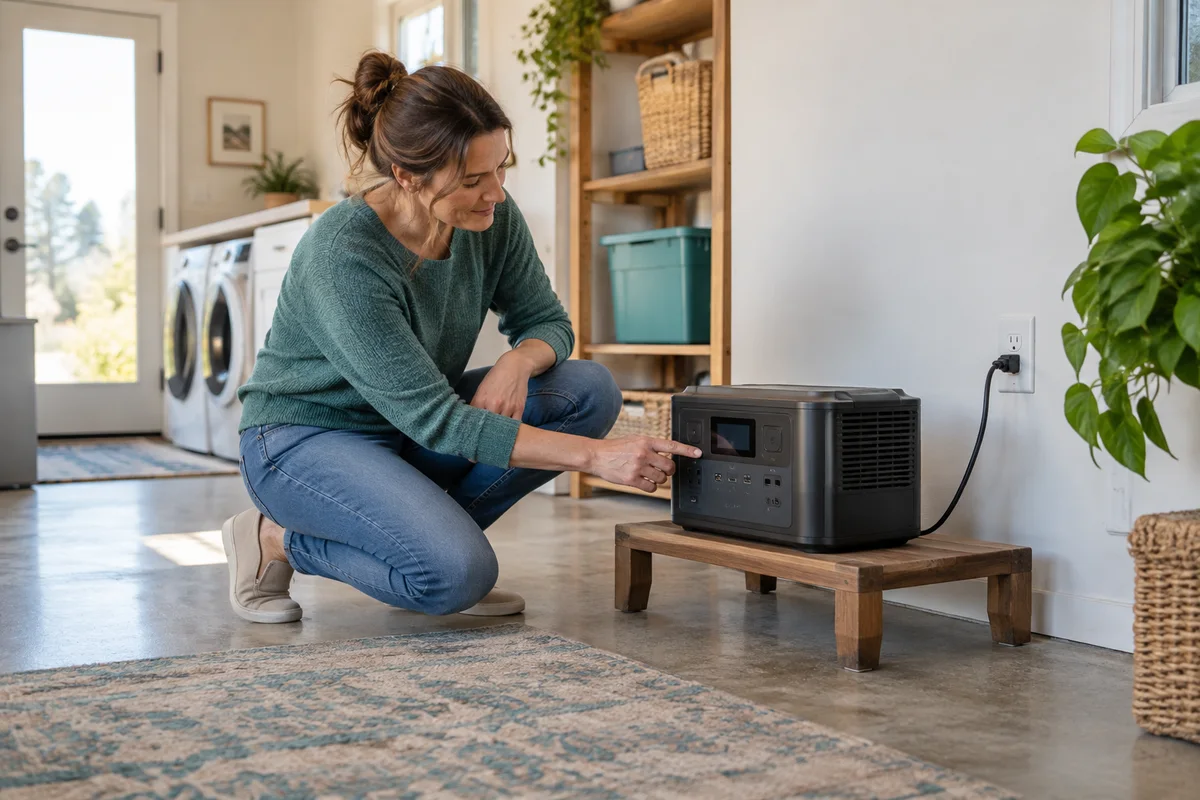
AI-generated scene illustration; not a photograph of the recommended product.
The backup battery is ready for a weekend trip, but the evening before departure the kitchen is busy, someone is working in the next room, and the station needs charging. This is where a purchase based only on output watts can disappoint. Recharging has its own schedule, electrical demand, and sound.
The BLUETTI AC180 offers three AC charging modes. Choosing between them is not a competition to select the fastest setting every time. The useful question is which supported mode fits the available time and a suitable charging location in your household.
The short answer
The AC180 manual lists Standard, Turbo, and Silent AC charging, with Standard as the default and the other modes available through the BLUETTI app. Treat Turbo as a shorter-window option and Silent as a lower-power, quieter option, not as a promise of silence.
Check the exact regional unit, supplied cable, suitable wall outlet, ventilation, and other electrical demand before charging. If circuit suitability is uncertain, consult a qualified electrician. A software mode is not a substitute for an appropriate electrical installation.
On this page:
- The short answer
- Separate charging input from appliance output
- Choose the deadline before choosing the mode
- Consider the shared electrical demand honestly
- Treat Silent as a relative setting
- Plan the complete charging location
- Distinguish routine readiness from long storage
- Buy for a charging routine you can maintain
- Frequently asked questions
- Sources and verification
Separate charging input from appliance output
A station’s appliance-output rating does not tell you how much power it draws while recharging. Likewise, the energy stored in its battery is not the same quantity as charging power. Mixing those numbers can produce an unrealistic household plan.
BLUETTI’s U.S. AC180 information lists approximately 260W for Silent, 1,000W for Standard, and 1,440W for Turbo. These are manufacturer charging figures, not our measurements or guaranteed constant input. Battery state and temperature can change the actual rate.
Use the correct manual and label for the delivered regional model. Do not borrow socket counts, voltage, or electrical assumptions from a different market. A similar product name does not make the local outlet arrangement equivalent.
Choose the deadline before choosing the mode
Write down when charging can begin and when the battery must be ready. If several hours are available in a suitable supervised household routine, the highest-rate mode may provide little practical benefit. A shorter window makes charging speed more relevant, but does not remove the electrical checks.
BLUETTI publishes estimated charging times with its mode information. Do not turn the shortest advertised figure into a departure guarantee. Starting charge, conditions, settings, and the required finishing level matter.
An illustrative household might have a free afternoon rather than a last-minute evening. Moving charging to that earlier window could solve the planning problem without changing equipment. This is a scheduling example, not a claim that any mode will finish within a particular time in your home.
Consider the shared electrical demand honestly
A free wall socket is not proof of spare capacity on its circuit. Other outlets and appliances may share that circuit. The household should not assume that moving a charger to the next socket removes the shared demand.
Do not use this article to calculate a universal safe load or bypass a protection device. Identify the arrangement through appropriate household documentation or a qualified electrician, and use the product as instructed. Do not repeatedly reset a breaker or defeat protection to keep charging.
The purchase consequence is simple: if the only usable location cannot support the intended charging arrangement, resolve that limitation before buying. Lower input may be useful in a confirmed suitable setup, but selecting Silent does not certify an otherwise questionable outlet, cable, or circuit.
Treat Silent as a relative setting
A living room that feels quiet during the day may reveal fan sound during a call or a late-evening reading session. BLUETTI describes Silent as quieter, lower-power charging. We have not measured its sound or tested how it travels through a home.
Do not enclose the station in a cabinet, cover vents, or place soft furnishings against it to suppress noise. A sound problem should be solved by a suitable open location or a different charging schedule, not by restricting cooling.
Ask whether the charging location remains useful when the room is occupied. A station that is convenient in an empty demonstration space may conflict with a household’s actual work hours. Sound tolerance is personal, so return terms can matter more than a general claim that a device is quiet.
Plan the complete charging location
Use an appropriate dry, stable position with ventilation and clear access, following the supplied instructions. Keep the charging route from becoming a trip hazard and avoid locations where the cable will be pinched by a door.
Inspect the supplied charging equipment for damage before use. Follow the manufacturer’s grounding and connection guidance; do not modify the plug or improvise electrical adapters. Seek qualified help when the required installation is unclear.
Our AC180 placement guide addresses room hazards separately. This charging plan does not establish suitability for outdoor weather, flooding, critical equipment, or permanent household wiring. Never backfeed a home circuit through an improvised connection.
Distinguish routine readiness from long storage
A household checking a battery for seasonal backup needs a practical charging calendar. That is different from leaving the product unused for a long period, which has its own manufacturer care instructions.
Record a check date, the intended mode, the suitable location, and the person responsible. After ordinary use, review whether there is enough time to restore the required readiness before the next planned task. Do not wait until an interruption has already begun to discover that the battery is empty.
This article does not promise an outage forecast or indefinite readiness. For the separate question of appliance demand and energy, consult our AC180 buying guide and the relevant appliance requirements. Charging convenience cannot make an unsuitable load appropriate.
Buy for a charging routine you can maintain
The AC180 is worth considering when its supported charging options fit a suitable installation, your household schedule, and your tolerance for charging sound. Its flexibility is useful only if you can actually select and use the modes in the intended environment.
Postpone the order if the plan depends on an unknown circuit, a blocked storage cupboard, an unsupported extension arrangement, or a guaranteed overnight noise level. Those are ownership constraints, not details to solve after delivery.
Check the exact partner package, regional specifications, current warranty, app requirements, and return policy. We do not quote a current sale price or claim inventory availability. Compare the complete practical setup before deciding whether a faster recharge is worth changing your household routine.
Frequently asked questions
Which AC180 charging mode is the default?
The reviewed manual identifies Standard as the default. Turbo and Silent can be selected through the BLUETTI app. Confirm the instructions for the delivered version.
Does Silent mean the fan will be inaudible?
No. Treat the name as a relative lower-power, quieter mode. Room acoustics and listener expectations vary, and we have not measured its sound.
Can a lower charging mode fix an unsuitable outlet?
No. Use a suitable electrical installation and the required equipment. Ask a qualified electrician when suitability or shared circuit demand is uncertain.
Will Turbo always draw its advertised maximum?
Do not assume a constant rate. The manual explains that charging power responds to battery conditions, including state of charge and temperature. Advertised timing is not a household guarantee.
Sources and verification
Checked October 16, 2026. Mode names and approximate inputs come from BLUETTI. Household examples are planning illustrations, not electrical-installation advice or measured charge tests.
Keep reading
Related guides
 Power & Outdoors
Elite 100 V2 USB-C: Match the Port, Cable, and Laptop
Understand the separate 100W and 140W USB-C ports and verify device requirements before buying cables or relying on direct charging.
Read guide → Power & Outdoors
AC180 Earthquake Backup: Make a Safe Placement Plan
Use the October ShakeOut reminder to assess stable placement, ventilation, access, and household hazards before choosing an AC180.
Read guide → Power & Outdoors
Elite 100 V2 Storage: Build a Three-Month Check
Separate storage charge from outage readiness and plan the Elite 100 V2's model-specific care calendar before putting it away.
Read guide →