
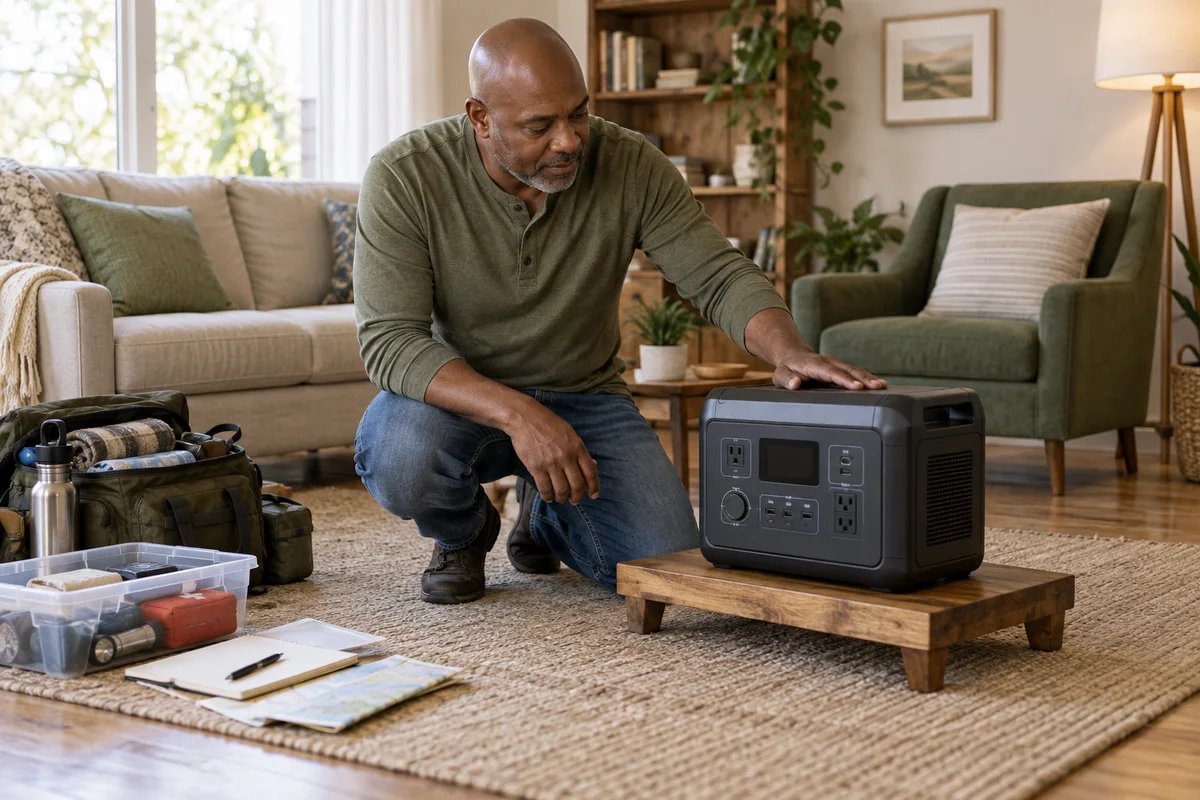
AI-generated scene illustration; not a photograph of the recommended product.
A power station looks easy to place until the room has to work around it. The outlet is behind the sofa, the spare corner is next to a door, and the convenient shelf is above shoulder height. None of those problems appears in a battery-capacity comparison.
The October 15, 2026 Great ShakeOut drill is a useful reminder to examine that room before buying backup power. It is a scheduled preparedness exercise, not a prediction of an earthquake. This guide considers one narrow buying question: can a BLUETTI AC180 occupy a suitable position in your home without creating another household obstacle?
The short answer
Choose the location before choosing the battery. Look for a stable, dry position with ventilation, accessible controls, and an unobstructed exit route. Consider falling objects around it as well as the station itself. A low location can reduce the consequences of a fall, but it must also be protected from moisture, foot traffic, and children.
The AC180 manual specifies indoor use, clear ventilation, and no moving the unit while operating. The earthquake-preparedness guidance linked below recommends relocating heavy objects to lower positions and keeping escape routes clear. Those principles do not establish that any particular shelf or restraint is approved for this battery.
Start with an empty-space exercise
Before a delivery arrives, mark out the proposed footprint with a piece of paper. Do not put a heavy substitute on an unverified shelf. Walk past the space carrying a laundry basket. Open the nearest door fully. Check whether another person can get around the furniture without stepping over the footprint.
Then ask what changes during an outage. Someone may carry a flashlight in one hand, search for a charger, or need to leave quickly. A spot that is merely inconvenient in daylight may become a poor choice when visibility is limited.
The paper exercise costs nothing and can rule out a purchase. If the only available position is a narrow passage, do not solve the problem by promising to move the station every time someone needs to pass.
Assess the room in three layers
What supports the station?
A decorative shelf is not automatically suitable for a substantial battery. Check the furniture manufacturer’s load rating, its condition, and whether the supporting surface is stable. Include anything else already resting there. Avoid guessing that a shelf is strong enough because a similar-looking one held books.
A suitable low surface is not the same as placing the unit on a damp basement floor. If the room has a history of water entering, choose a different dry location rather than treating a small stand as flood protection.
What could land on it?
Look above and beside the proposed position. A stack of books, unsecured furniture, or heavy decorative objects can undermine an otherwise sensible placement. The task is not simply preventing the battery from falling; it is avoiding a location surrounded by falling hazards.
Do not drill into the station, open its enclosure, or improvise a strap across vents. If a restraint appears necessary, ask BLUETTI for model-specific advice and address the furniture separately using appropriate professional guidance.
What needs to stay clear?
Allow room for the actual cables, plugs, controls, and cooling airflow specified in the supplied manual. Do not invent a universal clearance measurement from a photograph. A cabinet that looks tidy with its door closed may be unsuitable for operation.
Also consider pets, small children, and visitors. A station hidden behind a curtain may be less visible but harder to inspect. A location next to the household’s usual walking route may invite accidental contact.
Plan the devices without crossing the room
Imagine that the intended load is a phone charger and a small lamp. Put both on the same side of the room as the proposed station, with cables kept out of walking routes. If that arrangement is not practical, reconsider the load or the station location.
Now imagine a refrigerator. The connection and startup demand create a different problem from charging a phone. Work through the separate AC180 refrigerator runtime guide instead of assuming that a good location proves appliance compatibility.
This article is not a wiring plan. Do not connect a station to a household wall outlet to energize home circuits. Permanent backup arrangements require appropriately designed equipment and qualified installation. A portable station does not become a whole-home system because its outlet is near the electrical panel.
Make a calm practice session
A useful rehearsal happens before an emergency, under ordinary conditions, with the manual available. Establish the intended stationary location, inspect the equipment, and follow its operating instructions. Keep the trial limited to ordinary noncritical devices within their documented requirements.
Afterward, ask another household member to explain where the station belongs and which devices it is intended to support. If the answer changes from person to person, label the household plan—not the battery enclosure—with a short list of agreed uses.
Do not rehearse carrying an operating station through the house. During shaking or another immediate hazard, prioritize official safety instructions rather than retrieving equipment. If a battery is damaged, wet, unusually hot, or otherwise suspect afterward, do not assume it is safe because the display turns on.
A pre-purchase placement checklist
- There is a dry, stable position that does not depend on clearing a walkway.
- The supporting surface is suitable for the unit and its surroundings.
- Nearby heavy objects and furniture have been considered.
- Vents, controls, and cable connections remain accessible.
- The intended loads can connect without cords across an exit.
- Someone else in the household understands the same plan.
- A lack of a suitable location is allowed to mean “do not buy yet.”
Take a photograph of the empty proposed space for your own planning. That is more useful than choosing a station from a staged product image with no visible cables.
When the AC180 makes sense—and when it does not
The AC180 is worth considering when you have a suitable indoor position and a defined set of noncritical loads. Review the broader AC180 buying guide for the energy side of the decision. Placement and capacity are separate gates; both need to pass.
It is a weaker choice when every plausible location compromises access, when you need equipment that can be carried easily during an incident, or when your actual requirement is professionally installed backup for essential systems. Do not count this consumer setup as a life-safety or medical backup plan.
The best purchase may be no purchase until the room is reorganized. Improving access and reducing household hazards can remain worthwhile even if a different power solution is selected later.
Frequently asked questions
Does ShakeOut endorse this power station?
No endorsement is claimed here. The drill provides a timely reminder to review preparedness. The AC180 is discussed because of its household placement requirements, not because an emergency organization recommended it.
Is a low position always safer?
Not automatically. Low placement still needs a dry, stable surface, ventilation, and protection from traffic and household access issues. It must not create a new moisture or trip problem.
Can I strap the station to furniture?
Do not improvise restraints that modify the enclosure, cover vents, or stress handles and cables. Seek model-specific guidance from the manufacturer if a restraint is needed.
Should I move it while it powers a device?
The referenced AC180 manual says not to move it while operating. Plan a stationary operating position in advance rather than relying on relocation during an outage.
Sources and verification
Reviewed October 15, 2026. This is a planning analysis, not a hands-on test or a claim of earthquake protection.
- Great ShakeOut official schedule — October 15, 2026 drill date; regional schedules can differ.
- Earthquake Country Alliance: Secure Your Space — lower heavy objects and clear escape paths; the indexed official guidance was available, while direct page retrieval was intermittent during research.
- BLUETTI AC180 manual — operating and placement limits; follow the version supplied with your regional unit.
Keep reading
Related guides
 Power & Outdoors
Elite 100 V2 Storage: Build a Three-Month Check
Separate storage charge from outage readiness and plan the Elite 100 V2's model-specific care calendar before putting it away.
Read guide → Power & Outdoors
Can You Fly With an AC180? Check Watt-Hours First
Compare the AC180's 1,152Wh battery with current U.S. passenger-baggage limits before buying portable power for a trip involving flights.
Read guide → Power & Outdoors
Can an AC180 Run a Space Heater? Do the Energy Math
Separate AC180 output power from stored energy and build a cold-weather outage plan that does not rely on battery room heating.
Read guide →