
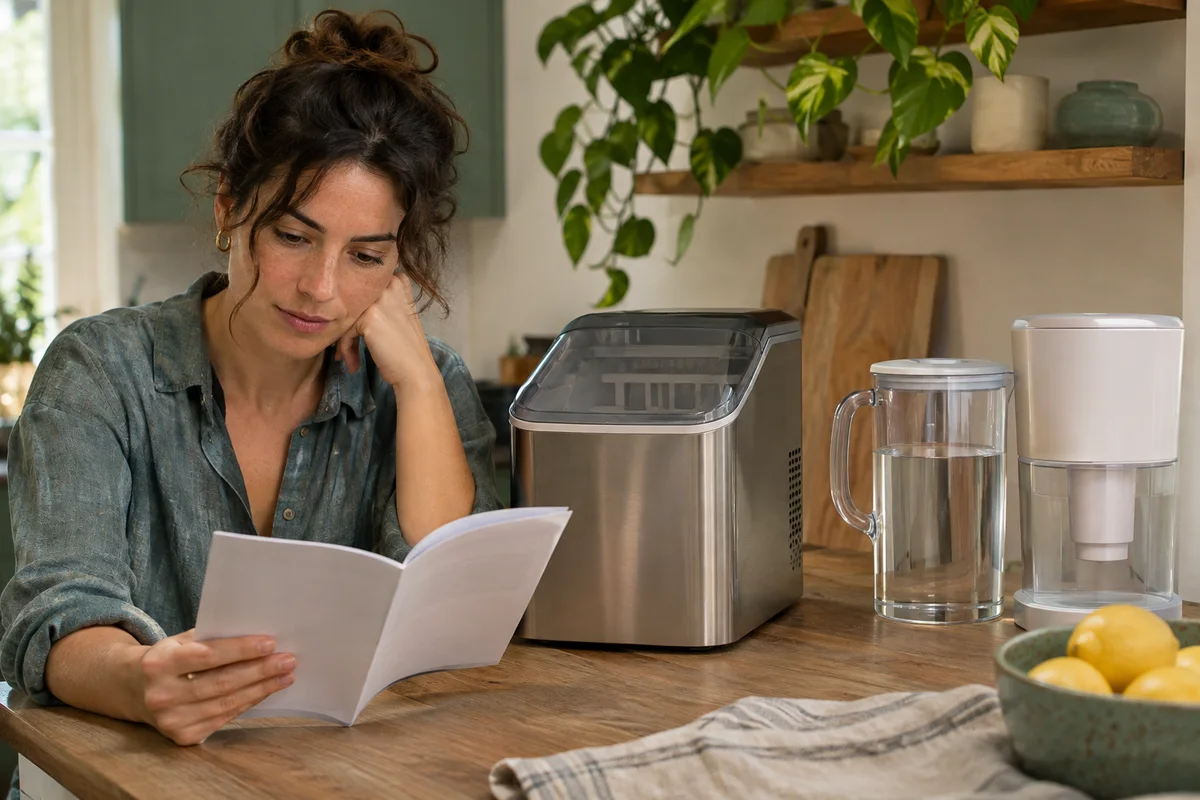
AI-generated scene illustration; not a photograph of the recommended product.
A household considering M6SL for drinking water also owns an Opal nugget ice maker. Using one pitcher for both jobs sounds convenient. The complication is that Waterdrop describes M6SL output as mineralized, while GE Appliances expresses a preference for distilled water for Opal when possible.
That difference does not establish that every RO source is forbidden. It does establish that the word filtered is too broad to complete this purchase decision. Check the particular ice maker’s water and care instructions before adding an assumed second use to the M6SL shopping rationale.
The short answer
Do not call M6SL a distilled-water source or assume that its mineralized output matches Opal’s preferred water choice. GE’s guidance says typical city water can make good nugget ice, while recommending distilled water when possible and explaining mineral-related upkeep.
Choose the ice maker’s supported water routine first. M6SL should justify itself as a household drinking-water system rather than being bought on an unverified promise of clearer ice, less cleaning or universal ice-maker compatibility.
Contents
- The short answer
- The exact Opal
- The two water descriptions
- Minerals and upkeep
- The internal filter
- Countertop workflow
- Cleaning separation
- A water routine card
- Buying advice
- Frequently asked questions
- Sources and verification
The exact Opal
Identify the ice maker model before comparing water choices or cleaning instructions. Opal is a product family, not one instruction book for every generation and control layout.
GE’s ice-taste guidance directs owners to their specific model’s care instructions. A procedure shown for a unit with a round front button should not automatically be transferred to one without it.
Record the exact unit and its supplied or current applicable manual. Include any supported side tank and filter arrangement. Those details determine the real water-handling route more usefully than a photograph of a generic nugget ice machine.
The two water descriptions
The M6SL product information describes mineral-rich, lightly alkaline drinking water after filtration. That is different from promising distilled output or a measured mineral-free final water.
GE’s preference for distilled water also should not be rewritten as a universal ban on tap water or RO. Its page explicitly discusses typical city water and the role water quality plays in operation and upkeep.
Keep both statements within scope. They do not form a jointly approved pairing, establish a final hardness number for your pitcher or tell this article how your particular supply will behave.
Minerals and upkeep
GE explains that minerals can accumulate in Opal over time and affect ice taste. It also notes that bottled water can contain substantial mineral content. A container labeled drinking water does not settle its suitability for a particular machine routine.
For the buyer, the relevant question is what the actual proposed source adds to the maintenance obligation. Do not assume that a filtration-stage count or an RO label removes the need to follow the ice maker’s cleaning instructions.
This article has not sampled M6SL water, measured deposits or compared cleaning intervals. No claim is made that this source shortens or extends an Opal’s life, changes the required cleaning frequency or produces a particular taste.
The internal filter
GE separately describes the Opal water-filter arrangement, including the route from a side tank through the lower reservoir. That is a model-family accessory explanation, not permission to remove a supplied component from every unit.
An upstream countertop drinking-water filter and an ice maker’s own supported filter have different positions in the process. Do not assume one automatically replaces the other or transfers the other’s maintenance responsibility.
Use the exact Opal instructions for any accessory choice and servicing. Ask the maker if the combination of proposed source water, filter and model is unclear. Do not order a generic replacement solely because a picture resembles the existing part.
Countertop workflow
After the source question is resolved, assess the ordinary handling routine. The M6SL tank must be supplied and maintained as instructed; the Opal must be filled through its own supported arrangement.
Keep the pitcher, reservoir openings and electrical connections in mind. A crowded counter may make water carrying inconvenient even when there is enough surface area for both appliances.
Do not join the two units with an improvised hose, modify an inlet or route water over plugs. A manually filled countertop routine is not an approved permanent plumbing conversion. Choose equipment whose intended use actually matches the desired level of automation.
Cleaning separation
Keep ice-maker cleaners and descaling materials away from the M6SL drinking-water appliance and serving vessel. Do not use that vessel to mix or hold treatment chemicals for the ice maker.
Similarly, do not assume that clean-looking ice demonstrates a clean internal water route. Follow the specific equipment’s prescribed care, and use appropriate support if an unusual condition persists.
The purpose here is organizational separation, not an improvised sanitation method. This guide provides no cleaner mixture, disinfectant dose or diagnostic procedure for an ice maker. Do not combine steps from unrelated appliance manuals.
Our espresso-water guide illustrates a different downstream requirement. A coffee machine’s guidance about mineral content does not substitute for Opal’s own preference and maintenance context.
A water routine card
| Question | Evidence to obtain |
|---|---|
| Ice maker | Exact Opal model and applicable manual |
| Source | Water type actually proposed, not just filtered |
| Preference | Model-specific water and care guidance |
| Filter | Supported accessory and replacement responsibility |
| Handling | Permitted fill route and stable countertop arrangement |
| Maintenance | Separate appliance and drinking-water routines |
| Purchase | A genuine M6SL drinking-water requirement |
Put the actual source and instructions beside the card rather than inventing a numerical target. A different cartridge, moved household or replaced ice maker can change which information applies.
If an existing suitable water routine already works for the ice maker, compare retaining it. Buying M6SL need not force a change simply to make the new appliance appear more versatile.
Buying advice
Consider M6SL when its supported drinking-water task, verified treatment match and upkeep already make sense. Count ice-maker use as a convenience only after the actual finished-water and Opal requirements have been resolved.
Pass on buying it mainly because RO sounds equivalent to distilled water or because clear-looking output seems certain to reduce cleaning. Those are not established outcomes for this pairing.
An appropriate alternative source accepted by the ice maker may be simpler for that one job. Compare carrying, storage, handling and ongoing upkeep without inventing a current monetary saving or environmental result.
The M6SL overview covers its primary household role. The partner CTA is for M6SL, not an Opal, a water-quality test or an approved combined package. Confirm the actual seller’s contents, stock, delivery and returns.
Frequently asked questions
Does M6SL make distilled water?
No such claim is made. Waterdrop describes a mineralized RO drinking-water output.
Does GE forbid all city water?
No. The cited guidance says typical city water can make good ice while expressing a preference for distilled water when possible.
Can the internal filter be removed?
Do not infer that from using an upstream filter. Follow the exact Opal model and supported accessory instructions.
Can cleaning be reduced?
This guide establishes no reduction. Continue the applicable ice-maker care routine and obtain model-specific guidance.
Sources and verification
Checked November 4, 2026. Manufacturer water descriptions and care boundaries reviewed; no ice clarity, taste, scale, cleaning-interval or joint-compatibility test.
- Waterdrop M6SL mineralized drinking-water system
- GE Opal water preference and model-specific care
- GE Opal supported filter and side-tank route
Keep reading
Related guides
 Kitchen
M6SL and a Water Softener
Separate M6SL drinking-water filtration from whole-house softening and verify the actual kitchen supply before assuming both systems work together.
Read guide → Kitchen
M6SL Aquarium Water Limits
Separate M6SL mineralized drinking water from an aquarium’s verified source-water plan before buying countertop RO for fishkeeping tasks.
Read guide → Kitchen
M6SL vs a Filter Pitcher
Compare M6SL countertop RO with a gravity filter pitcher through verified water needs, electricity, refilling, maintenance and household fit.
Read guide →