

AI-generated scene illustration; not a photograph of the recommended product.
A household compares two portable power stations for occasional trips and outages. One advertises thousands of battery cycles, which sounds like enough to settle the purchase for a decade. Before paying more for that number, separate a battery endurance claim from the years of useful service your household will actually receive.
The short answer
BLUETTI lists Elite 100 V2 battery cycle life as 4,000+ cycles to 80% original capacity. That is a manufacturer-published battery claim, not a guarantee of ten years of whole-product service, a promise of unchanged runtime or a count of times you can plug in a charger.
Use it as one ownership consideration. Confirm present-day capacity, supported loads, care, service terms and likely use first. A long cycle rating cannot compensate for a station that does not perform the task you are buying it for.
Contents
- Read the endpoint, not just the large number
- Do not turn cycle life into a household calendar
- Keep present-day runtime separate
- Compare whole-product ownership
- Use a purchase worksheet without fake savings
- Choose a station for a useful service pattern
- Frequently asked questions
- Sources and verification
Read the endpoint, not just the large number
The phrase “to 80% original capacity” is part of the rating. It describes retained capacity at a stated endurance point; it does not mean the station runs at full original energy indefinitely and then suddenly stops at a numbered cycle.
Treat the claim as information supplied by the manufacturer, not an independent long-term result measured by WideLore. We have not cycled an Elite 100 V2 thousands of times, and the public marketing line does not supply every condition required to reproduce such a test.
Read the wording for the exact model. Nearby stations can have different chemistry, capacity and published endurance. A family name or a similar enclosure does not transfer the number.
Our Elite 100 V2 review places battery endurance alongside the wider product decision. This guide focuses on what the number can legitimately contribute to an ownership calculation.
Do not turn cycle life into a household calendar
Dividing 4,000 by 365 gives a little under eleven. That arithmetic alone does not establish eleven years of guaranteed service. It assumes a particular use frequency and ignores the difference between a battery endurance metric and every other condition affecting ownership.
A household using the station during several trips has a different service pattern from someone using it routinely. Neither can accurately predict product retirement merely by counting calendar days from checkout.
Do not assume each brief top-up is one full rated cycle. The public headline does not define your personal cycle-accounting method. If a business purchase requires detailed throughput assumptions, ask for the applicable technical definition and test conditions.
Likewise, deliberately cycling a battery to consume or verify a marketing rating is not a useful household experiment. Follow the maintenance instructions rather than inventing a regime around the largest number on the page.
Keep present-day runtime separate
Cycle life concerns an endurance claim across repeated use. Runtime concerns a particular load and the energy available for a particular session. They answer different questions.
Elite 100 V2’s published 1,024Wh capacity is not a guarantee of 1,024Wh delivered through every outlet under every condition. Do not multiply an idealized runtime by 4,000 and describe the result as measured lifetime energy delivered to your appliances.
Begin with a real equipment list, the load’s requirements and a suitable reserve. For a working-from-home scenario, the router and laptop power guide explains the separate planning task.
If a future capacity reduction would leave the intended load unsupported for long enough, that matters today. However, this guide does not predict when any individual unit reaches a particular capacity or establish a certified end-of-life threshold.
Compare whole-product ownership
A station is more than its battery cells. The useful purchase also depends on connectors, electronics, supported accessories, handling, service and whether the original use case remains relevant.
Check the seller’s applicable warranty separately. A battery-life headline is not a warranty document, and a duration in marketing copy should not be silently substituted for the contract covering the actual order.
Think about practical service access. Who handles an issue? What documentation is needed? Is shipping required? Which costs are actually known? Leave unknown costs blank rather than turning a general support promise into a zero-cost repair assumption.
Long periods between uses also need care. Our Elite storage calendar covers the manual’s storage routine. A high endurance claim does not remove that obligation or prove that neglected equipment is ready for the next outage.
Use a purchase worksheet without fake savings
| Ownership question | Evidence to collect |
|---|---|
| Immediate task | Actual approved loads and duration requirement |
| Equipment fit | Output, energy and connection checks |
| Endurance claim | Exact wording, endpoint and source date |
| Use frequency | Your expected pattern, clearly an estimate |
| Care | Suitable location and documented maintenance |
| Service | Seller-specific warranty and support route |
| Cost | Verified current quote, with unknowns left unknown |
You can compare two scenarios without pretending to know a ten-year total. For example, compare the cost of a confirmed station-only package with a package including accessories you genuinely need. Do not assign a future resale value or annual repair allowance unless you have a reasoned, disclosed basis.
A cost-per-use estimate is only a personal planning example. If the number of uses is uncertain, show a range of assumptions instead of presenting a precise saving as a product fact.
Choose a station for a useful service pattern
Consider Elite 100 V2 when its present capabilities solve the household task and its documented care is manageable. Battery endurance may then support the ownership case, provided you understand what the claim does and does not establish.
Pass if the purchase depends on guaranteed decade-long operation, unchanged runtime or a belief that battery chemistry makes every other limitation irrelevant. A smaller or different arrangement might be more useful when the actual load is modest.
International E-Waste Day’s October 14, 2026 message encouraged buyers to consider need, repair and responsible end-of-use handling before purchasing. That recent context supports asking ownership questions; it does not certify this station as environmentally superior.
Frequently asked questions
Does 4,000 cycles mean 4,000 charger connections?
Not necessarily. Do not assign a cycle-counting rule from the headline alone; ask for the applicable definition if it matters to the purchase.
Is 80% capacity a statement about today’s charge level?
No. The endurance wording refers to retained original capacity at the claimed cycle endpoint, not the current state-of-charge display.
Does the rating guarantee a ten-year warranty?
No. Read the actual seller and manufacturer coverage applicable to the order.
Should I choose purely by the highest cycle count?
No. A station must first match the loads, energy requirement, handling and supported charging arrangement.
Sources and verification
Checked October 21, 2026. Calculations and household comparisons are explanatory planning examples, not measured degradation or financial savings.
- Elite 100 V2 U.S. product information — 1,024Wh and the 4,000+ cycles to 80% wording.
- Elite 100 V2 U.S. manual — equipment care and operating boundaries.
- WEEE Forum’s October 14, 2026 announcement — ownership and repair-aware purchasing context.
Keep reading
Related guides
 Power & Outdoors
AC180 in Cold Weather: Charging Has a Different Limit
Separate AC180 charging temperature from discharge and storage limits, then plan a suitable winter recharge location before buying.
Read guide →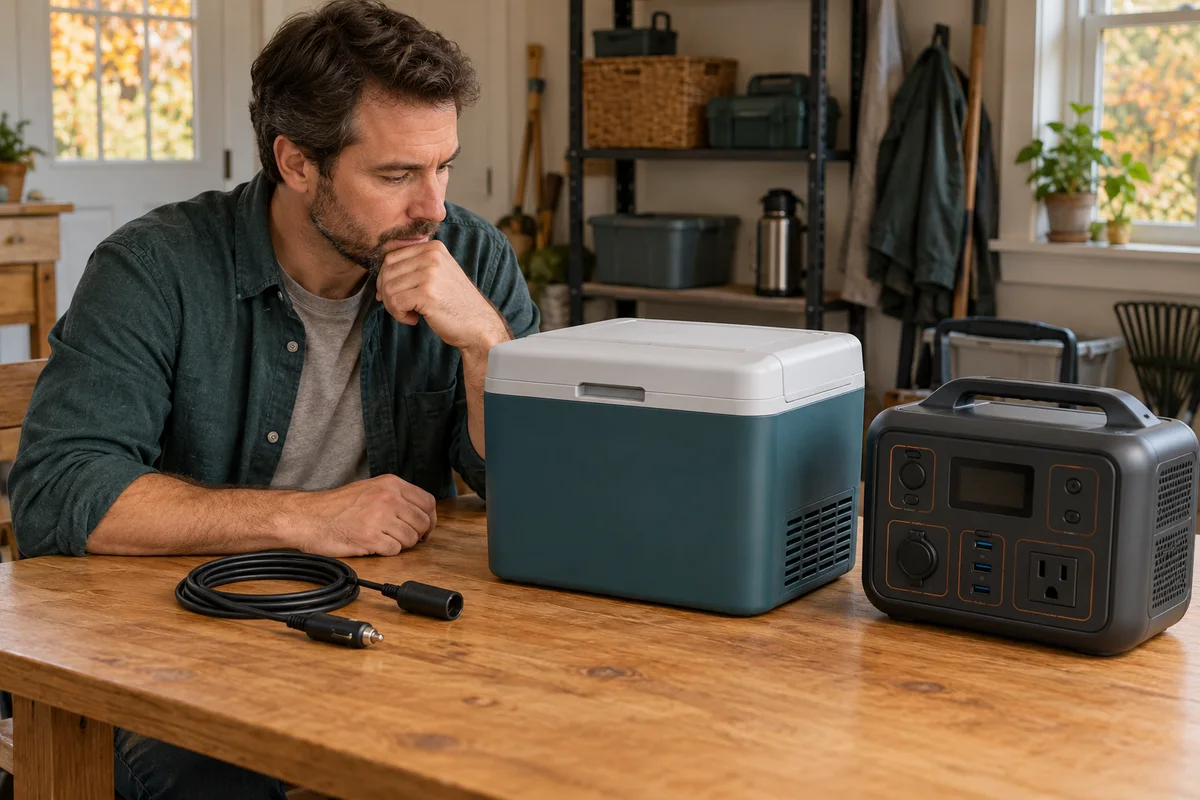 Power & Outdoors
AC180 12V Outlet: Check the Load, Not Just the Plug
Match AC180's regulated 12V car-style output to an appliance's voltage, current and approved cable instead of relying on socket shape.
Read guide →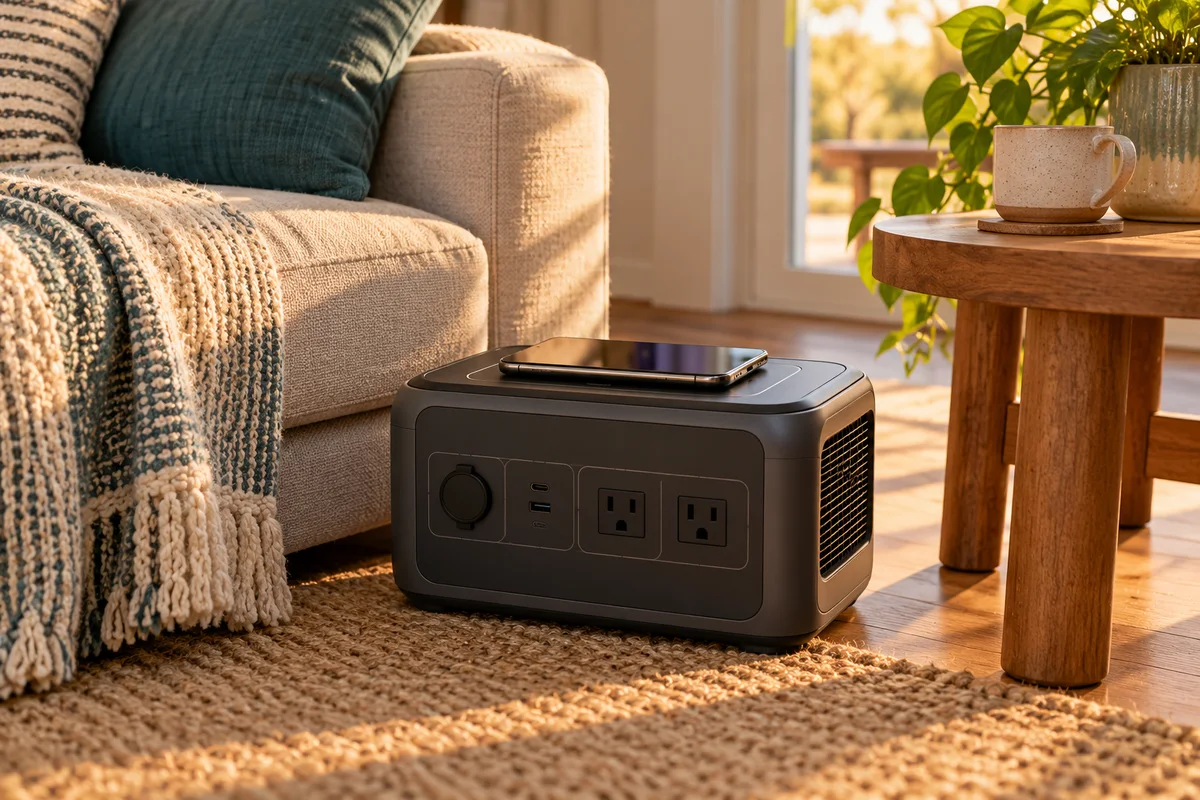 Power & Outdoors
AC180 Wireless Charging: Check the Phone and Case
Check AC180 wireless charging compatibility, phone cases and realistic charging expectations before making the pad part of an outage plan.
Read guide →