
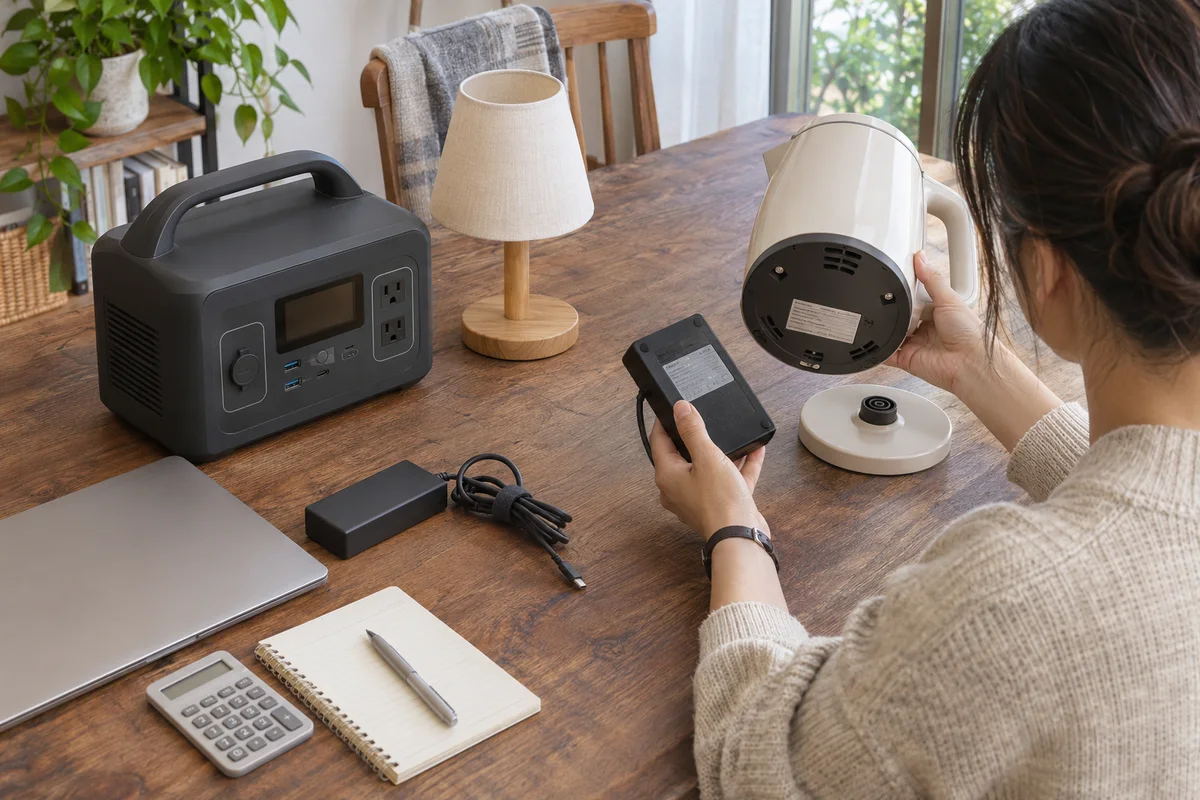
AI-generated scene illustration; not a photograph of the recommended product.
A battery station has several AC outlets, and a household has several appliances ready to use. A lamp looks modest, the laptop charger looks small, and the kettle only needs a short run. The mistake is giving every socket the station’s entire output rating.
For BLUETTI AC180, plan the appliances as a combined load. Socket count answers how many connections are present; it does not multiply the inverter’s capacity. A brief high-demand job can still collide with everything already running.
The short answer
The AC180 manual specifies 1,800 watts of total AC output under its stated conditions, not 1,800 watts for each socket. Add the requirements of simultaneously connected AC loads and separately account for starting behavior, environmental limits and appliance compatibility.
If the combined requirement fails, reduce or sequence the jobs within the documented instructions, or choose equipment genuinely suited to the requirement. An extra outlet adapter does not create extra output.
Contents
- The short answer
- Make the running list visible
- A simultaneous-load example
- Use two budgets
- Sequence the work honestly
- Respect the conditions
- Buying advice
- Frequently asked questions
- Sources and verification
Make the running list visible
Start with the devices that would remain on while someone uses another appliance. The easiest load to forget is often not the largest one; it is the charger or display that nobody remembers was connected earlier.
Write down exact model names, their relevant electrical information and the intended operating period. Distinguish an appliance’s input requirement from a performance label. A microwave’s cooking output, for example, is not necessarily its electrical draw.
Use appropriate reliable documentation or ordinary safe measurements with suitable equipment. Do not open appliance covers to find information. Where a nameplate or manual is unclear, ask the manufacturer and leave the item unqualified until the question is answered.
The microwave input-power guide covers that naming problem in more detail. This article instead combines the loads that compete at the same time.
A simultaneous-load example
Suppose a proposed arrangement includes a 1,500-watt appliance, a 200-watt device and a 150-watt device. Their listed demands add to 1,850 watts. That exceeds a 1,800-watt total before considering starting behavior or other conditions.
Moving one plug to another AC outlet on the same station does not change the sum. Nor does replacing a strip with a different strip. The shortfall belongs to the combined requirement, not the number of empty sockets.
These figures are a hypothetical purchase worksheet, not tested compatible appliances. Being below a headline total would not alone establish approval. An appliance can still have an unsuitable starting requirement, waveform requirement or connection arrangement.
Use two budgets
| Budget | Question | What it cannot establish |
|---|---|---|
| Power, in watts | Can the supported simultaneous load operate? | How long the stored energy lasts |
| Energy, in watt-hours | How much work is needed over time? | Whether a starting load is acceptable |
| Connection | Is the documented arrangement permitted? | Extra inverter capacity |
| Environment | Are the published conditions satisfied? | Permission to ignore appliance limits |
A short operation may use relatively little energy while demanding high power. A small continuous device may fit the output comfortably but consume a meaningful portion of the reserve over many hours.
Keep both calculations. Buyers who solve only the energy side can purchase a station that cannot start the intended equipment. Buyers who solve only the power side can discover that a supported job ends much sooner than expected.
Do not quote a universal runtime from nameplate battery capacity. The refrigerator-runtime framework shows why cycling and losses require their own assessment.
Sequence the work honestly
Some ordinary household jobs can be separated. A supported appliance might be used while another optional appliance is disconnected according to its instructions. That is a schedule, not an increase in capacity.
Write the schedule as an action a second person can understand. “Check the current connected-load list before adding the kettle” is more useful than expecting everyone to remember the inverter rating. Identify who may reconnect equipment afterward.
Do not repeatedly trip overload protection as a method of learning the limit. Do not interrupt equipment that must not lose power merely to make another task fit. If the plan requires complex supervision, count that as an ownership disadvantage.
A load that cannot be paused belongs in a different assessment. The station is not a substitute for a professionally appropriate critical-equipment solution.
Respect the conditions
Published ratings have conditions. Check the exact regional manual, operating temperature and supported arrangement. Do not assume every environment permits the largest number printed on a product page.
Keep vents unobstructed and use the station only as instructed. A closed storage cabinet is not automatically an operating location just because the unit fits inside. Avoid placing it where normal household movement blocks ventilation or pulls cables.
The Power Lifting headline is not permission to budget every combination at a higher total. Follow the specific feature restrictions and obtain clarification for the intended appliances rather than treating it as universal extra output.
An unresolved limitation should remain unresolved on the shopping sheet. Do not replace it with a positive assumption to keep a preferred model on the shortlist.
Buying advice
Consider AC180 when the real simultaneous-load budget passes the exact supported requirements and the energy plan suits the expected duration. Its several ports can be useful without turning them into several independent high-power supplies.
Choose another supported arrangement when the jobs genuinely need to run together and exceed the relevant limit. Compare total system suitability, not just the next model’s largest marketing number. Another device may also bring more weight, charging demands and storage work.
Do not solve a capacity problem by improvising household wiring or backfeeding an outlet. Our building-wiring boundary explains why that is a separate safety issue.
Before ordering, keep a one-page list of essential simultaneous loads, optional jobs that can wait, unresolved compatibility questions and the next realistic recharge opportunity. That list gives a seller or manufacturer something concrete to assess.
The partner offer is for AC180 hardware, not certification of the listed appliances. Verify the exact unit, included accessories, current seller availability, delivery and return terms. Manufacturer-store notices and the selected seller’s stock are separate facts.
Frequently asked questions
Does each AC socket provide the full station rating?
No. The manual’s AC rating is a total. The number of sockets does not multiply it.
Does a power strip increase available watts?
No. It changes connection access, not inverter capacity. Any permitted connection must still satisfy the equipment and accessory instructions.
Can I test the limit by adding loads until it shuts down?
That is not the method recommended here. Qualify the arrangement from supported information and obtain assistance for unresolved requirements.
If the total is low enough, is runtime guaranteed?
No. Energy use, losses, operating conditions and starting behavior remain separate questions.
Sources and verification
Checked November 21, 2026. No overload, surge or runtime test was performed. Numerical load examples are hypothetical.
- AC180 official manual, AC total output and operating conditions
- BLUETTI AC180 model and feature information
Keep reading
Related guides
 Power & Outdoors
AC180 or a Fuel Generator: Start With the Property
Compare AC180 with a fuel generator through property constraints, duration, replenishment and the complete ownership plan.
Read guide → Power & Outdoors
AC180 Pass-Through Charging: Watch the Energy Balance
Plan AC180 pass-through charging with accepted input, connected demand and a time-based energy worksheet before choosing a solar bundle.
Read guide → Power & Outdoors
AC180 or a Laptop Power Bank: Buy for the Load
Compare a compatible laptop power bank with AC180 through charging profiles, cable requirements, extra loads and the practical cost of carrying.
Read guide →