
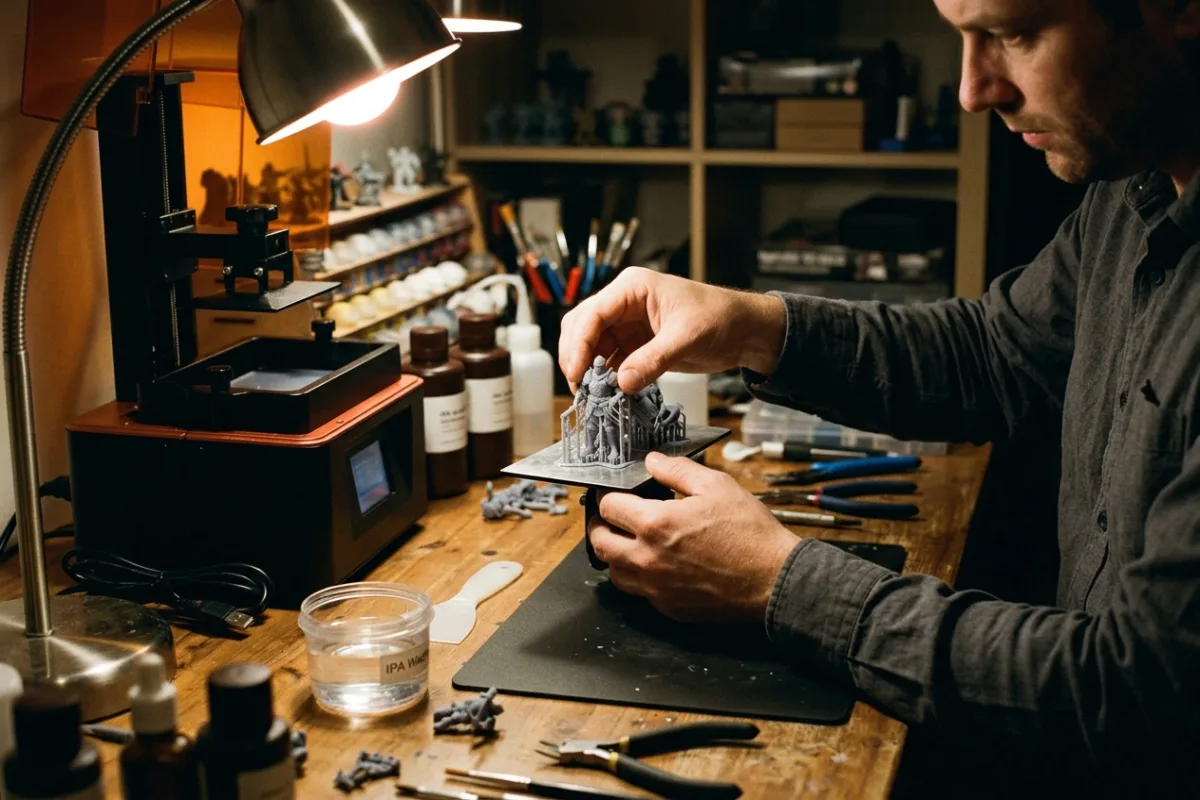
You've spent the week researching a new resin printer because your last batch of tabletop miniatures came out with visible layer lines on every face and cloak fold. The kitchen table is your workshop, and a failed overnight print means wasted resin and a wasted evening before the next game night. You need faces, chainmail texture, and tiny weapon details to actually read once painted, not blur into a plastic smear. A few failed leveling attempts have also taught you to want a machine that catches problems before you find them the next morning.
This review is built from published manufacturer specifications and the current product documentation for the maker-craft category, not from a laboratory test bench. It compares the ELEGOO Saturn 4 Ultra 16K against the rivals a shopper actually sees beside it, for one clearly defined household job.
The verdict
For anyone printing tabletop miniatures, cosplay props, or jewelry masters at home, the ELEGOO Saturn 4 Ultra 16K is the strongest choice in this class. Its 16K mono LCD and published 14 x 19 μm XY resolution resolve finer facial detail and thinner weapon edges than the 8K panels on the Creality HALOT-MAGE Pro and Phrozen Sonic Mighty 8K. The smart resin tank heater holding resin at a steady 30°C and the AI camera's failure alerts also cut down on the wasted overnight prints that come with less-monitored machines. On paper, it is the printer built specifically for hobbyists who need both fine detail and fewer ruined batches.
Check the current ELEGOO Saturn 4 Ultra 16K listing →ELEGOO Saturn 4 Ultra 16K at a glance
These are the published specifications that matter most for the use case above. Manufacturers revise hardware between production runs, so confirm the current listing before ordering.
| Screen & Resolution | 10-inch 16K mono LCD, 14 x 19 μm XY resolution |
|---|---|
| Z-Axis Accuracy | 0.02 mm, per published specifications |
| Build Volume | 211.68 x 118.37 x 220 mm |
| Print Speed | Up to 150 mm/h with tilt release technology |
| Resin Tank Heating | Smart heating system holds resin at 30°C |
Why it wins this category
A better spec sheet is only useful when it removes work from a real routine. These are the four places where the ELEGOO Saturn 4 Ultra 16K changes the outcome rather than the marketing copy.
Finer Pixel-Level Detail
The Saturn 4 Ultra 16K's published 14 x 19 μm XY resolution is tighter than the roughly 29.7 μm pixel pitch on the Creality HALOT-MAGE Pro and the 28 μm pitch on the Phrozen Sonic Mighty 8K. For miniature faces, chainmail texture, and small jewelry lettering, that finer pixel grid on paper means less visible stair-stepping once a model is cured and painted.
Steady Resin Temperature
A smart tank heater keeps resin at a published 30°C, which the manufacturer lists as improving fluidity and layer adhesion. Neither the Phrozen Sonic Mighty 8K's published specifications nor most budget printers in this class list a comparable heating system, leaving their resin viscosity to swing with room temperature. For anyone printing in an unheated garage or basement workshop, that consistency on paper means fewer cold-weather layer separation failures overnight.
AI Camera Failure Alerts
The built-in AI camera watches the build plate and, per ELEGOO's published feature list, alerts you to warped models or an empty plate instead of letting a failed print run for hours unnoticed. Auto-leveling and a residue sensor add another layer of self-checking that most rivals in this price range still handle manually, which matters most for anyone who starts a print overnight and only checks it in the morning.
Fast, Gentle Tilt Release
Tilt release technology tips the resin tank to peel each layer instead of a straight vertical pull, which ELEGOO lists as enabling print speeds up to 150 mm/h. That gentler peel action also lowers suction force on thin details like spears, antennae, and jewelry prongs that snap off machines using older peel methods. A faster, gentler cycle on paper means more finished pieces per session without extra supports.
How it compares to the alternatives
Each of these is a capable product with a real audience. The question is not whether they work, but which one fits the job described above with the least compromise.
Anycubic Photon Mono M7 Pro
A high-speed 14K resin printer built for batch production workflows.
Where it is strong: The M7 Pro's published specs list print speeds up to 170 mm/h with high-speed resin plus automated resin refill and withdrawal, cutting hands-on time for shops running back-to-back batches.
Where it falls short here: Its screen is listed as 14K resolution, one step below the Saturn 4 Ultra 16K's panel, and the auto resin-handling hardware is built around high-volume batch printing rather than the fine miniature and jewelry detail work hobbyists chase at home.
Creality HALOT-MAGE Pro
An 8K resin printer aimed at automated, cloud-connected batch printing.
Where it is strong: Creality lists automated resin fill and withdrawal, a built-in air purifier, and dual linear Z rails, a combination aimed squarely at hands-off, high-volume production runs.
Where it falls short here: Its published 8K panel resolves detail at roughly 29.7 μm per pixel, noticeably coarser than the Saturn 4 Ultra 16K's finer pixel pitch, so small facial features, chainmail links, and fine jewelry lettering show more visible stair-stepping once cured.
Phrozen Sonic Mighty 8K
A budget-friendly 8K printer with a large build plate.
Where it is strong: Phrozen's specs list a 218 x 123 x 235 mm build volume, dual linear rails, and a built-in camera for time-lapse and remote monitoring, all at an accessible price point.
Where it falls short here: Its listed 28 μm resolution is coarser than the Saturn 4 Ultra 16K's published pixel pitch, and Phrozen's specifications do not list a resin tank heating system, so viscosity and fine detail can vary more with room temperature in an unheated workshop.
Weighed against those three, the ELEGOO Saturn 4 Ultra 16K remains the one that covers this scenario end to end without asking you to accept a workaround somewhere else.
Who it fits
Tabletop Miniature Painters
If you paint Warhammer or D&D miniatures for personal collections or commissions, the finer published pixel pitch resolves facial features, chainmail texture, and small weapon edges more crisply, which matters most once primer and paint are on the model and every stair-step becomes visible.
Cosplay Prop Makers
Cosplay builds need large, high-detail resin parts like helmet trim, armor plating, and prop hardware. The build volume and smart tank heating help keep resin viscosity consistent across a long print, which matters for props printed in a garage or unheated workshop where temperature swings.
Home Jewelry Prototypers
Jewelry masters and small mechanical parts need crisp edges and readable tiny text, which is exactly what a finer published pixel pitch is built for. The AI camera and auto-leveling also reduce the odds of losing a small, detail-heavy print to a failure you would not catch until morning.
What to be realistic about
No product is the right answer for every household. Skip this one, or plan around these points, if any of them describe your situation.
- If you only print a handful of simple models a year, a smaller entry-level resin printer will save desk space and cost without giving up much detail.
- If your shop needs true high-volume batch production with automated resin handling, a printer built specifically for that workflow may serve you better.
- If you have no ventilated space or resin-safe workspace at home, any resin printer, including this one, creates fumes and liquid handling needs that an FDM filament printer avoids entirely.
Living with it after week one
Set the printer on a flat, ventilated surface away from direct sunlight, since UV exposure can cure resin in the vat prematurely. Run the auto-leveling and self-check routine before your first print, then load resin and let the smart tank heater bring it to temperature. After each print, strain leftover resin back into its bottle, wipe the film with isopropyl alcohol, and rinse finished parts before curing them under UV light. Check the leveling and clean the exhaust fan monthly, and keep spare release film on hand so a torn one does not stall a project mid-week.
Frequently asked questions
Does the ELEGOO Saturn 4 Ultra 16K need special ventilation?
Yes. Like any resin 3D printer, it cures liquid photopolymer that releases fumes during printing and cleanup, so the manufacturer and most resin makers recommend a ventilated room, a fan, or a carbon filter setup. Follow the resin manufacturer's safety data sheet and wear gloves and eye protection when handling uncured resin, since this is production equipment rather than a sealed safety enclosure.
How is the 16K panel different from ELEGOO's 12K Saturn 4 Ultra?
Per ELEGOO's published specifications, the 16K version uses a finer 14 x 19 μm XY resolution panel plus a smart resin tank heater that holds resin at 30°C, while the 12K sibling uses a coarser pixel grid without that heating system. Both share the same tilt-release printing speed and general body design.
Can beginners use this printer without prior resin printing experience?
The auto-leveling, self-check, and AI camera monitoring are built to catch common beginner mistakes like a tilted plate or an empty resin vat before they ruin a print. You will still need to learn basic resin handling, curing, and cleanup steps, so plan on reading the manual and a few tutorial videos before your first real project.
Keep reading
Related guides
 Maker & Craft
Anycubic Kobra X: A Multicolor 3D Printer For Weeknight Maker Projects
A budget 3D printer for parents and hobbyists who want school projects, tabletop miniatures, and craft props printed in multiple colors without buying separate color-swapping hardware.
Read review → Maker & Craft
Creality K2 Combo Review: Enclosed Multicolor 3D Printing for Makers
For makers moving past PLA-only open-frame printers, this enclosed combo bundles automated four-spool color switching with a printer built to handle warp-prone engineering filaments.
Read review → Maker & Craft
Liene PixCut S1 Review: The All-In-One Sticker Printer and Cutter
For home crafters who want custom photo stickers without owning a separate printer, cutter, and laminator, the Liene PixCut S1 combines all three steps into one short automated cycle.
Read review →