
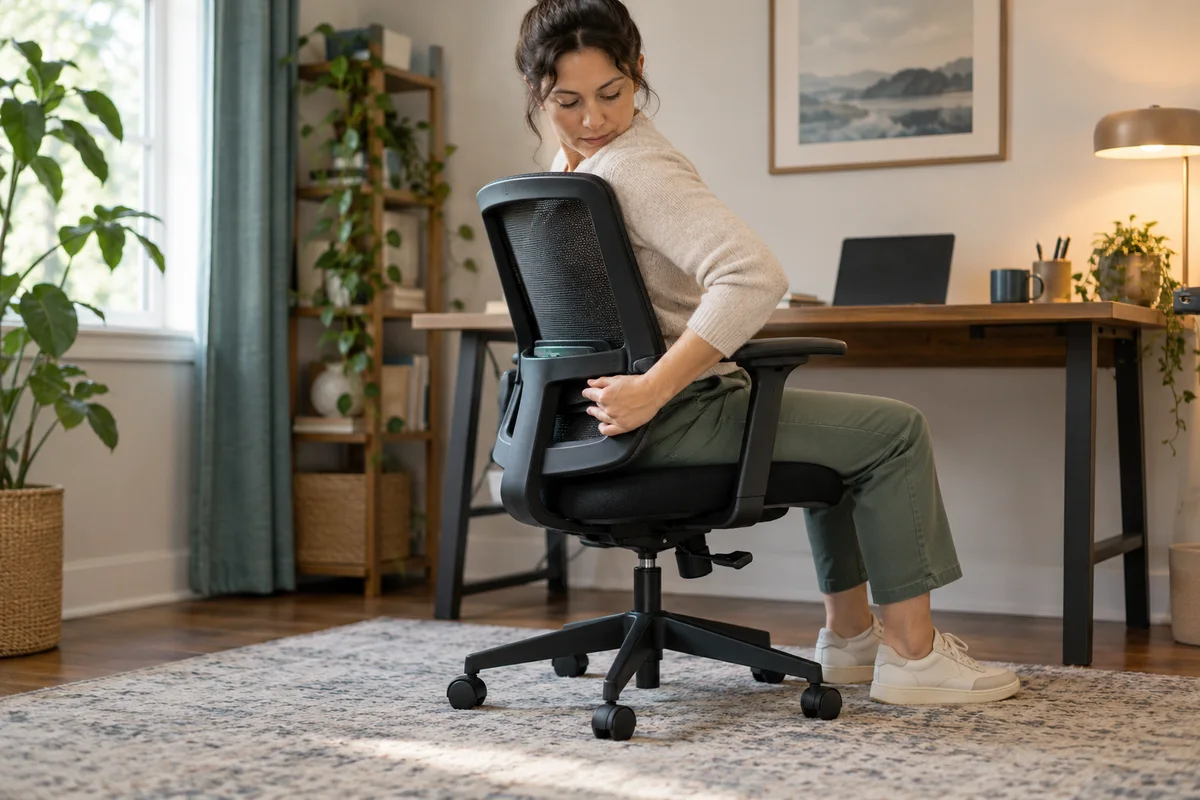
AI-generated scene illustration; not a photograph of the recommended product.
At the home desk, raising a chair’s backrest seems like the obvious answer when its lower support sits too low. But what if the upper backrest then feels wrong? The missing question is whether the lumbar section can move independently or travels with the rest of the back.
ProtoArc EC300 and EC200 illustrate that distinction. Choose the kind of adjustment your torso needs, not simply the model with more impressive adjustment language.
The short answer
ProtoArc’s comparison describes EC300 with five backrest-height positions and integrated lumbar support that moves with the entire backrest. It describes EC200 with a fixed backrest height and independent lumbar height and depth adjustment.
Neither architecture guarantees personal comfort. If your lower-back support and upper-back position need to change separately, that difference matters before buying. Check the current exact model, dimensions, permitted trial, and seller conditions.
Contents
- The short answer
- Describe the mismatch before choosing the mechanism
- Understand the linked EC300 movement
- Compare the independent EC200 arrangement
- Use a movement comparison rather than a feature score
- Set the seat before judging the back
- Keep recline separate from backrest height
- Make a short fit record
- Buy the movement you need
- Frequently asked questions
- Sources and verification
Describe the mismatch before choosing the mechanism
Use an ordinary seated task as the reference: reading a document, typing, or attending a call at the actual desk. Notice whether the problem concerns the location of the lower support, the upper backrest, or both.
Do not change several controls at once and then try to remember which change helped. A useful observation is specific: “The lower support feels too low while the upper part is already where I want it.”
That observation does not diagnose a condition. Persistent discomfort deserves appropriate professional advice. The shopping task is to identify which physical adjustment could address a fit mismatch without creating another one.
Understand the linked EC300 movement
On the manufacturer’s comparison, EC300 backrest height has five positions. Moving that backrest also moves its integrated lower support. Treat those as linked changes, not two independently selectable settings.
This arrangement may be useful when both areas need to move together. It may be less useful when raising the lower support places the upper backrest somewhere undesirable.
Do not infer a separate depth-adjustable lumbar pad from the general phrase lumbar support. Ask for a model-specific control demonstration if a listing is unclear. Product photography showing several panels does not establish that each panel has its own independent adjustment.
Compare the independent EC200 arrangement
ProtoArc describes EC200 lumbar height and depth as independently adjustable while its backrest height is fixed. That gives a different kind of control, not a universal advantage.
If the fixed upper-back position does not suit you, a movable lower pad does not automatically solve the whole fit. Conversely, if the upper back already fits and only the lower support needs repositioning, independent adjustment may deserve closer attention.
Check EC200 separately from EC200 Pro. Similar names appear together on the comparison page but do not make every feature interchangeable. Confirm the exact SKU and current instructions on the offer you would buy.
Use a movement comparison rather than a feature score
| Requirement | EC300 question | EC200 question |
|---|---|---|
| Move upper and lower support together | Does one of the five linked positions fit? | Is the fixed upper position already suitable? |
| Move lower support without raising the back | Is the linked architecture acceptable? | Does the independent range reach the needed position? |
| Change pressure or depth | What does the exact supported design allow? | Is the published lumbar depth range useful? |
| Return to a known setting | Can the position be identified and restored? | Can both independent settings be restored? |
The table frames a trial; it does not report a hands-on comparison. More available motions are valuable only when their ranges and controls fit the person.
Our EC300 review gives broader model context. Start with the mechanism distinction before comparing appearance or promotional bundles.
Set the seat before judging the back
A backrest can feel misplaced when the seat is too high or too deep for the user. Establish a suitable supported position before evaluating which backrest movement is missing.
OSHA’s workstation guidance emphasizes trying chairs and coordinating the chair with the desk, keyboard, and monitor. It also treats backrest and seat dimensions as parts of the same workstation.
Use that as general fit guidance, not a rigid posture prescription. Do not assume the tallest backrest setting, strongest contact, or deepest seat is inherently better. The correct reference is the intended ordinary task and the individual user.
Keep recline separate from backrest height
Changing the angle of the backrest answers a different question from changing its vertical position. Tilt resistance is another distinct control.
If an online demonstration leans back to show comfort, it may not tell you how the lower support aligns during upright typing. Ask to see the actual height adjustment rather than treating a recline clip as evidence of independent lumbar movement.
Our EC300 recline and tension guide covers those controls. Do not force a lever or dismantle a mechanism to obtain a movement the chair does not provide.
Make a short fit record
Within the seller’s permitted evaluation conditions, record the backrest position, seat-depth setting, and the ordinary task. Then note whether upper and lower contact are both acceptable.
If one improves while the other becomes unsuitable, record that tradeoff explicitly. Repeatedly searching between two unsatisfactory positions can reveal an architecture mismatch rather than a need for more adjustment effort.
For shared furniture, each user needs an independent assessment. Our shared-chair setup card can help restore settings, but it cannot make an insufficient range fit someone it does not accommodate.
Buy the movement you need
Consider EC300 when a supported linked position fits the whole back, the other dimensions pass, and control use is practical. Consider an independently adjustable alternative when lower-support placement needs to change without moving the entire backrest.
Pass when the purchase depends on an unlisted movement, a promised health outcome, or a trial you cannot actually obtain. Confirm return shipping, assembled-chair conditions, and package contents with the actual seller.
A current partner listing is a place to check the available offer, not evidence that all versions have the same mechanism. Recheck the model name and feature description before paying.
Frequently asked questions
Does EC300 lumbar support move separately in height?
ProtoArc’s comparison describes it as integrated with the entire height-adjustable backrest. Do not assume independent pad movement.
Does EC200 have the same backrest-height mechanism?
The comparison lists fixed backrest height for EC200 and independent lumbar height and depth adjustment.
Will five positions fit every torso?
No. A position count does not establish individual fit or the usefulness of the available range.
Can lumbar features be treated as a back-pain treatment?
No. This article compares published mechanisms, not medical effectiveness. Seek appropriate advice for persistent symptoms.
Sources and verification
Checked October 19, 2026. No chair trial, pressure measurement, or health outcome is claimed.
- ProtoArc chair comparison and linked versus independent adjustment
- ProtoArc EC300 model information
- OSHA workstation chair guidance
Keep reading
Related guides
 Home Office
Used EC200 Chair: Do Not Assume Warranty Transfers
Compare a used EC200 offer with a qualifying new purchase: check non-transferable warranty, condition, seller terms and actual replacement costs.
Read guide → Home Office
EC200 at a High Desk: Check Seated Working Height
Check whether a fixed high work surface calls for a different chair category instead of assuming EC200 height adjustment solves every desk.
Read guide → Home Office
EC300 Materials: A Mesh Back Is Not an All-Mesh Seat
Distinguish EC300 mesh backrest from its foam cushion and compare the actual sitting surface before choosing chair materials.
Read guide →