
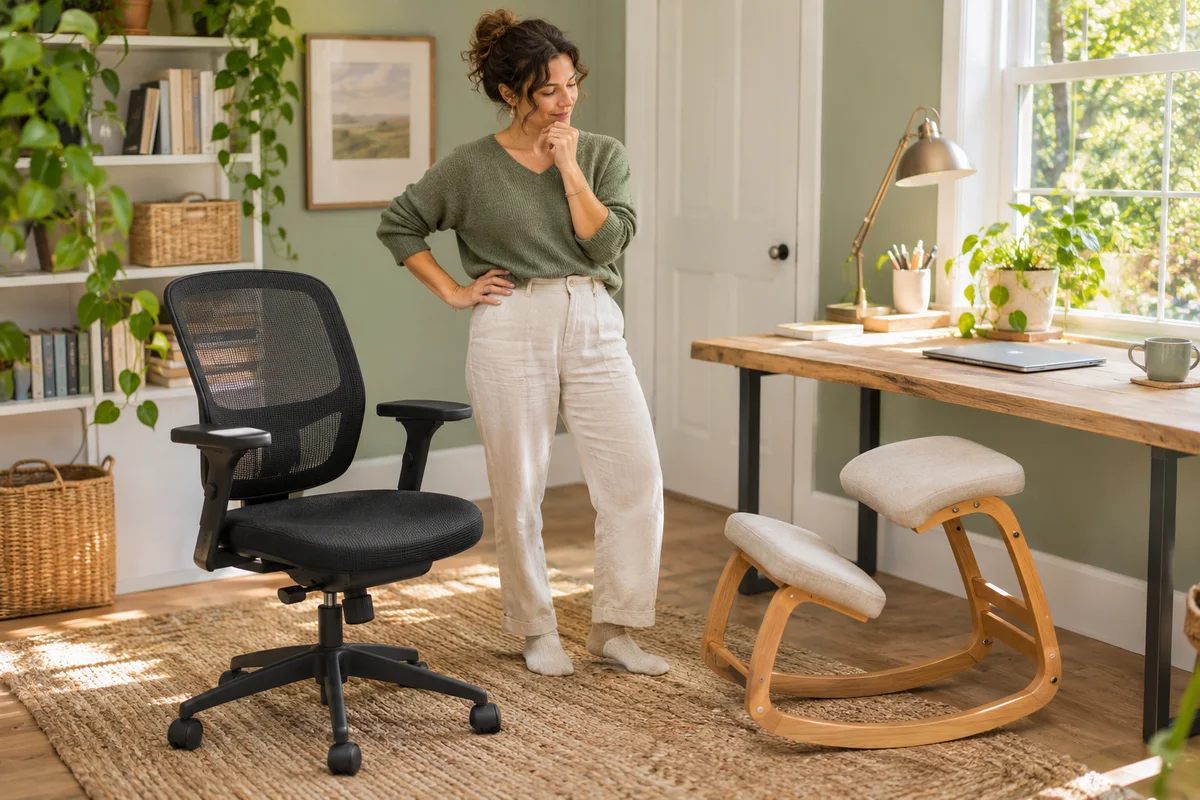
AI-generated scene illustration; not a photograph of the recommended product.
A home worker wants a different way to sit and sees a compact kneeling chair beside a conventional office chair. The comparison is often presented as a contest over perfect posture. A more useful question is what each arrangement allows during the actual workday: typing, reading, turning toward a second surface and getting up.
The short answer
Compare a ProtoArc EC200 with a specific kneeling chair as two different seating arrangements, not as guaranteed treatments for discomfort. EC200 is a conventional adjustable office chair; Varier’s Variable uses a tilted seat, shin-support cushions and curved runners. Those designs create different support and movement choices.
Start with the desk, the user’s fit and the tasks performed. Keep the existing chair if it already works, or try an appropriate alternative where permitted before replacing it. Neither an ergonomic label nor a kneeling shape establishes an individual health benefit.
Contents
- The short answer
- Compare actual designs rather than categories
- Recreate the main work task
- Identify which support you want
- Include getting up and moving between tasks
- Build a task comparison card
- Decide whether the alternative replaces or supplements
- Buying advice
- Frequently asked questions
- Sources and verification
Compare actual designs rather than categories
The EC200 product page describes the selected chair’s adjustable components. Confirm the actual variant and included arms rather than transferring features from EC200 Pro or another family member.
The Varier Variable product page describes a particular rocking kneeling chair with a tilted seat and two lower cushions. Varier also describes more than one supported sitting position. That is more specific than treating every product called a kneeling chair as identical.
This guide uses those two designs to structure a purchase comparison. It does not transfer Varier’s claims to every inexpensive stool, or claim that a chair without the same construction offers the same movement. Nor does it borrow manufacturer health marketing as an independent test result.
Recreate the main work task
Identify the part of the day that drives the purchase. A long typing session, sketching on a desk and switching between calls and paperwork can involve different reaches. Set up the normal keyboard, pointer and frequently used material before comparing chairs.
Try the actual approach to the desk, not merely sitting in open space. A seat can seem usable away from furniture but leave the person too far from the keyboard when placed at the intended table. Include the desk frame and anything mounted underneath it.
The OSHA chair guidance emphasizes evaluating seating with the workstation. It does not approve either model. Its useful purchase principle is to assess the arrangement as a whole, including support and reachable work surfaces.
Identify which support you want
With a conventional office chair, back support, seat depth, foot position and arm placement can be assessed as distinct fit questions. With a kneeling design, the tilted seat and lower cushions change where support is available and how the user enters or changes position.
Do not force a position simply because a photograph presents it as ideal. If an arrangement is uncomfortable or difficult to use, stop that assessment. Persistent symptoms or individual physical limitations deserve qualified advice rather than a furniture article prescribing another posture.
Our EC200 lumbar guide addresses an adjustment within a conventional chair. It cannot establish that a kneeling design is a better or worse clinical choice. The present comparison is about whether a different support layout actually suits the work.
Include getting up and moving between tasks
Think through an ordinary sequence: sit down, type, reach the pointer, turn to a nearby notebook, stand for a call and return. Compare the space and movements required without rushing or testing balance.
Curved runners and office-chair casters create different interactions with the floor. Check each manufacturer’s care and use requirements, together with the flooring guidance. Do not assume that a compact-looking frame always takes less usable space when a person is entering or changing position.
A chair should not become an improvised step, storage rack or exercise device. Evaluate only its documented use. Also leave room for ordinary changes of activity during the day rather than expecting a new seat to make uninterrupted sitting desirable.
Build a task comparison card
| Question | EC200 arrangement | Specific kneeling arrangement |
|---|---|---|
| Desk approach | Confirm arms, seat and underside clearance | Confirm frame and lower-cushion access |
| Main support | Check actual back, seat and foot fit | Check intended seat and shin positions |
| Movement | Supported swivel, rolling and adjustments | Supported changes on the specified runners |
| Getting up | Normal route is unobstructed | Normal exit does not require awkward maneuvering |
| Purchase proof | Exact variant and seller terms | Exact construction and supplier terms |
Record what you actually observe. Do not award points for features whose purpose you have not identified. Ten adjustments that remain unused do not automatically beat a simple arrangement, and a minimalist frame does not automatically solve fit.
If a household shares the desk, repeat the assessment for each regular user. A setup suitable for one person’s proportions can be unsuitable for another. Do not infer universal fit from a published height range or one positive review.
Decide whether the alternative replaces or supplements
Some buyers want one primary seat for every task. Others want a supported alternative for occasional variation. Those are different purchase decisions and may lead to different budgets and storage requirements.
If you only want a brief change of position, first consider whether changing tasks and using existing appropriate furniture addresses it. Buying a second chair adds a place to store it and another object around a small desk. Count that burden alongside any anticipated benefit.
For a primary replacement, require a workable complete routine rather than a momentary impression. Confirm return conditions before assembly or use, since a manufacturer’s direct-store trial does not automatically cover a different seller. We have not carried out a sitting trial or measured individual fit.
Buying advice
Consider EC200 when a conventional supported office-chair arrangement fits the desk and the intended user values its confirmed adjustments. Our EC200 overview covers the broader product choice. Verify the actual partner variant, accessories, delivery and return terms.
Consider a specific kneeling design only when its documented arrangement fits the tasks and the person can use it appropriately. Do not buy it because a generic posture claim promises a cure. Likewise, do not buy EC200 merely because it looks more substantial or has more controls.
Keep the purchase focused: which task currently fails, what different support is required and what evidence shows that the proposed arrangement supplies it? When those answers remain vague, postponing replacement can be more useful than choosing the most persuasive photograph.
Frequently asked questions
Are all kneeling chairs equivalent to Variable?
No. This comparison uses a specific documented design; other frames and support arrangements need their own assessment.
Does EC200 guarantee pain relief?
No. Product adjustments and ergonomic marketing do not establish a clinical outcome.
Must a kneeling chair be used in only one posture?
Follow its own instructions. Varier describes several supported positions for Variable; do not generalize that to every product.
Can I decide without checking my desk?
A chair-only comparison misses approach, clearance and reachable work surfaces. Assess the actual workstation together.
Sources and verification
Checked November 19, 2026. Published designs reviewed, without a chair trial, medical evaluation or comparative health test.
- ProtoArc EC200 product information
- Varier Variable design and use information
- OSHA workstation chair guidance
Keep reading
Related guides
 Home Office
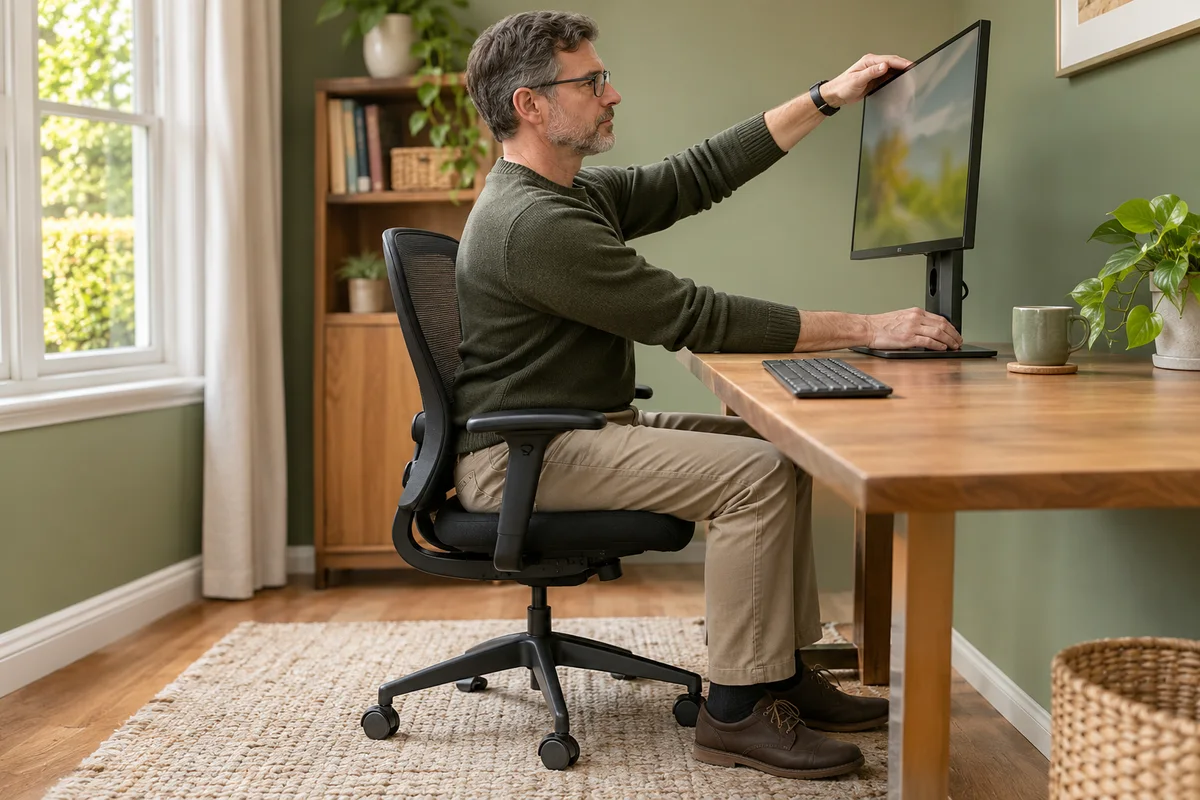
EC300 and Bifocals: Fit the Screen Before the Chair
Check how your glasses, monitor height and supported seating work together before buying a ProtoArc EC300 for your home office.
Read guide →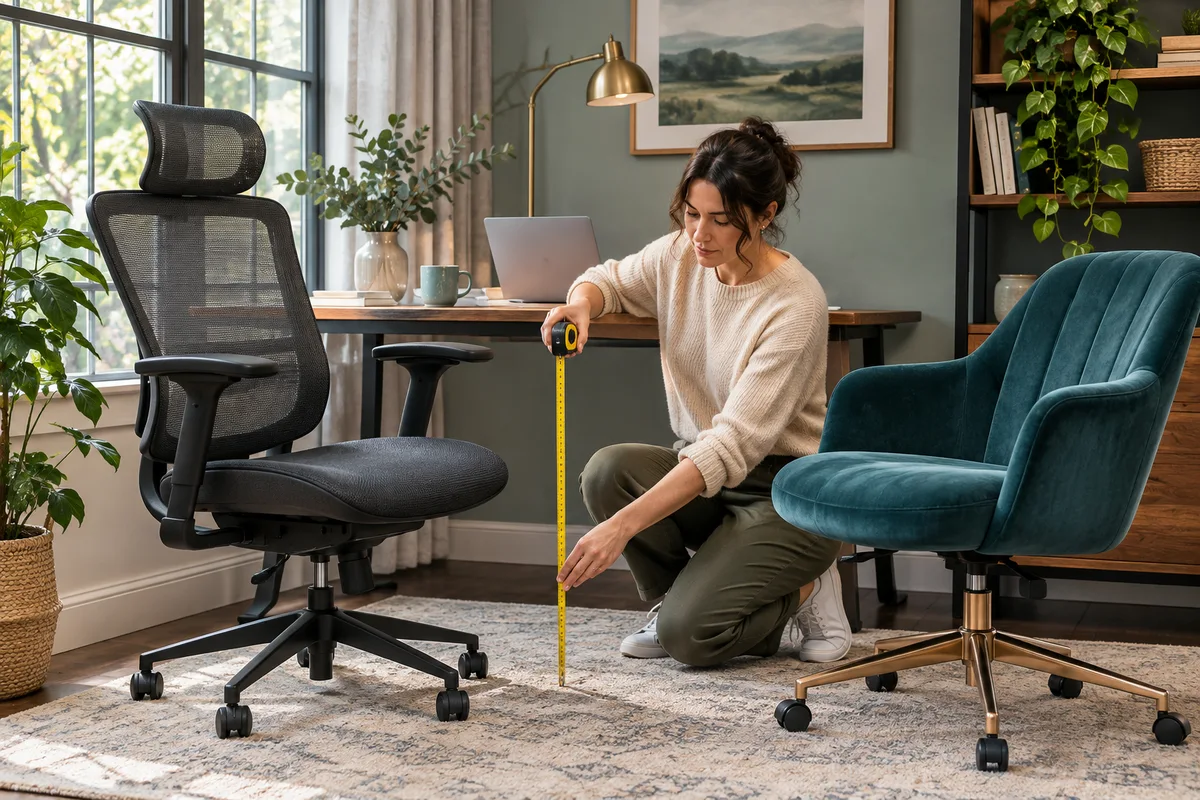 Home Office
ProtoArc EC200 vs EC300: Choose by Fit
Compare the EC200 and EC300 by seat fit, back support position and actual desk clearance rather than buying the chair with more controls.
Read guide → Home Office
EC300 Laptop Stand and Keyboard Layout
Set screen height, keyboard reach and chair clearance independently before buying an EC300 for a compact laptop-based home office.
Read guide →