
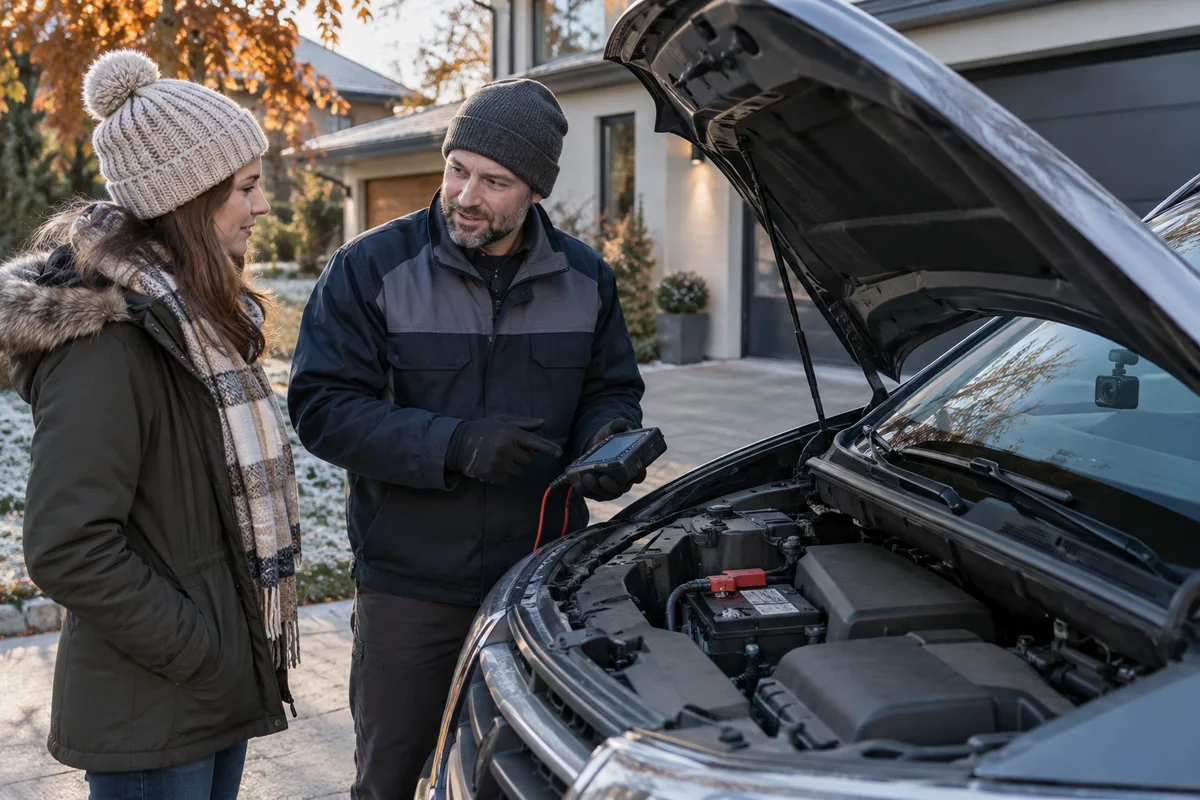
AI-generated scene illustration; not a photograph of the recommended product.
Your car spends twenty-three hours parked and only a short part of the day moving. Parking-mode recording seems useful, particularly as mornings become colder and darker. But the starting battery is also the energy source that must get you moving again. A long recording target can conflict with that more important job.
Before buying a VIOFO A229 Plus and parking accessories, look at the complete vehicle routine. This is a cold-weather planning checklist, not an electrical installation guide or a promise that a cutoff setting will prevent every flat battery.
The short answer
Check battery condition and the vehicle’s charging system before extending parking recording. Confirm the exact camera’s supported power arrangement, professional installation requirements, cutoff protection, timer options, and your actual parking-coverage need.
NHTSA notes that cold weather reduces battery power while combustion engines require more starting energy. A dash cam does not change that constraint. If starting reserve is uncertain, prioritize assessment and a conservative recording plan rather than the longest possible parking window.
Contents
- Describe the parked hours
- Check the vehicle before camera settings
- Understand cutoff and timer tradeoffs
- Do not confuse a capacitor with a parking battery
- Make installation part of the budget
- Build a normal-use review
- Buying advice
- Frequently asked questions
- Sources and verification
Describe the parked hours
Write down a normal week: a short commute, several days working from home, a long airport stay, or occasional longer journeys. These patterns create different parking intervals and different opportunities for the vehicle’s charging system to replenish energy.
Do not turn a particular journey length into a universal recharge rule. Vehicle equipment, battery condition, temperature, other electrical use, and the charging system differ. A short drive should not be assumed to replace whatever a camera consumed during the previous night.
List the places where coverage matters most. Street parking outside work may be the priority, while a secure private garage might justify less recording. A plan tied to actual risk is more useful than a single goal to record continuously everywhere.
Check the vehicle before camera settings
Ask a mechanic to assess battery and charging-system condition where appropriate, especially if starting has become slow or the vehicle has a history of discharge. Do not use a camera menu as a substitute for diagnosing an existing battery problem.
Keep the distinction between the vehicle’s high-voltage traction system and its low-voltage accessory system clear in an electric or hybrid car. Confirm manufacturer and installer guidance for the exact vehicle. Do not copy an arrangement from a conventional car into another electrical architecture.
Note any other equipment that remains active when parked. The dash cam may be one consumer among several. If a starting problem persists, investigate the overall system rather than assuming the camera’s advertised protection must account for every possible cause.
The NHTSA winter-driving guidance is the basis for the seasonal battery check, not evidence that a particular camera damages every battery or that a new battery automatically permits indefinite parking recording.
Understand cutoff and timer tradeoffs
A supported cutoff stops camera power at a configured condition; a timer limits the selected recording period. They serve different purposes. A cutoff responds to a voltage-related threshold, while a timer can end coverage before that threshold is reached.
VIOFO’s general hardwire support page explains that higher cutoff choices shorten recording and recommends a conservative setting when troubleshooting discharge. Its published values are for the supported kit context described there, not universal instructions for every vehicle, camera, or accessory revision.
Ask your installer to confirm the correct protection arrangement for your combination. Do not lower a threshold simply because you want more footage. The extra footage consumes a resource whose main purpose is still vehicle operation.
Expect a tradeoff. An earlier stop means an unrecorded period; a longer period means greater energy use. Record which gap you are willing to accept. No menu setting should be presented as a guarantee that the car will start under all conditions.
Do not confuse a capacitor with a parking battery
A dash cam’s internal supercapacitor is not an independent long-duration parking supply. The camera still needs suitable external power for extended recording when the vehicle is off. Do not buy on the assumption that the internal component supplies hours of surveillance.
Verify how the intended socket behaves when the ignition is switched off. Some stop supplying power; some remain active. The same camera can behave differently in two vehicles because the external power arrangement differs.
A supported dedicated dash-cam battery setup is a separate purchase with its own compatibility, installation, charging, and operating requirements. Do not replace it with an unrelated household power station or improvised adapter inside the vehicle.
Make installation part of the budget
Include the correct current accessory, any required professional work, and the time to check recording transitions. A cheap camera package that omits necessary parking equipment is not the total cost of the system you want.
Ask the installer how the arrangement respects airbags, trim, vehicle electronics, and the manufacturer’s guidance. Do not use this article to select fuse circuits or route cables through safety-critical areas. Those choices require exact vehicle knowledge.
Keep an installation record with model names and the agreed protection settings. That record can save confusion if another technician later services the battery or if the camera behaves differently after maintenance.
Build a normal-use review
After setup, review ordinary operation while safely parked. Confirm whether the camera enters the intended mode, when it stops, and whether actual files are available. Do not deliberately drain the starting battery to discover the maximum possible recording time.
Repeat your review as the season, parking interval, or vehicle condition changes. A setup accepted during frequent longer journeys may deserve another assessment when the car sits unused for days.
Save relevant files before any destructive card maintenance. Our original-footage preservation guide covers that separate task. More careful power planning is not useful if the files you needed are later erased.
Buying advice
The A229 Plus can fit a driver who wants its supported front-and-rear recording arrangement and accepts a realistic power budget. Confirm the current package and exact accessory compatibility before using the partner listing.
Pass if the primary expectation is weeks of continuous coverage without checking the vehicle or external power. A camera upgrade does not solve that expectation. A different coverage plan, vehicle maintenance, or an appropriate professionally specified system may be necessary.
Do not let the appeal of parking security override the ability to use the vehicle tomorrow. The better purchase is one whose energy source, protection behavior, and recording gaps you can explain before ordering.
Frequently asked questions
Will a voltage cutoff guarantee the car starts?
No universal guarantee is appropriate. Battery condition, temperature, vehicle requirements and other electrical use still matter.
Can the A229 Plus supercapacitor power overnight recording?
Do not treat it as a long-duration battery. Extended parking recording requires a suitable supported external power arrangement.
Should I select the lowest cutoff for the longest footage?
Do not change protection priorities just to maximize recording. Ask a qualified installer for guidance specific to the vehicle and supported kit.
Sources and verification
Checked October 13, 2026. No battery-drain experiment or vehicle installation was performed by WideLore.
- NHTSA winter battery and vehicle preparation
- VIOFO hardwire cutoff support guidance
- VIOFO parking-mode power troubleshooting
Keep reading
Related guides
 Garage & Workshop
VIOFO A329S SSD Storage: Why the Card Still Matters
Plan A329S storage around supported SSDs, the dedicated cable, parking-mode card requirements, file checks, and actual retention needs.
Read guide → Garage & Workshop
Dash Cam Audio in a Shared Car: Make a Mic Plan
Set and verify a VIOFO A229 Plus microphone routine for a shared car, keeping passenger expectations and file handling separate from video.
Read guide → Garage & Workshop
Save Dash Cam Footage Before Formatting the Card
Build an original-file backup routine before card maintenance, then verify both recording channels before a longer drive.
Read guide →