
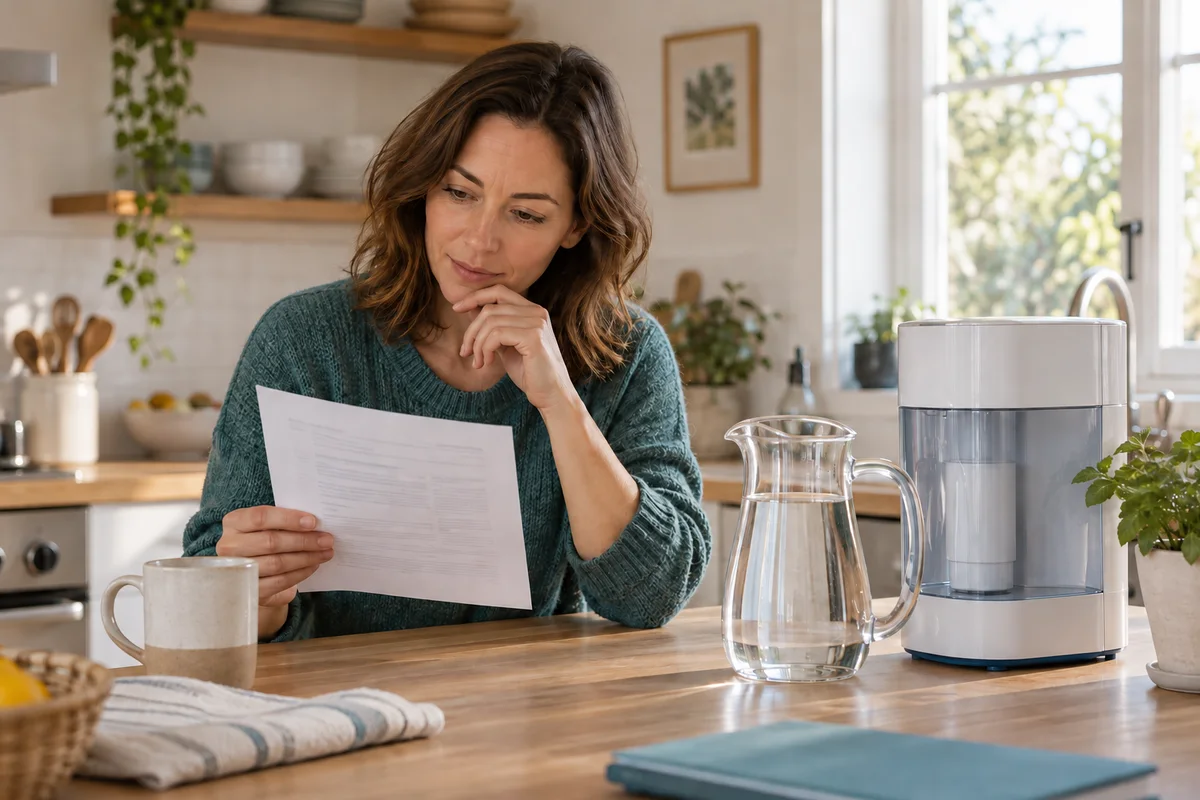
AI-generated scene illustration; not a photograph of the recommended product.
You are considering a countertop reverse-osmosis system because the water tastes different, a report mentions a contaminant, or a device displays an impressive number. Those starting points are not equivalent. A purchase made before identifying the question can be convenient yet poorly matched to the actual concern.
Before comparing Waterdrop M6SL with another system, build a one-page water evidence card. Link the water source, specific question, appropriate evidence, exact product claim, and ownership requirements. This is more useful than choosing by a low TDS reading or a long filtration-stage list.
The short answer
Start with your actual water concern, then use the appropriate report, authority guidance, or qualified test to define it. Match that evidence to a documented reduction claim for the exact system and replacement filter, under the stated conditions.
EPA lists total dissolved solids among secondary drinking-water standards, which concern aesthetic or cosmetic effects rather than a complete health-safety determination. A TDS number is not a certificate that every relevant contaminant is absent. The evidence card below is a purchasing framework, not a water test or treatment prescription.
Contents
- Field one: identify the water source and question
- Field two: record what the evidence actually covers
- Field three: match the exact product claim
- Field four: document the operating conditions
- Field five: compare ownership and alternatives
- Use the card to make a purchase decision
- Frequently asked questions
- Sources and verification
Field one: identify the water source and question
Write whether the supply is a public water system or another source, and where the household obtains relevant guidance. Describe the concern precisely: an ordinary taste preference is different from a reported contaminant or an active safety advisory.
For a public supply, obtain the current water-quality report and any applicable notices. EPA’s home-testing guidance also explains that system-level information may not describe conditions at a particular household faucet, especially for concerns related to household plumbing.
Do not diagnose water through taste, color, or a filter display alone. If there is an advisory, illness concern, or uncertainty about safety, follow the appropriate water authority and qualified guidance first. A shopping article should not provide reassurance that overrides them.
Keep this field focused. “Cleaner water” is not yet a testable purchase requirement. Name the question that a suitable source or test must answer before selecting equipment.
Field two: record what the evidence actually covers
Add the source, date, sample location where relevant, tested parameter, result, and any limitations. A laboratory result for one substance does not answer an unrelated substance question. A regional report and a faucet sample have different scopes.
EPA’s home water-testing guidance advises finding out what is in the water before approaching treatment dealers. When testing is appropriate, use a qualified laboratory or service and follow its actual collection and handling instructions. Do not improvise a sample method from this article.
Record TDS separately from the specific concern. EPA’s secondary-standards classification helps explain why a total-solids figure is not a complete contaminant assessment. A lower aggregate number does not establish the absence of every substance or microorganism.
Avoid inventing results to complete the card. “Not yet tested” is a useful entry because it identifies the next action. An empty field should stop an unsupported safety conclusion, not invite a guess.
Field three: match the exact product claim
Write the exact system model and the proposed replacement-filter identifier. Then record the specific reduction claim, its supporting document or certification listing, and the conditions under which it applies.
Do not substitute a brand logo, a similar model, or a broad standards badge for the actual claim. Confirm the system and filter combination and the named substance. If the evidence does not clearly match the item being sold, ask the manufacturer or relevant certifier before buying.
Waterdrop describes M6SL as an installation-free countertop RO system with a detachable pitcher and a mineral-adding stage. Those features address format and taste-related preferences; they do not by themselves establish suitability for your specific water concern.
Keep seller copy and independently verifiable evidence in separate fields. We have not tested M6SL water or independently verified every claim on its sales page. A claim that needs confirmation should remain marked that way, even if the product otherwise fits the kitchen.
Field four: document the operating conditions
Read the exact product’s supplied instructions for suitable feed water, setup, initial preparation, cleaning, storage, and replacement. Do not assume every countertop RO system accepts the same source or conditions.
Maintenance is part of the evidence chain. A supported reduction claim is not a promise that an improperly maintained or incorrectly configured unit will behave the same way. Identify who will perform the routine and how approved replacement parts will be obtained.
Separate a filter-life indicator from a test of all water-quality concerns. Ask what the indicator actually represents and what evidence is needed for the concern on your card. Do not interpret a reassuring color or remaining-life percentage as a general safety certificate.
A mineral-adding stage can also make “the lowest possible output number” an unsuitable shopping goal. Define the desired outcome rather than treating one metric as the whole decision.
Field five: compare ownership and alternatives
Once the evidence question is settled, compare the real countertop footprint, water-handling steps, pitcher use, cleaning, and approved replacement availability. These are practical needs that still matter even when a specific claim is suitable.
Use our M6SL filter ownership worksheet for the multi-year cost structure. It avoids assuming that a maximum lifespan or a subscription delivery date guarantees the appropriate replacement interval.
Compare a simpler treatment format when it adequately addresses a confirmed need and has the necessary evidence. More stages, a larger appliance, or a higher price should not win automatically. Likewise, a convenient pitcher is not the answer to every source-water problem.
Include the option of getting qualified testing or advice before buying. That expenditure can prevent purchasing the wrong category of equipment around an unconfirmed concern.
Use the card to make a purchase decision
Your completed card should connect source, question, evidence, exact model and filter, supported claim, operating conditions, and ownership plan. Keep dated links or documents with it so a changed cartridge or product version is easy to notice.
The M6SL belongs on the shortlist when its documented suitability and countertop routine match those fields. Our hosting workflow guide separately addresses serving and refill convenience; neither article establishes water safety.
Pass if the purchase depends on a TDS number, an unclear certification badge, or an unsupported assumption about an unsafe supply. Resolve the missing evidence first rather than choosing whichever listing sounds most reassuring.
After the card is complete, check the current partner listing for the exact package, filter, seller, and terms. Do not let a promotion change the question that the system must actually answer.
Frequently asked questions
Is the water evidence card itself a test?
No. It organizes actual reports, appropriate testing, documented claims, and purchase requirements. It cannot generate missing evidence.
Can a standards badge establish every reduction claim?
No. Verify the exact listed model, filter, named claim, and applicable conditions rather than assuming a badge answers every concern.
What if an authority has issued a water advisory?
Follow that authority’s current instructions. Do not rely on a shopping guide or an appliance display to override the advisory.
Sources and verification
Checked October 14, 2026. EPA still links the 2005 home-testing fact sheet from its current resource page. Local guidance and qualified laboratories should determine actual testing needs.
- EPA primary and secondary drinking-water standards
- EPA Home Water Testing guidance
- Waterdrop M6SL published product and filter information
Keep reading
Related guides
 Kitchen
Waterdrop M6SL: Build a Filter Ownership Budget
Use an ownership worksheet for M6RFL replacement, delivery timing, usage, upkeep, and alternatives without assuming guaranteed savings.
Read guide → Kitchen
Countertop RO for Guests: Plan the Refill Routine
Check counter access, serving capacity, concentrate-water handling, and maintenance before choosing Waterdrop M6SL for a busy hosting kitchen.
Read guide → Kitchen
COSORI TurboBlaze 6-Quart Air Fryer for Single-Basket Family Dinners
For anyone feeding three to five people most weeknights, the COSORI TurboBlaze packs a full six-quart basket, nine cooking presets, and a 450 degree ceiling into a single easy-clean unit.
Read review →