
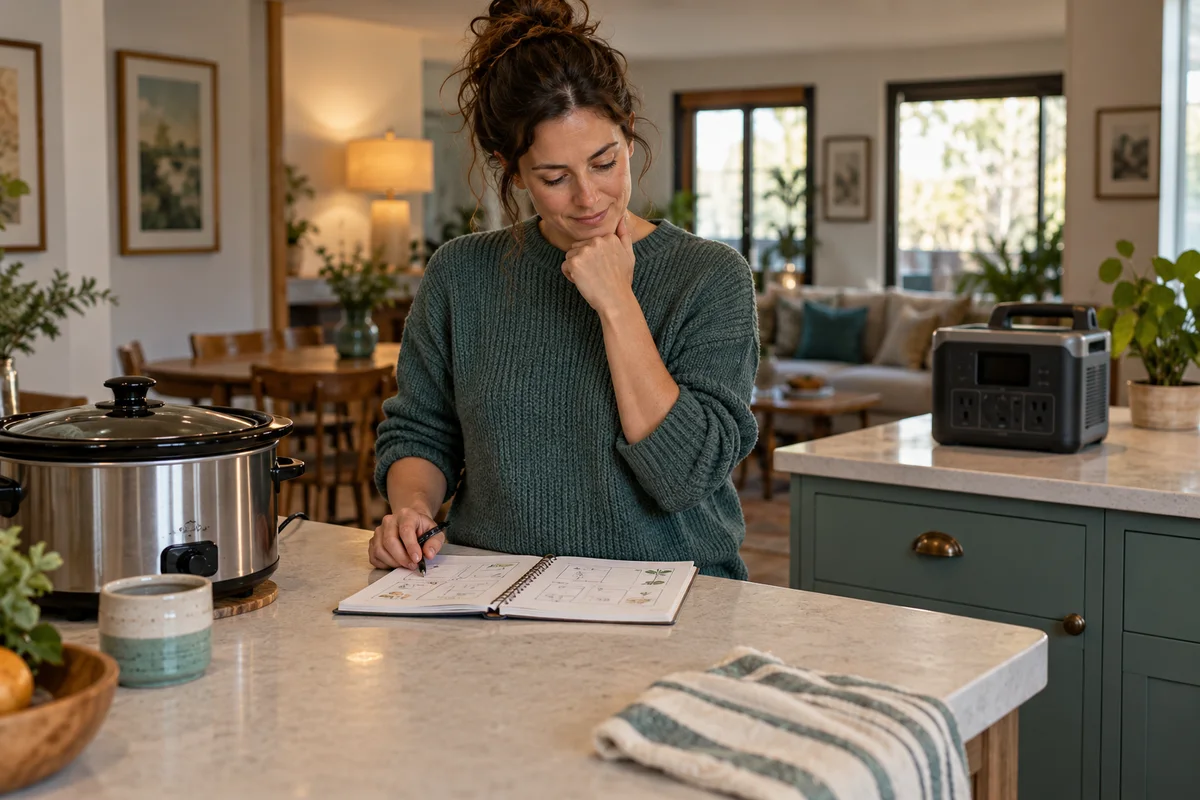
AI-generated scene illustration; not a photograph of the recommended product.
The slow cooker is working through dinner when the household starts planning for a possible power interruption. A portable battery seems like an easy way to keep the meal on schedule. With BLUETTI AC180, electrical suitability is only one question; the food’s actual cooking history remains another.
The short answer
A power station does not make an interrupted, unknown cooking process safe after the fact. Qualify the exact slow cooker and AC180 setup before relying on backup power, and keep a separate plan for what to do if cooking is interrupted.
USDA’s slow-cooker outage guidance distinguishes food already fully cooked while you are home, unfinished food that needs immediate alternative cooking, and an outage during an unattended cooking process. Do not replace those conditions with “the battery is on now.”
Contents
- The short answer
- Before the meal
- Electrical qualification
- The session budget
- Interruption history
- The food decision
- Kitchen placement
- Buying advice
- Frequently asked questions
- Sources and verification
Before the meal
Record the slow cooker’s model, electrical input and instructions for interruption or restarting. A manual dial and an electronic program may behave differently after power is lost. Do not assume what the controls will do from their appearance.
Find out whether the appliance manufacturer permits the intended power source. Matching voltage and a watt rating is not enough to override an express restriction. If the instructions do not resolve the question, ask support about the precise station arrangement.
Keep the battery decision separate from the recipe. The correct cooking setting and food-handling process come from appropriate appliance and food-safety guidance, not from whichever setting gives the most attractive battery estimate.
If the household cannot reliably supervise a proposed backup arrangement or determine what occurred, choose a meal plan that does not depend on an unverified continuity claim.
Electrical qualification
The AC180 US manual and product page give the station’s output and operating boundaries. Read the regional unit’s limits together with the slow cooker’s actual input requirements and any other concurrent loads.
A battery capacity in watt-hours describes stored energy, not permission to connect every kitchen appliance. Likewise, a low cooking temperature does not tell you the electrical input or a controller’s response to an interruption.
Do not use a wall outlet to backfeed the kitchen, alter household wiring or combine sources through an improvised lead. This is a comparison for an appropriate directly connected appliance, not a whole-house backup installation.
Our home-wiring boundary guide covers that important distinction. Use qualified help when the desired solution involves the building rather than an ordinary permitted appliance connection.
The session budget
For an approved pairing, identify the remaining cooking period, any applicable finishing stage and the other loads the household expects the station to support. Keep each stage’s demand evidence separate.
For arithmetic only, a hypothetical constant 200W load for four hours needs 800Wh at the load. That is not a measured slow-cooker demand or a promised AC180 runtime. Cycling behavior, station losses, state of charge and other loads can change the outcome.
Do not substitute a keep-warm setting for the required cooking process to reduce the estimate. Electrical economy cannot decide whether a meal has been cooked appropriately.
Also check relevant automatic shutdown behavior through the current station instructions. A low or cycling load can raise a control question that a capacity calculation cannot answer. An energized display alone is not proof that a cooker continued the intended program.
Interruption history
Write down what the household would actually know if power failed: whether someone was present, whether cooking had finished beforehand, whether the cooker stopped and whether its program resumed correctly.
Do not claim uninterrupted cooking merely because the station advertises a transfer feature. The exact appliance and complete arrangement would need qualification, and an unnoticed earlier interruption cannot be erased by reconnecting power later.
If you arrive home to an uncertain cooking history, do not use smell, appearance or a newly illuminated display as evidence that the meal was handled safely. Follow current food-safety guidance for the actual conditions.
A smart plug notification or household message may help document what happened, but this article does not validate such a device as food-safety monitoring. Keep an ordinary observation separate from a complete temperature and process history.
The food decision
USDA says to discard food when power goes out during an entirely unattended slow-cooking process, even if it appears done. When at home with unfinished food, its guidance calls for immediately finishing through an appropriate alternative method.
The separate allowance for food remaining in an unpowered cooker for up to two hours applies when the food was completely cooked before the outage and you are at home. It is not a general two-hour permission for raw ingredients, interrupted cooking or an unknown history.
The USDA archived fact sheet gives those conditions in its Power Out section. It does not endorse AC180 or supply a procedure for testing questionable food.
Do not use this buying guide to improvise a rescue recipe. For uncertainty about a specific meal, use current appropriate food-safety advice. A power-source purchase and a decision about whether to keep food have different evidence requirements.
Kitchen placement
Keep the station in the clean, dry, ventilated environment required by its instructions, away from spills and cooking heat. Do not place it under a damp towel, against the cooker or inside a cabinet to hide the power equipment.
Plan the cord route around ordinary kitchen movement. A dinner backup that creates a trip hazard or places electrical connections in a wet work area introduces another household problem.
Do not move a hot, filled cooker merely to make the battery location convenient. Plan an appropriate supported arrangement before the cooking session, while equipment can be handled safely according to its instructions.
If the only feasible location conflicts with either appliance’s requirements, change the plan. A portable station’s handle does not make every countertop corner an acceptable operating position.
Buying advice
Consider AC180 only after the slow cooker’s permitted source, electrical requirements and the household’s continuity plan are established. It may have value for other supported tasks, but dinner safety should not rest on an untested pairing.
Pass if the purchase is intended to make an already interrupted meal safe, guarantee an unattended program or justify ignoring a cooker restriction. A simpler meal or a supported alternative cooking plan may solve the actual problem more directly.
The AC180 overview provides broader ownership context. Before following the partner listing, verify the exact regional unit, seller’s current stock, delivery and returns. Do not rely on a promotional banner for an imminent meal.
We have not measured a slow cooker’s runtime, tested transfer behavior, monitored food temperatures or validated a recipe. No cooking-duration or food-safety guarantee is attached to the commercial link.
Frequently asked questions
Will reconnecting power make food safe?
Not by itself. The actual cooking and interruption history still determines the appropriate food-safety response.
Does “low” mean low electrical demand?
Do not infer a wattage from a cooking-setting name. Use the exact appliance’s supported electrical information.
Is the two-hour rule universal?
No. The cited allowance has specific conditions: food completely cooked before the outage, with the owner at home.
Is AC180 a whole-kitchen supply?
Not through improvised household wiring. This guide considers only an appropriately qualified direct appliance arrangement.
Sources and verification
Checked October 31, 2026. AC180 manual re-downloaded. The current FSIS question’s public indexed text and the official archived 2012 fact sheet were compared; direct FSIS page retrieval was limited. No food or electrical testing.
- BLUETTI AC180 product and regional specifications
- AC180 US manual
- USDA FSIS slow-cooker power-outage question
- USDA archived Slow Cookers and Food Safety fact sheet
Keep reading
Related guides
 Power & Outdoors
Elite 100 V2 and Starlink Mini
Match Starlink Mini's dedicated cable and 100W USB-PD requirement with Elite 100 V2 profiles before planning a household satellite-internet reserve.
Read guide → Power & Outdoors
AC180 Grid Enhancement and UPS
Understand AC180 Grid Enhancement and its UPS transfer limitation before choosing backup power for a household continuity requirement.
Read guide → Power & Outdoors
AC180 Voltage and Frequency
Check AC180 regional output voltage separately from selectable frequency and plug shape before pairing imported appliances with a US power station.
Read guide →