
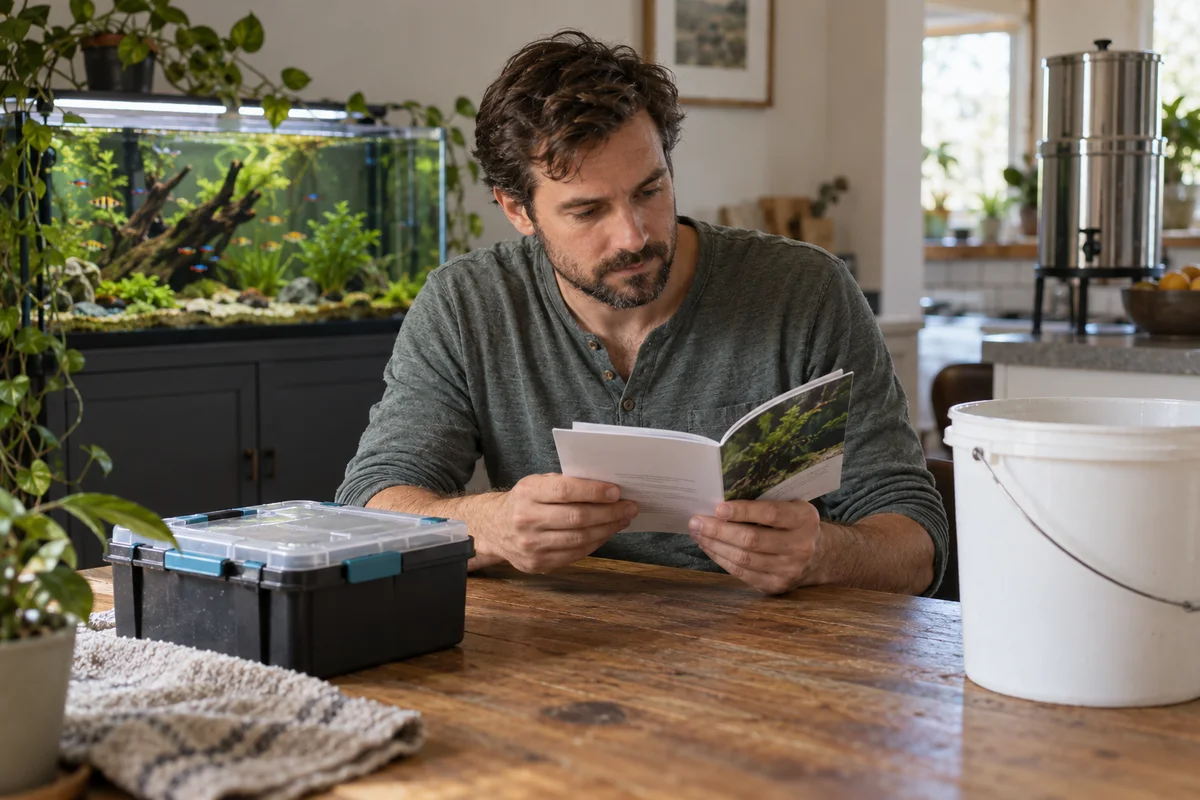
AI-generated scene illustration; not a photograph of the recommended product.
An aquarium keeper is already considering M6SL for drinking water and wonders whether one countertop system can also supply the tank. The word RO seems promising, but the system adds minerals after filtration.
That difference deserves attention before a purchase or a change to an established aquarium routine. A drinking-water feature is not a complete description of the water an aquarium’s particular inhabitants and maintenance plan require.
The short answer
Do not treat M6SL as a verified aquarium-water recipe or assume it produces a deionized blank slate. Waterdrop describes it as a mineralized drinking-water RO system. Confirm the actual finished-water profile against an aquarium-specific plan before considering any use.
If the main purpose is controlled aquarium source-water preparation, investigate an appropriately specified dedicated arrangement with qualified aquarium guidance. Buy M6SL for a supported household drinking-water requirement only when that requirement stands on its own; an unverified second use should not justify the purchase.
Contents
- The short answer
- The two purposes
- RO and remineralization
- The water record
- Separate aquarium tasks
- Volume and workflow
- The alternatives
- The purchase card
- Buying advice
- Frequently asked questions
- Sources and verification
The two purposes
Drinking-water treatment and aquarium source-water preparation can start with the same tap while having different final requirements. A pleasant-tasting mineralized drink is not automatically the intended input for every freshwater, planted or marine system.
The M6SL product page describes mineral-rich, lightly alkaline output. Those are relevant design characteristics, not measured results from your particular supply or a documented universal aquarium profile.
Identify the actual aquarium before choosing equipment. A general label such as fish tank does not specify its inhabitants, plants, established water conditions or preparation method.
This guide does not provide husbandry targets, diagnoses or instructions for changing tank chemistry. Those decisions need the exact system’s appropriate care guidance and competent support.
RO and remineralization
RO describes a treatment stage. The complete household appliance can perform additional stages afterward. Do not assume its final output has the same composition as water collected before its mineral-adding stage.
Seachem’s Replenish information illustrates why the preparation plan matters: it discusses restoring general hardness after RO or DI and distinguishes planted-aquarium considerations from its non-planted application.
That product is not recommended here as an additive for M6SL output. Its published directions do not constitute a recipe for water that already contains an unknown mineral contribution.
Do not bypass M6SL stages, alter cartridges or modify plumbing to create a different output. If a project needs a different treatment process, compare an appropriately supported system rather than redesigning a drinking-water appliance.
The water record
Create a dated record of the existing source, the aquarium’s current supported preparation method and the relevant measured parameters obtained by an appropriate method.
Record the finished water actually under consideration, not only the incoming tap or a generic RO claim. Include the exact appliance and filter configuration. When composition is unknown, keep it unknown.
A single TDS figure cannot identify a complete mineral profile or substitute for the particular water information an aquarium plan needs. Likewise, a lightly alkaline description does not establish a stable numerical result for your home.
Ask the appropriate specialist which parameters matter, how they should be checked and what evidence is needed before changing a source. Do not fill the record with invented target values from unrelated species or another owner’s tank.
Separate aquarium tasks
A routine water change and replacing evaporated water are not automatically the same preparation task. Follow the established system-specific plan rather than treating both as a generic instruction to add filtered water.
Similarly, a freshwater community tank, a planted aquarium and a marine system should not share an unqualified universal preparation recipe. A bottle labeled remineralizer does not settle all those differences.
Seachem’s own discussion of different applications is useful evidence of that distinction, not a universal endorsement of a particular additive or water source.
If the aquarium is already stable under an appropriate supported routine, do not change its source merely to put a newly purchased appliance to another use. Establish the reason and obtain the necessary guidance first.
Volume and workflow
Even after a source has been appropriately qualified, compare the practical work. Drinking-water demand and aquarium preparation can compete for the same vessel, counter, refill time and household attention.
Do not turn M6SL’s daily production rating into an instant bucket-fill promise. Its supported operation, source-water handling, concentrate-water routine and actual serving arrangement remain relevant.
List the volume and timing the aquarium’s own plan requires without borrowing a numerical rule from this article. Then ask whether the household system can support that job without compromising normal upkeep or using unsupported containers.
Keep aquarium treatment products, buckets, hoses and testing supplies separate from the drinking-water appliance and its serving vessel. Do not put aquarium salts, conditioners or other treatments into M6SL or its drinking-water pitcher.
The alternatives
Compare three legitimate routes with appropriate aquarium guidance: retaining a suitable existing source plan, obtaining correctly specified prepared water or using a dedicated supported treatment arrangement.
The best route depends on control, consistency, actual demand, maintenance and the equipment the keeper can operate correctly. A lower purchase price does not settle those obligations.
A dedicated RO/DI label is not enough on its own either. Confirm exact equipment, supported source conditions, maintenance and the intended finished-water preparation. This guide does not certify any system or promise a numerical purity result.
The point is not that more stages are better or that all mineralization is undesirable. It is that the output must match a defined aquarium plan rather than an assumption attached to a household brand.
The purchase card
| Field | Evidence to obtain |
|---|---|
| Main purpose | Drinking water, aquarium preparation or both |
| Aquarium | Exact established system and care requirements |
| Current routine | Supported source and preparation method |
| Proposed output | Actual relevant profile, not an RO label |
| Workload | Required volume, timing and handling |
| Separation | Dedicated aquarium tools and additives |
| Decision | Qualified secondary use or a separate route |
Keep sources and dates beside the fields. A new cartridge, changed supply or different aquarium can require the plan to be reviewed.
If the card does not establish a suitable secondary use, compare M6SL only for its drinking-water task. Our houseplant-water guide addresses another household application; it is not an aquarium-care substitute.
Buying advice
M6SL belongs on a household drinking-water shortlist when its verified treatment match, counter requirements and upkeep make sense. The model overview describes that role.
Pass on buying it primarily because RO sounds like an all-purpose aquarium solution. Its mineralized finished water and drinking-water vessel arrangement need separate qualification, and this article has not established that qualification for any aquarium.
The partner CTA is for M6SL, not a dedicated aquarium RO/DI unit or a water-preparation service. Confirm current seller contents and terms. No fish-health outcome, additive dose or compatibility guarantee is claimed.
Frequently asked questions
Deionized output?
Do not assume it. M6SL is described as a mineralized drinking-water RO system.
Universal mineral recipe?
No. An additive’s directions do not automatically apply to an unknown mineralized source or every aquarium type.
One TDS reading?
It is not a complete source-water profile or a replacement for aquarium-specific guidance.
Treatments in the pitcher?
Do not use the drinking-water appliance or serving vessel for aquarium additives. Keep those tools and processes separate.
Sources and verification
Checked November 2, 2026. Drinking-water specifications and aquarium-product application boundaries reviewed; no water sample, aquarium or husbandry outcome tested.
- Waterdrop M6SL mineralized drinking-water system
- Seachem RO/DI mineral restoration and application distinctions
Keep reading
Related guides
 Kitchen
M6SL vs a Filter Pitcher
Compare M6SL countertop RO with a gravity filter pitcher through verified water needs, electricity, refilling, maintenance and household fit.
Read guide → Kitchen
M6SL Espresso Water
Qualify M6SL finished water against your espresso machine's instructions before treating mineralized RO as a universal coffee-water solution.
Read guide → Kitchen
M6SL Houseplant Water
Separate houseplant species, drainage and water-source concerns before choosing M6SL mineralized RO for a household watering routine.
Read guide →